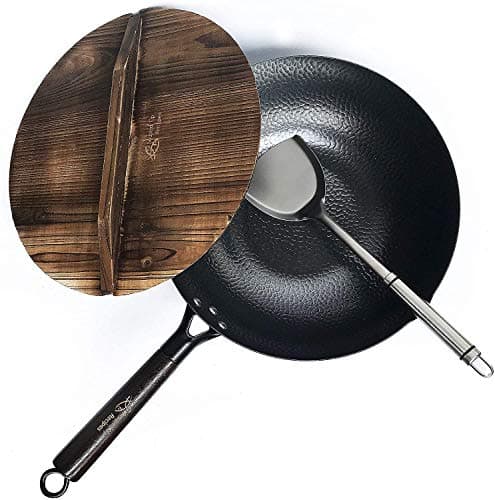
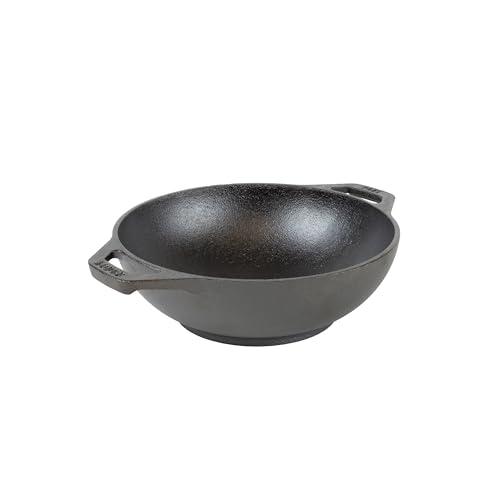
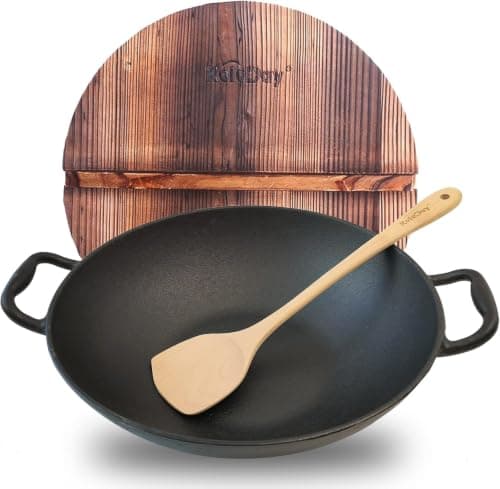
The best wok under $50 is the Keleday 14-inch cast iron wok, best for a cook who wants one full-size wok and a lid without spending more. The budget pick is the Lodge 6.25-inch mini wok, which is a single-serving pan and says so. Three woks in our registry carried a live price under the ceiling when this page was written, and the ceiling genuinely excludes four others — so unlike a hundred-dollar wok band, this one is a real shelf rather than the whole category with a number attached.
Why the cheap end of this category is unusually good
A wok is close to the simplest object in a kitchen: a disc of metal spun or hammered into a bowl, with a handle attached. There is no cladding, no coating to spray, no machined surface, no enamel to fire. A thirty-dollar wok and a hundred-dollar wok are frequently the same thickness of the same alloy, differing in how the bowl was formed, how the handle is fixed, and whether the maker pre-seasoned it.
That is very different from, say, dutch ovens under $50, where the ceiling forces you down to thinner enamel and smaller hardware. Here the ceiling mostly costs you brand and finish. The thing it does cost you is covered below, and it is not what most people expect.
What the band actually excludes
This is worth being precise about, because it is the whole justification for the page. We carry seven woks. Three are under fifty dollars. The four that are not are the Craft Wok 14-inch and the Mammafong 14-inch — both hand-hammered carbon steel, both round-bottomed — the Lodge Chef Collection 12.5-inch cast iron wok, and the pre-seasoned Yosukata 14-inch.
So the honest summary of this ceiling is: fifty dollars buys you a full-size wok, but it does not buy you a hand-hammered one or an American-cast one. If either of those matters, the best carbon steel woks and the best cast iron woks rank the field without a price cap, and Yosukata versus Craft Wok is the head-to-head between the two most-searched pans just above this line.
Why the cast iron wok wins a price band
On a gas flame, thin carbon steel is the better material and we say so everywhere else on this site: it heats in seconds, it is light enough to toss one-handed, and the flame wraps up the outside to heat the walls directly. The Keleday wins here for three reasons that are specific to this ceiling.
First, diameter. It is the only 14-inch pan in the band, and in a wok the diameter is not a comfort spec — stir-frying depends on constant motion and on having somewhere cooler to push food to, and a 12-inch bowl runs out of cool wall quickly once there is a pound of vegetables in it. Second, the lid. A wooden lid turns the pan into a steamer and a braiser, and no other wok in this band includes one. Third, most home hobs are not a restaurant wok burner, and on a domestic burner the stored heat of a thick cast iron bowl is what stops a handful of cold broccoli dropping the surface below browning temperature.
The cost is weight. A 14-inch cast iron wok loaded with food is a two-handed object, and you will not be flipping anything in it with a flick of the wrist. If tossing is central to how you cook, buy the carbon steel pick instead and accept the smaller bowl.
The flat bottom question
All three picks here are flat-bottomed, which is not a coincidence — it is what the cheap end of the market sells, because it is what Western hobs need. A round-bottomed wok needs a flame that can curl around it. On a flat electric or smoothtop hob only a small tangent of metal touches the heat, and on induction, where the hob heats only the metal in close flat contact with it, most hobs will not detect a round pan at all. A wok ring does not fix this; it lifts the metal further from the heat.
If your hob is induction, the Keleday is also the right answer for a second reason: thick iron carries the base heat up the walls, where thin steel conducts sideways poorly and leaves them cold. The best woks for induction cooktops works that through in full, and the best woks for glass-top and electric stoves covers the radiant-smoothtop version. If you have gas, the best woks for gas stoves is the page that will push you above this ceiling, and reasonably so.
The mini wok is not a small wok
We rank the Lodge 6.25-inch because it is genuinely useful and genuinely cheap, not because it is a scaled-down version of the pan above it. At 6.25 inches there is no cool zone, no room for motion and no batch: it is a one-portion pan for a single serving of fried rice, a small side, toasting spices or nuts, or reheating something, and it doubles as a hot serving dish at the table.
Bought as a mini wok, it is excellent. Bought as a cheap way into stir-frying, it will disappoint, and we would rather say that here than let you find out. If a small pan is actually what you want, the best small cast iron skillets covers the same shelf without the wok shape.
Seasoning: what you take on at this price
Both cast iron picks arrive pre-seasoned from the foundry and the carbon steel pick arrives with a factory finish, but none of them is finished in the sense a non-stick pan is. All three are bare metal under a thin layer of polymerized oil, and they only become slick as you build your own seasoning on top. A wok gets there faster than a skillet does, because stir-frying is high heat and a film of oil, repeated.
What you must not do is leave any of them wet. Our guides to using a wok, seasoning carbon steel and keeping cast iron from rusting are the three that matter for everything on this page.
The honest limit of a cheap wok on a home hob
No wok at any price turns a domestic burner into a restaurant wok range, which can put out several times the heat and direct most of it up the outside of the bowl. What you can do very well at home is cook in smaller batches: get the pan properly hot, cook a quarter of the food at a time, take it out, repeat, and combine at the end. That technique matters far more than which of these three pans you buy, and it is the reason a fifty-dollar wok is rarely the thing holding a stir-fry back.
If you are weighing a wok against a pan you already own, the best wok alternatives ranks what to use instead when the shape is the problem, and are cast iron woks good takes the obvious objection to the Keleday head-on.
How the prices on this page work
Every number comes from the live Amazon listing at the date stamped under the comparison table, read at request time through this site’s price layer. A fifty-dollar band in a category this cheap is a tight one and the population moves — this band had only two qualifying woks a day before this page was written. If a pick drifts above the ceiling it comes off the page rather than sitting here with a stale number.