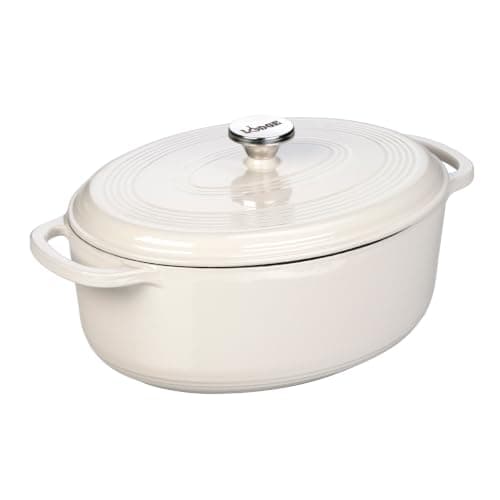
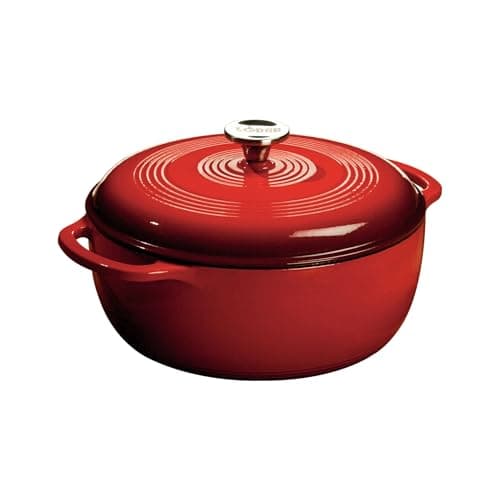
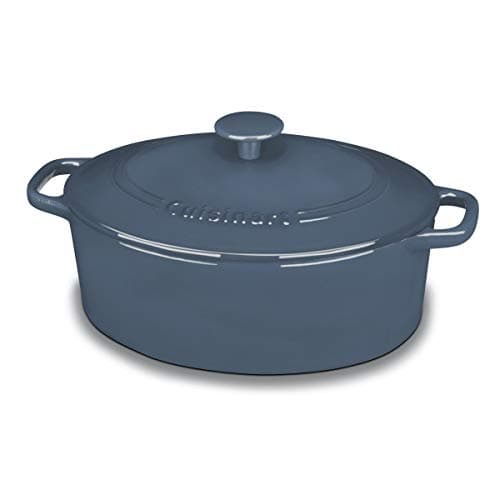
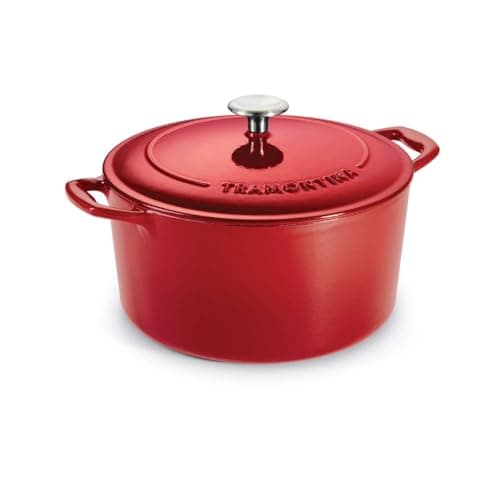
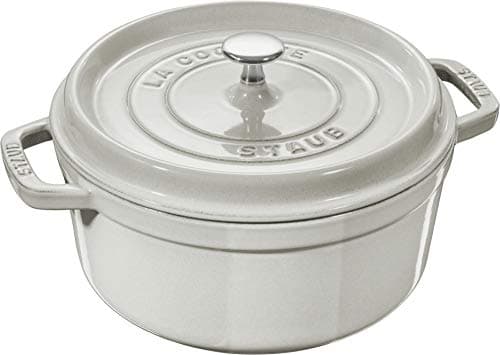
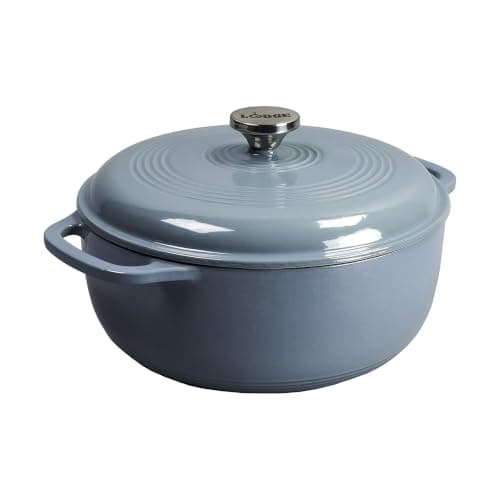
The best dutch oven for pot roast is the Lodge 7.5-quart enameled, best for a cook who roasts for four to six people and is tired of a pot that will not quite close. The budget pick is the Tramontina 6.5-quart, best for someone who wants the capacity and not the extra fifty degrees of oven rating. Every pot on this page braises well; what separates them is whether the meat and its vegetables both fit with the lid still sealing.
Why pot roast is a capacity problem
Most dutch-oven dishes are liquid-led: soup, stew, chili, beans. You can scale those down. A pot roast cannot be scaled down, because the thing that makes it a pot roast is a single large piece of meat. A supermarket chuck roast is typically three to four pounds and does not fold. It has to sit flat on the bottom of the pot to brown properly, and that initial browning is where most of the dish's flavor comes from — crowd it and it steams instead of browning.
Then the vegetables go in around it, which is the step the recipe assumes and the pot often cannot take. Add a pound of carrots, two onions and a few potatoes and a 5-quart pot is full to the rim with the lid propped open. A dutch oven works because its heavy, tight-fitting lid traps moisture; a lid that does not seat is a pot that dries out. So the capacity floor for a proper pot roast is about 6 quarts, and 7 to 7.5 quarts is where it stops being tight.
Round or oval
Round pots are better at almost everything else: they sit evenly over a single burner, they stack, and they cost less for the same volume. A roast is the one case for oval. A brisket flat, a long bone-in chuck or a pork shoulder is a rectangle, and in a round pot a rectangle has to be curled or cut; in an oval it lies flat and browns across its whole face. If pot roast is the dish you make most, that is a real reason to take the Lodge 7-quart oval or the Cuisinart 7-quart oval casserole over a round pot of the same size. If pot roast is one of twenty things you cook, buy round — our round vs oval dutch oven comparison walks through the trade in full.
Enameled, every time, for this dish
Every pick on this page is enameled rather than bare iron, and that is not an accident. A pot roast runs for three hours in a liquid that usually contains wine, tomato or stock with acid in it, and acid in prolonged contact with bare seasoned iron strips the seasoning and picks up a metallic taste. Enamel is glass fused to the iron, so it is chemically inert and does not care. A bare-iron pot will make one good pot roast; it will not make fifty without being re-seasoned. Our enameled vs bare cast iron guide covers where that line falls.
Where the money goes, and where it does not
The Staub 5.5-quart cocotte is ranked last here and is the most expensive pot on the page, which deserves an explanation. It is the best browning vessel of the six — the dark matte interior and the heavy lid are genuinely excellent — and it is too small for the dish. For a 3-pound roast and nothing else it is superb. Add the vegetables and you are cooking in a different pot. That is the honest shape of this category: for pot roast, capacity beats refinement, and the cheaper 7.5-quart pot makes the better dinner. If you want the premium pots ranked on their own terms, that is the best Le Creuset dutch ovens and the best Staub cast iron.
What to do with the pot you already own
If you have a 5 or 5.5-quart pot and do not want to buy another one, the fix is technique rather than equipment: brown the roast, lift it out, brown the vegetables separately, then return the meat and add only as much liquid as it takes to come a third of the way up it. Roast the vegetables on a sheet pan and add them for the last forty minutes. You lose the one-pot convenience and keep the dish. Our dutch oven pot roast recipe runs the full method, and how to braise in a dutch oven covers the liquid level question properly.