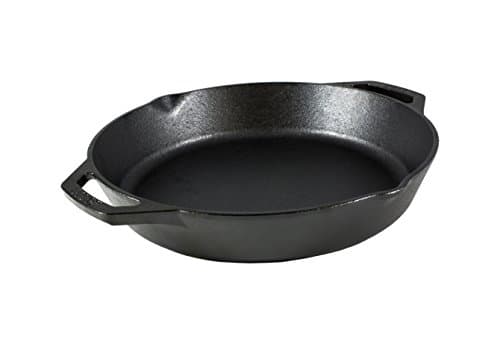
Buy the Lodge 10.25-inch skillet. Lodge operates two foundries in South Pittsburg, Tennessee, the 10.25-inch is the size most households cook in, and it is the cheapest pan in this entire roundup — which makes cast iron the rare category where the American-made option is also the budget option. If you want the American pan with the machined surface, that is the Stargazer from Allentown, Pennsylvania, and the premium buys you a better finish rather than a better sear.
Most “made in America” cookware lists are an upsell: the domestic option is the expensive one, and the page exists to move you up the price ladder. Cast iron is the exception. The largest surviving American foundry is also the cheapest brand on the shelf, so the honest version of this page spends most of its time telling you to spend less, not more.
What it does do is draw the lines carefully. “American-made” is not one claim in this category — it can mean cast here, machined here, seasoned here, enameled here, or some combination. One of the biggest brands on this page is American for its bare iron and, by its own published wording, imported for its inexpensive enameled pots. That distinction is the single most useful thing here, and nobody puts it on a label.
What “made in the USA” actually means on a skillet
Every pan here is made by sand casting: molten iron poured into a sand mold, knocked out, cleaned up, then seasoned. For barecast iron that is nearly the whole process, which is why a bare-iron origin claim is simple and hard to fudge — the foundry either poured it or it did not.
Enameled cast iron is where it gets complicated. Enamel is vitreous enamel — powdered glass fired onto the metal at high heat — and that is a separate industrial capability from casting. A company can cast in one country and coat in another, and the bright-color enameling lines are concentrated overseas. It is why the enameled pots on this site are French, Brazilian or Chinese far more often than American.
So the rule we applied: a ranked pick has to be cast in the United States by the maker's own published statement. Not “designed in,” not “an American brand.” Where a maker is silent, we say so rather than filling the gap.
The criteria we ranked on
1. Does the maker state it plainly?
Lodge says it operates two foundries in South Pittsburg, Tennessee. Stargazer publishes its whole process in Allentown, PA, down to the melt temperature and the seasoning oil blend. Field's skillet page carries Made in USA at the top. FINEX states Made in the USA, guaranteed good forever. Those are the makers we are willing to rank on origin.
2. Price per unit of usefulness, not price alone
An American pan you do not use is worse than an imported one you cook on nightly. The 10.25-inch skillet and the combo cooker top this list partly because they are the two pieces that get used most in a real kitchen — and they happen to be the two cheapest things on it.
3. Cast here is not the same as finished here
A maker that casts, machines, finishes and seasons under one roof — Stargazer describes exactly that — has a genuinely short supply chain. A brand that casts domestically and ships the piece abroad for a coating does not, even though the iron is American. We did not find a ranked pick making the second claim, but it is the question to ask the moment a brand gets vague.
4. Can you actually buy it?
Two of the best American foundries — Smithey and Lancaster — sell mainly through their own stores, so there is no live marketplace price for us to show. They are discussed below rather than ranked. That is a purchasing fact, not a quality judgment.
5. What the premium actually buys
Going from the cheapest American pan to the dearest one here buys a machined cooking surface, a thinner casting and a better handle. It does not buy a better sear. A cast-iron pan of a given thickness behaves the same whoever poured it. We rank on surface and handling, and we say when the upgrade is a want rather than a need.
The picks, and who each one is for
Lodge 10.25-inch — the one to buy
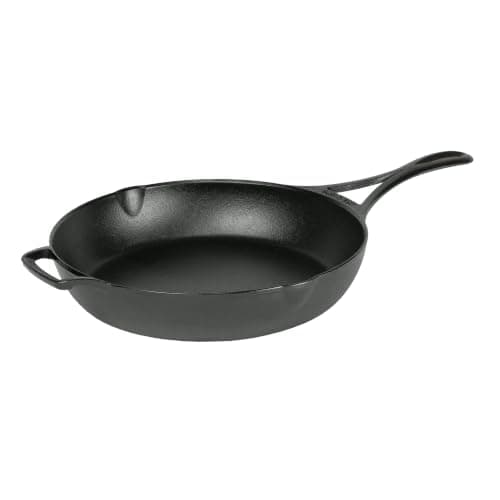
American-cast, foundry-seasoned, and the cheapest pan here. Lodge debuted seasoned cast iron in 2002, so the pan works the day it arrives. Ten and a quarter inches fits four eggs, two steaks or a round of cornbread, which is the whole weeknight repertoire.
Its honest weakness is the surface: it comes out of the sand mold pebbly, not machined, and it takes a few months of real cooking before food releases the way a milled pan does from week one. If you cannot live with that, skip down to the Stargazer and pay for it. Our full Lodge review goes further on the brand.
Lodge Combo Cooker — the most useful American piece
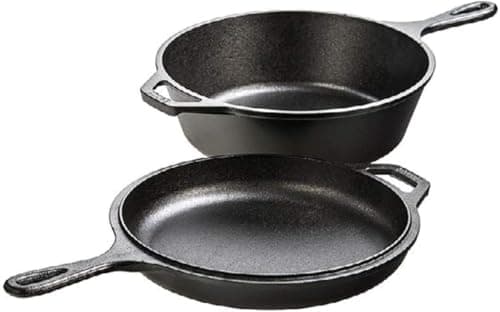
A deep 3.2-quart pan whose lid is a 10.25-inch skillet, both made in the USA and seasoned with 100% natural vegetable oil. It is two pans for one price, and the shallow base makes it the easiest bread vessel on this site to load a shaped loaf into — see best for sourdough.
The trade is blunt: at a published 12.85 lb for the pair, it is a lot of iron to wrangle out of a hot oven, and 3.2 quarts suits one standard loaf rather than a double batch. If you want taller walls, read combo cooker vs dutch oven and dutch oven vs bread cloche.
Lodge Blacklock 10.25-inch — the American pan for people who find iron heavy
Lodge's premium bare line: Made in the USA, engineered to be lighter than traditional iron, triple seasoned at the foundry, with an extended handle Lodge says stays cooler longer. It costs a little over double a standard Lodge and solves the complaint most people actually have, which is weight rather than surface texture.
State the limit clearly: Lodge makes no machining claim for Blacklock, so neither do we. It is a thinner, better-seasoned sand casting. Thinner also means less stored heat than a classic Lodge of the same diameter. Our full Blacklock review takes it apart properly.
Field No. 6 — the light, heirloom American pan
Field's skillets are machine polished, like the best vintage cast iron skillets, and cast thin in the pre-war style, which makes them the lightest iron in this group. Genuinely a different object from a Lodge in the hand.
The catch is size: the No. 6 measures 8.38 inches, a one-to-two serving pan at many times a Lodge's price. It is a jewel, not a workhorse. Read our Field review and Field vs Stargazer before you commit.
Stargazer 10.5-inch — the best American pan, full stop
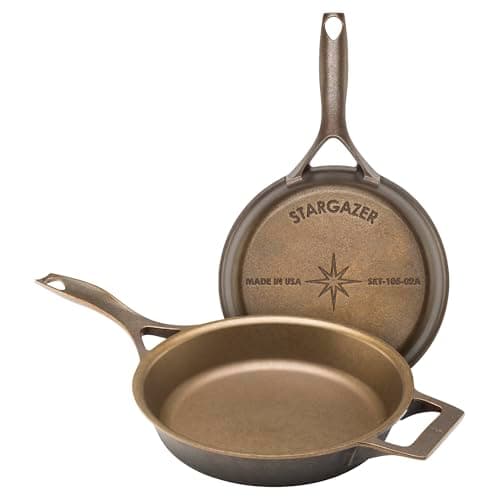
If this list were ranked on quality rather than value, this would be first. Stargazer casts from domestically sourced, primarily recycled iron, CNC machines the entire interior surface, hand-finishes the burrs and seasons with a non-GMO canola, grapeseed and sunflower blend — all in Allentown. It publishes real numbers: 5.2 lb, an 8.1-inch cooking surface, 2.0 inches deep.
Two honest cons. It is heavier than the Lodge it is sold as an upgrade to, so do not buy it to spare your wrist. And at several times the price it buys a better surface and a much better handle, not a better sear. Full detail in our Stargazer review.
FINEX 10-inch — the American design object
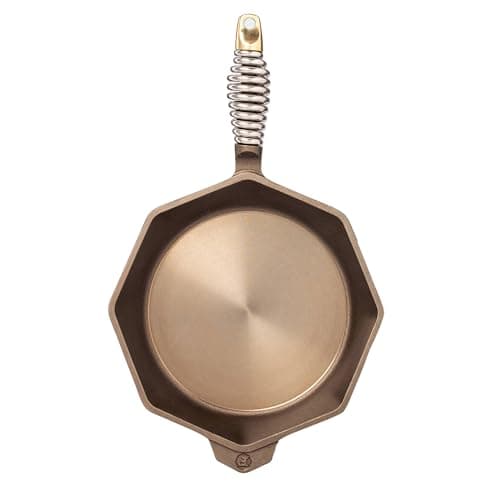
Octagonal, eight pour spouts, a coiled stainless spring handle, and Made in the USA, guaranteed good forever on the maker's own front page. FINEX started in Portland and was acquired by Lodge in 2019, which is worth knowing and does not change the claim on the label.
It is the most expensive pick here and the heaviest for its size — FINEX casts thick, the opposite of the Field and Blacklock pitch. Buy it because you want the object. We make that case plainly in is FINEX worth it.
The line Lodge draws, and most buyers miss
This is the part worth the page. Lodge's bare iron is American. Its inexpensive enameled pots are not, and Lodge says so: its own side-by-side page calls the Essential Enamel range our much-loved, imported line of enameled cast iron. Lodge separately sells a collection it brands USA Enamel.
So if you buy the inexpensive Lodge enameled dutch oven this site recommends on value — and we still recommend it, because it cooks superbly for the money — you are not buying an American-made pot. Those are two separate decisions and they deserve to be made separately. Our enameled dutch oven roundup ranks on cooking, not on origin.
The great American foundries you cannot buy on a marketplace
Smithey Ironware makes some of the most beautiful mirror-polished iron in the country and says it designs and crafts its cookware in the USA. It sells mainly direct, so there is no live marketplace price here. Our Smithey review covers where to buy one.
Lancaster Cast Iron is the other one worth knowing: thin, polished, American, direct-sold. Our Lancaster review and Lancaster vs Smithey are the places to start. Wikipedia's list of American cast-iron manufacturers names several more small shops, Butter Pat among them, if you want to go further down that road than we can price.
The pans we recommend that are not American
An honest origin page has to say this out loud: origin is not a quality signal in cast iron. Several of our favorite pieces are made elsewhere, by companies that publish exactly where.
Victoria is a family-owned business based in Medellin, Colombia, casting since 1939, and its long curved handle is better than Lodge's — see Lodge vs Victoria. Tramontina is Brazilian and has been the budget reviewer's enameled pot for years (Lodge vs Tramontina). Le Creuset and Staub are French, and the best enameled pots made anywhere (Le Creuset vs Staub).
If buying American is a value you hold, cast iron lets you act on it for the price of the cheapest skillet on the shelf, which is a rare thing. If it is not, nothing here should push you away from a Colombian skillet or a French pot.
The honest bottom line
The American-made question in cast iron has an unusually boring answer: the default recommendation on this entire site — a pre-seasoned Lodge skillet — is already made in Tennessee and already the cheapest good pan you can buy. You do not need to spend more to buy American here. You spend more to buy a machined surface, a thinner casting, or an object you enjoy looking at.
So the sequence we would follow: buy the Lodge 10.25-inch. Add the combo cooker when you start baking bread. Upgrade to a Stargazer only if, after six months, the pebbly surface is still the thing that bothers you. And if what you actually want is a pot rather than a pan, read what size dutch oven to buy first — and accept that the best value there is very likely imported.