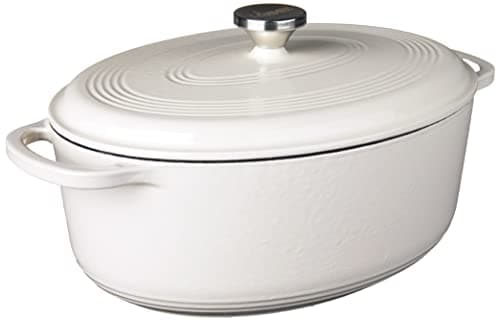
Buy the Lodge 7-quart enameled oval. It roasts a whole chicken and braises a long cut within a whisker of a French oval that costs several times more, and for most cooks that gap is not worth the money. Step up to a Le Creuset or a Staub oval only if you want the heirloom object, the lifetime warranty and the resale value — those are honest reasons, just not cooking ones. And before you commit to the shape at all, know the trade-off: an oval buys you length at the cost of a little stovetop evenness.
A dutch oven is a thick-walled pot with a heavy, tight-fitting lid, and its whole job is to hold heat steady and spread it evenly (the short version is on Wikipedia). The oval version keeps that job and changes one thing: the footprint. Where a round pot is a circle centered over a round burner, an oval is stretched along one axis so it can swallow something long — a whole bird laid breast-up, a pork loin, a rack of short ribs, an oval boule. That length is the entire reason ovals exist, and it is worth being honest about the cost of it before you spend. If you have not settled the shape yet, start with the full round vs oval dutch oven breakdown, then come back here to pick a pot.
Who an oval is actually for
Buy an oval if the thing you cook most is long. A 6-to-7-quart oval takes a whole roasting chicken lengthwise without wedging it, holds a beef roast or a pork shoulder flat instead of curled, and fits a torpedo-shaped loaf that a round pot would force into a ball. It also tucks onto a fridge or oven shelf more efficiently than a wide round pot, which matters in a small kitchen. For a covered, fall-apart roast chicken, an oval is genuinely the better tool.
The catch is the stovetop. Home burners are round, so on an oval the two ends overhang the flame or element and run a little cooler than the middle. For oven work — braises, roasts, anything covered at 300–350°F — that difference disappears, because the whole oven cavity is one even temperature. It only shows up when you are searing or simmering directly on the burner, where the ends lag the center. That is why the honest default for a first, do-everything pot is still round; the oval is the specialist you buy second, or first only if roasts are your reason for buying. We make that case in full in the best dutch ovens roundup, and cover sizing in what size dutch oven you need.
The value pick wins here too
Exactly as in the round category, the smart-money oval is the Lodge. Its 7-quart enameled pot does the thing you bought an oval to do — hold long, even, covered heat around a roast — as well as pots that cost three to five times as much. Blind, in a serving dish, nobody is telling a Lodge braise from a Le Creuset braise. What you give up is refinement: the enamel and hardware are a step below the French pots, and the warranty is limited rather than lifetime. For the overwhelming majority of home cooks that is the right trade, which is why it anchors this list. The same argument, laid out pot against pot, is in the Lodge vs Le Creuset comparison and the best Lodge dutch ovens guide.
| Oval pot | Capacity | Interior | Maker's oven rating |
|---|
| Lodge enameled oval | 7 qt | Pale enamel | 500°F |
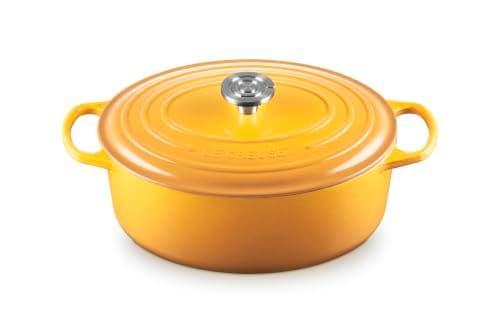
| Le Creuset Signature oval | 6.75 qt | Pale enamel | 500°F |
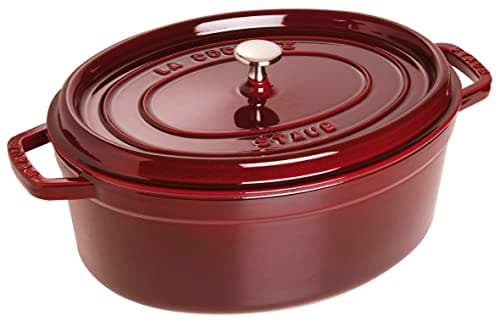
| Staub oval cocotte | 7 qt | Matte black enamel | 500°F |
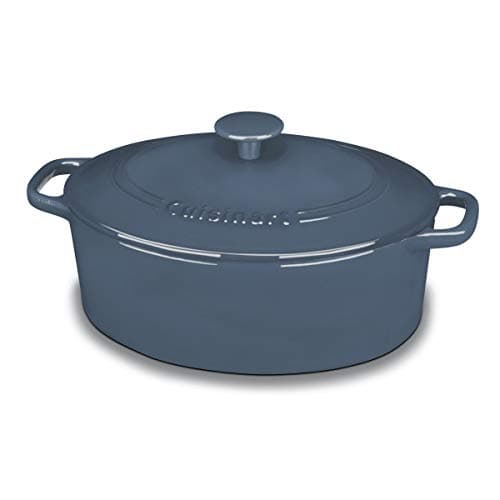
| Cuisinart Chef's Classic oval | 7 qt | Pale enamel | 500°F (oven & broiler) |
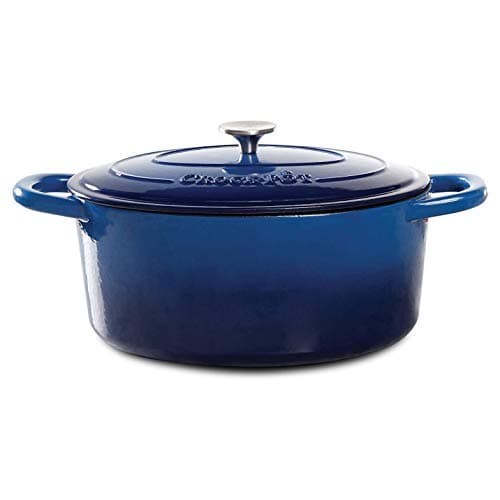
| Crock-Pot Artisan oval | 7 qt | Pale enamel | 500°F |
Every temperature above is the manufacturer's own published rating, not a number we measured. It matters most if you preheat the empty pot hot for bread; for braising and roasting, which happen well below it, all five are equal on paper.
When a French oval is worth it
The Le Creuset and the Staub are genuinely wonderful, and the oval shape is where each brand is at its most iconic — the long French oven is the pot on a thousand kitchen shelves. Buy one with a clear conscience, just know what you are paying for. Le Creuset's pale sand-colored interior makes it easy to read the color of your fond, its handles and knob are the most comfortable in the category, and the pot (knob included) is oven-safe to 500°F per Le Creuset. It also holds resale value like almost no other cookware.
The Staub oval cocotte goes the other way with a dark matte-enamel interior that browns aggressively and hides stains for life, plus a spiked, self-basting lid that drips condensed moisture back over a long roast as it cooks — exactly the pot you want for a duck or a whole chicken that needs to stay moist through a slow braise. Neither French oval is a cooking upgrade over the Lodge; they are nicer-object upgrades, and that is a real thing to want. If you are choosing between the two, the Le Creuset vs Staub comparison settles it, and the best Le Creuset dutch ovens guide covers the size ladder.
The value and budget ovals
Below the Lodge sit two pots that fit a whole bird for even less. The Cuisinart Chef's Classic oval is a genuine 7 quarts, works on every cooktop including induction, and carries a lifetime warranty against defects from a familiar brand — the pick when you want the most oval capacity for the least money without going rock-bottom. The Crock-Pot Artisan oval is the rock-bottom option: a full 7-quart pot with a self-basting lid for the lowest number on the page, in a wide range of colors. Both cast a little thinner than the pots above them, so they hold and spread heat slightly less evenly, and their enamel is the first to show wear over years. For an occasional roasting pot that spends most of its life in the oven, that is a fair trade; for a daily driver, spend up to the Lodge.
The honest caveat:no enamel lasts forever, and an oval is no exception. Thermal shock, metal utensils and stacking pots without protectors all chip or craze the glass coating over time, and the cheaper the pot, the sooner it shows. A little care doubles a pot's life — see how to care for enameled cast iron, which echoes Lodge's own care guidance.
How to choose an oval dutch oven
Size: think length, then volume
Ovals are usually bought bigger than rounds, because the whole point is to fit something long. A 6-to-7-quart oval is the sweet spot: long enough for a standard roasting chicken or a family-sized roast, without becoming a two-handed monster. Go smaller (a 3-to-5-quart oval) only if you cook for one or two and mostly want the shape for a single loaf or a small roast. Remember that an oval's quoted quarts sit in a shallower, longer pot than the same quarts in a round, so liquids run thinner across the base — a point in an oval's favor for browning, a point against it for a deep, small-batch simmer.
Oval or round: the trade you are actually making
This is the decision, so make it on purpose. A round pot sits centered over a round burner, heats evenly and simmers predictably; it is the better all-rounder and the better bread pot. An oval trades a little of that stovetop evenness for length — a whole bird, a long roast, an oblong loaf, a neater fit on a shelf. If most of what you cook is stew, chili, soup and round loaves, buy round and spend the savings elsewhere. If you roast whole birds and long cuts often, the oval earns its keep. The round vs oval dutch oven guide walks through it example by example.
The knob is the hidden spec
The maximum oven temperature of an enameled dutch oven is usually set by its lid knob, not the pot. Every oval on this list publishes a 500°F rating, which is generous headroom: braising happens at 300–350°F, roasting rarely tops 450°F, and only bread pushes you toward the ceiling by asking you to preheat the empty pot hot. If you plan to bake a lot of bread in your oval, confirm the knob rating before you buy, or swap in a metal replacement knob. For a bread-first pot, though, a round vessel loads more easily — see the best dutch ovens for sourdough, and King Arthur's explanation of why the lid's trapped steam builds the crust.
Enamel color: light interior or dark
Enamel is a layer of glass fused to the iron (vitreous enamel), and the interior color changes how you cook, not how well. A pale interior — Lodge, Le Creuset, Cuisinart, Crock-Pot — lets you read the color of your fond and your browning at a glance, which matters when you are building a Maillard base for a braise. It also stains over time, which is cosmetic. Staub's dark matte interior is the opposite: harder to read, but it browns more aggressively and never shows a stain. Roasters who want maximum sear lean dark; cooks who want to watch a light sauce develop lean pale.
Weight and handles
Every oval here is heavy — that mass is the whole point of a heat battery — and a full 7-quart oval with a roast in it is a real lift. The handles decide whether that weight is a problem. Wide, tall loop handles you can grab with a full oven mitt are far safer to move from a hot oven than the small, tight handles on the cheapest pots. This is one place the French ovals and the Lodge earn their reputation, and where the budget pots cut a corner you feel every time you carry the pot full and hot to the table. If you are still weighing whether the premium is worth it at all, the are expensive dutch ovens worth it guide lays out what the extra money actually buys.