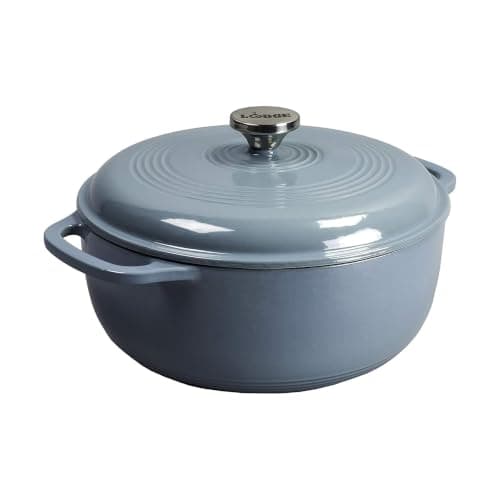
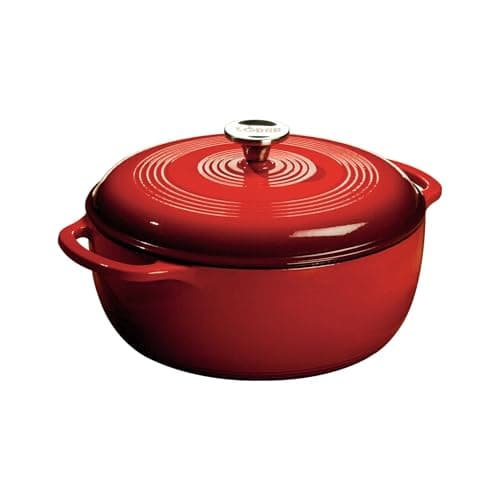
For most households the best soup and stew pot is the Lodge 6-quart enameled dutch oven: the right capacity, an enamel interior that takes a long acidic simmer without complaint, and a published 500°F oven rating. Drop to five quarts for one or two people, go to 7.25 or 7.5 quarts if you batch-cook for the freezer, and buy the French pot only if you want the object — it is not a better bowl of soup.
A dutch oven is a thick-walled pot with a tight-fitting lid, and soup asks less of it than almost anything else it does: there is no searing-hot preheat, no bread-oven temperature, no thermal shock. What soup asks for instead is capacity, a wide base you can brown in first, and a surface that will tolerate hours of acidic liquid. That changes the ranking from our general best dutch ovens list, which weighs bread and searing alongside braising.
Size first, because this is where people get it wrong
A pot's rated capacity is to the brim; you cook in about two-thirds of it. Fill a soup pot higher than that and it boils over the moment it gets going and you cannot stir without redecorating the stove. So translate down:
- One or two people: 4 to 5 quarts. A 5-quart pot comfortably makes four generous bowls with leftovers. Our small dutch oven roundup covers below that.
- A family of three or four: 6 quarts. This is the default and the reason the Lodge 6-quart leads this page.
- Batch cooking or entertaining:7.25 to 7.5 quarts. Lodge labels its 7.5-quart pot for cooking for a crowd and publishes it at 19.33 lb — that weight is empty, so a full one is a genuine two-handed lift from oven to stovetop. The large dutch oven roundup goes further up the range.
If you are still deciding, the what size dutch oven guide and the 5-quart vs 7-quart comparison work through it pot by pot.
Why enamel, not bare iron, for soup
This is the one category where we come down firmly on enamel. Soups and stews are long, wet and frequently acidic — tomatoes, wine, vinegar, lemon — and food acids attack the polymerized-oil seasoning on a bare iron pot over a long cook, which both damages the pot's surface and can leave the food tasting faintly metallic. Vitreous enamel is glass fused to the iron: it is chemically inert, so a four-hour tomato braise is simply not an event. You also get soap-and-water cleanup and no seasoning upkeep. The full argument is in bare vs enameled dutch oven and what is enameled cast iron.
The trade-off is that enamel cannot take the dry, screaming preheat that bread baking wants, and it chips. Treat it accordingly: no metal utensils (Lodge says so explicitly), no empty high-heat preheat, no cold water into a hot pot. Our enameled cast iron care guide and how to stop food sticking to enameled cast iron cover the two things that actually go wrong, and Lodge's own enamel care page says much the same.
Brown first: that is what the pot is for
The only real technique advantage a dutch oven has over a saucepan for soup is that you can build the base in the same vessel. Sear the meat hard, let the Maillard reaction leave a brown fond on the bottom, sweat the aromatics in the rendered fat, then deglaze with wine or stock to lift all of it into the liquid. That is also precisely the sequence of braising, which is why the same pot is the best stew pot you can own. A wide base matters more than wall height here, because a crowded base steams instead of browning. The method is in how to braise in a dutch oven, and dutch oven chili, dutch oven pot roast, dutch oven pork roast and dutch oven whole chicken all put it to work. A skillet cannot follow you past a shallow pan of liquid, which is the whole of dutch oven vs cast iron skillet.
Where the money goes, and where it doesn't
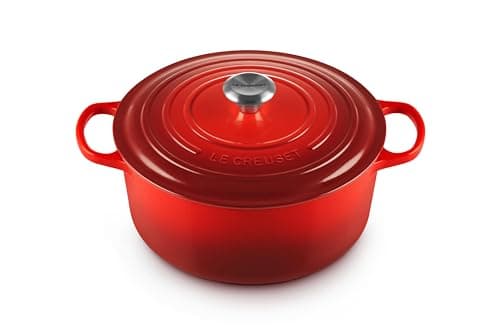
Between the Lodge and the Le Creuset there is a large price gap and a small cooking gap. What the French pot buys is a harder, prettier enamel, larger and more comfortable handles, a sand-colored interior that makes it easier to read the color of your fond, and resale value. Le Creuset's own care and use guidance is worth reading before you buy one. Those are real things to want — they are not performance reasons, and we say so on Lodge vs Le Creuset, Lodge vs Le Creuset vs Staub and are expensive dutch ovens worth it. A pot sold as a “French oven” is the same vessel under another name — dutch oven vs French oven explains why.
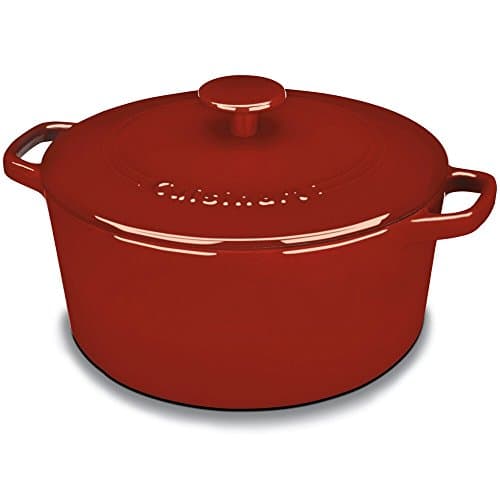
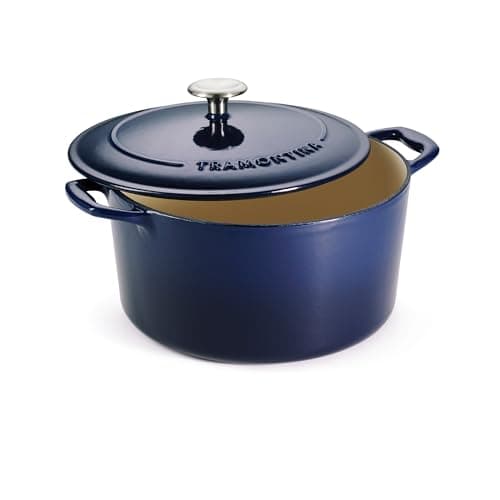
Below the Lodge, the Cuisinart is the sensible 5-quart for a small household, and the Tramontina is the big-capacity budget pot — a genuine 6.5 quarts, with a lower published oven rating that matters for bread and is irrelevant for soup, since a simmer happens around 200°F and an oven braise at 300–325°F. If price is the whole question, our best budget dutch ovens page ranks the cheap field properly, and Lodge vs Amazon Basics settles the bottom of it.
How to choose a soup and stew pot
1. Buy for two-thirds of the rated capacity
Rated quarts are to the rim. Six rated quarts is about four working quarts of soup, which feeds a family with leftovers. Size up one step if you habitually cook to freeze; size down if the pot has to live on a shelf you can reach.
2. Check the weight, not just the volume
A big enameled pot full of stew is heavy before you add the pot. Lodge publishes 13.52 lb empty for its 6-quart and 19.33 lb for its 7.5-quart; add six or seven pounds of soup and the larger one is a careful two-handed carry. Wide loop handles you can grip with a full oven mitt matter more than any other piece of hardware on a soup pot.
3. Wide base beats tall walls
You brown in the base, so a wider floor means fewer batches and less steaming. A pot that is tall and narrow for its capacity looks efficient on a shelf and fights you at step one of every recipe.
4. Pale interior for soup, dark for hard browning
A pale enamel interior lets you see exactly how dark your fond is, which is the single most useful visual cue in soup-making; it also stains, which is cosmetic. A dark matte interior browns aggressively and hides stains forever, but you are judging color by smell and guesswork. For soup, pale.
5. The knob rating matters less here than anywhere else
We bang on about lid-knob temperature ratings across this site because bread baking pushes pots to their ceiling. Soup does not: a simmer is around 200°F and an oven braise sits at 300–325°F. If this pot will only ever do soup and stew, a 450°F pot is as good as a 500°F one. If it will also bake bread, see best dutch ovens for sourdough.
6. Then look after the enamel
Wooden or silicone utensils, no empty preheat over high heat, no cold water into a hot pot, and lift the lid rather than scraping it across the rim. Those four habits are most of what keeps a cheap enameled pot alive for a decade — the detail is in enameled cast iron care, and if the worst happens, chipped enamel cast iron explains when a pot is still safe to use.