For a home stove, buy the Lehman's cast iron waffle maker. It is the reputable pick in a category full of unbranded imports: two hinged iron plates you flip on the burner, a raised rim that catches the batter that would otherwise run everywhere, and enough mass to bake a genuinely crisp waffle with no electricity at all. But read the next two paragraphs before you buy anything, because for a lot of people the honest answer is an electric waffle maker instead.
A cast iron waffle maker is a deliberately old-fashioned tool. As the history of the waffle iron records, they were "originally constructed of two hinged iron plates connected to two long, wooden handles," and waffles were "held at a distance and baked over the hearth fire." The modern versions work exactly the same way, minus the hearth: you heat both gridded plates, pour batter onto the hot bottom, close the hinge, and flip the whole thing so the top cooks too. There is no element, no thermostat, and no timer — just iron, heat, and your own attention.
That is the appeal and the catch in one sentence. Iron's thermal mass stores heat and hands it back to the batter, which is what drives the deep, crisp Maillard browning a thin electric plate struggles to match, and there is no nonstick coating to scratch or wear out. The price you pay is real work: these irons are heavy, they must be seasonedbefore batter will release, and you learn the timing by feel, so the first waffle or two is almost always a sacrifice to the pan. We ranked these five by how well each earns its keep for the person actually buying it — a home cook on a stove, or a camper over a fire — and we are blunt about who should skip the whole idea.
Why cast iron — and why not
The case for a cast iron waffle iron is the same case as for any good iron pan. The mass holds heat, so when cold batter hits the plate the temperature barely dips and the surface keeps crisping instead of stalling; the result is a waffle with a hard, deep-brown crust and a tender middle, the texture most electric makers only approximate. Bare iron also seasonsto a naturally stick-resistant surface and has nothing to peel or degrade, so a well-kept iron outlasts every plastic-bodied appliance in the drawer. And because it needs no power, it works over a campfire, on a camp stove, or during an outage — a genuinely useful trait an electric maker cannot offer.
The case against is just as honest. These irons are heavy, and flipping a hot one takes a confident hand. There is no browning dial, so consistency is on you, not the machine; you will burn a waffle learning the rhythm. They must be seasoned and kept dry like any bare iron, which is upkeep an electric maker does not ask for. And they cook one waffle at a time, slowly — this is a weekend, do-it-for-the-ritual tool, not a fast weekday one. None of that is a defect. It is simply the nature of the thing, and it is why the very first thing this guide does is ask whether iron is really what you want.
The honest question: stovetop cast iron or an electric maker?
Match the tool to how you actually cook breakfast. If you want to press a button, walk away, and pull out an even waffle every time, a plug-in electric maker with a browning control is the better buy, full stop — it is easier, more repeatable, and cheaper to run than the learning curve here is worth. Buy a cast iron waffle iron when you specifically want one of three things: the crisp, sturdy, deep-brown waffle that iron's heat retention produces; a maker that works with no electricity, for camping or off-grid cooking; or a single tool that will still be making waffles for your grandchildren. If none of those move you, we would rather send you to an electric maker than sell you a heavy iron you will fight with and shelve. That steer earns us nothing, and it is the honest one.
How the picks break down
A quick map of who each iron is for. Prices are live, so we do not quote them here — the buy buttons above show today's number and the date we checked it.
| Waffle maker | Type | Best for |
|---|
| Lehman's 7-inch | Stovetop, round | The default: reputable brand, drip-catching rim |
| Cococheers 7-inch | Stovetop, round | The cheapest honest way to try the category |
| 8-inch thickened | Stovetop, round | A bigger, thicker waffle with deeper pockets |
| Rome Chuckwagon 1028 | Long-handled | The grill and the campfire |
| Rome 1405 | Long-handled | A deep open fire, maximum reach |
Why the Lehman's wins for most kitchens
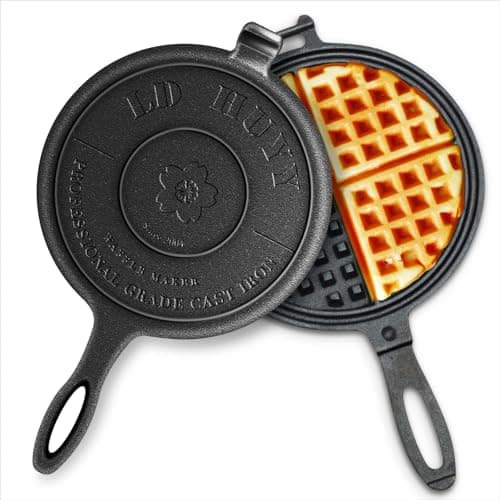
The Lehman's is the iron we'd hand a friend first. It is a two-piece hinged design sized for a 7-inch round waffle, and its standout detail is a raised "double rim" that catches the batter that inevitably squeezes out when you close and flip the plates — the single messiest part of stovetop waffle-making, designed away. Just as important, it is sold under a recognized homestead brand rather than as an anonymous listing, so there is an actual company standing behind it. It is heavy, around eight pounds, which is exactly why it holds heat and crisps well.
The honest knocks are the knocks against the whole category. It has no thermostat, so you dial in the timing yourself and the first waffle is usually a test bake. It arrives as bare iron that wants seasoning before batter releases cleanly, and it must be dried and lightly oiled after washing like any bare pan. And a 7-inch round is a classic waffle, not a deep restaurant Belgian pocket. Buy it for a lifetime stovetop waffle iron with a real brand behind it; if you want depth and size instead, the 8-inch below is the one.
The honest caveat: no stovetop iron gives you the push-button consistency of a good electric maker, and this one does not pretend to. What it gives you is a crisp, sturdy waffle, no cord, and a pan that will outlast the kitchen. Buy it for that, not for effortless weekday breakfasts.
The cheapest way in: Cococheers 7-inch
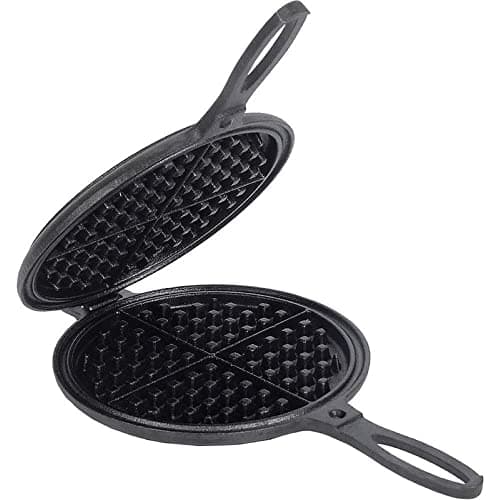
If you are not sure stovetop waffles are your kind of ritual, the Cococheers is the low-stakes way to find out. It is usually the cheapest full-size cast iron waffle iron on the page — often less than a decent electric maker — and it uses the same two-plate, flip-on-the-burner design as the irons that cost more. Cook a few weekends of waffles on it and you will know whether the payoff is worth the upkeep for you. The trade-offs are what you would expect at the price: it is an unbranded import with no meaningful warranty, its factory seasoning is thin so you will want to build a few extra coats before heavy use, and the casting and hinge feel a notch below the reputable makers. As a try-the-category pan it is honest value; as a forever pan, spend up.
Bigger and thicker: the 8-inch thickened iron
Some people want a waffle iron for the waffle a small round cannot make: a larger diameter with deeper pockets and a heartier bite. That is what the 8-inch thickened iron is for. Its larger head and heavier, roughly eight-pound body make a bigger, deeper waffle, and the extra mass recovers heat quickly between bakes so you are not waiting on the plate. Like the other stovetop picks it is bare, non-coated iron that seasons normally and has no nonstick layer to fail. The honest cons are the ones that come with an unbranded product: it usually costs more than the reputable Rome and Lehman's irons despite the anonymous label, it is genuinely heavy to lift and flip, and there is little brand support behind it. Buy it only if the bigger, thicker waffle is specifically what you are after — otherwise the Lehman's is the better-known pan for similar money.
For the grill and the campfire: Rome Chuckwagon 1028
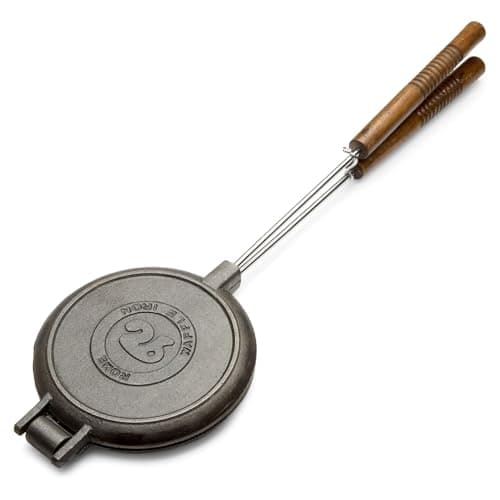
Once you leave the stovetop, the design changes: outdoor waffle irons get long handles so your hands stay out of the fire. The Rome Chuckwagon is the classic of the type. It has a roughly 6.75-inch round cooking head on long wood-and-steel handles about 23 inches overall, and it comes from a company that, per Rome Industries, has specialized in around-the-fire cookware since 1964 and backs this iron with a 10-year warranty. The steel rods are removable for cleaning and storage, which tames an otherwise ungainly tool. Its strength outdoors is its weakness indoors: those long handles make it awkward on a home stovetop, and like every iron here it is bare and needs seasoning and drying. It bakes one waffle at a time over the coals — a slow, social way to cook that is exactly the point at a campsite.
Maximum reach: Rome 1405 long-handled iron
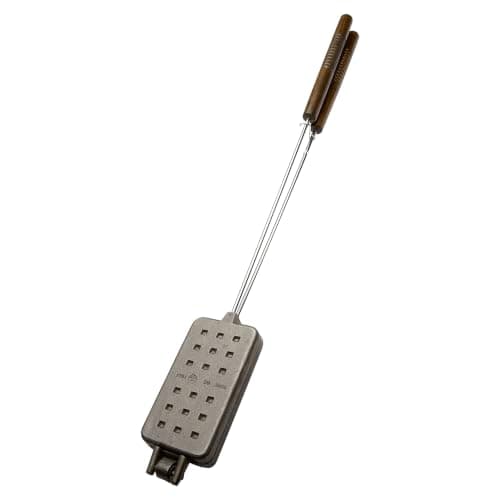
The Rome 1405 is the specialist for a deep fire. It is the longest iron here, around 30 inches, so you can bake over a real fire pit without leaning your knuckles into the flames, and it makes a rectangular campfire-style waffle. It carries the same Rome 10-year warranty as the Chuckwagon and the same removable-rod convenience. Because it is built purely for the open fire it is even less at home on a stovetop than the Chuckwagon, and its rectangular waffle is thinner than a deep Belgian pocket — this is a dedicated open-fire tool, not a do-everything one. If your cooking is genuinely over a deep campfire and you want the most reach and the least singed forearm, it is the pick; if you also want to use it on a grill or camp stove, the Chuckwagon's shorter handles are the more versatile choice.
How to choose a cast iron waffle maker
Decide where you'll cook first
Everything follows from this. A short-handled, two-piece iron like the Lehman's or the 8-inch is built to sit on a burner and flip in your hand — the right shape for a home stovetop, and it works on gas, electric, or an induction hob (cast iron is magnetic). A long-handled iron like the Rome Chuckwagon or 1405 is built to hold your hands away from open flame, which is perfect over a campfire or grill and clumsy on a stovetop. Buy the shape that matches where the waffles will actually be made, not the one that looks most traditional.
Size and weight
A 7-inch round is the standard home waffle and the size most people should buy; an 8-inch makes a bigger, deeper waffle if that is what you want, at the cost of more weight to flip. Remember that all of these are heavy, and a loaded iron is heavier still — the pan you can comfortably lift and flip is the one you will actually use, so do not over-buy on size. This is the same logic that governs picking a skillet size.
Seasoning and the first-waffle sacrifice
A bare cast iron waffle iron is not nonstick out of the box. Season it first — thin coats of oil polymerized by heat, exactly as our how to season cast iron guide describes, following the same principles Lodge lays out — and accept that the first waffle or two will stick and be sacrificed while the grid builds its seasoning and you learn the timing. Brushing a little oil onto both hot plates before the first few bakes helps. After that, a well-seasoned iron releases waffles cleanly, and every batch you cook in fat makes it better.
Cleaning
Treat it like any bare iron: no dishwasher, no long soak. While it is still warm, brush or scrape the grid clean, wipe it out, dry it thoroughly — gridded plates hold water in every pocket, so be deliberate — and wipe on a thin film of oil so it does not rust. Our how to clean cast iron routine applies exactly, just with extra attention to the grooves, the same way a ridged grill pan needs.
When to skip cast iron entirely
Be honest with yourself about the trade. If you want fast, foolproof, push-button waffles on a weekday, a plug-in electric maker with a browning dial will make you happier than any iron here, and it costs about the same. Cast iron is the right buy when you want the crisp, sturdy waffle its heat retention produces, when you need to cook without electricity, or when you want one heavy, near-indestructible iron that outlasts the kitchen. If a big flat breakfast surface for pancakes and bacon is more your style, the best cast iron griddles are the better tool.