Wagner is the vintage cast iron to buy if you want a pan rather than a collectible. It is the same era, the same thin pre-war casting and the same smooth finish as Griswold, it was made in enormous quantities — Wagner held roughly 60% of the cookware market at its peak — and because the collector market is less obsessed with it, you pay noticeably less for an equivalent pan. The company cast iron in Sidney, Ohio from 1891 until the foundry closed in 1999, so like Griswold everything on the market is second-hand, with one modern exception noted at the end.
The company, briefly, because the dates decide the markings
Brothers Milton M. and Bernard P. Wagner founded the business in Sidney, Shelby County, Ohio; construction of the complex started in 1890 and the company was incorporated in 1891. It added nickel-plated ware in 1892 and in 1894 was one of the first American firms to make aluminium cookware — which matters when you are shopping, because a great many “Wagner” pieces for sale are aluminium rather than iron.
Wagner's own early advertising is worth quoting, because it is the whole brand position in two sentences: “We do not strive to manufacture hollow ware as cheaply as possible, but as good as it can be made… The name ‘Wagner’ is cast on the bottom of each piece of ware.” By 1913 it was distributing globally. The cast-aluminium Magnalite line arrived in the early 1930s on a patented alloy, with the industrial designer John Gordon Rideout brought in to overhaul the range during the Depression.
Then the ownership chain, which is the part that explains confusing pans: the founding heirs began divesting in 1946; the Randall Company of Cincinnati bought Wagner in 1952; Randall's Wagner division acquired Griswold in 1957; Textron bought Randall in 1959; General Housewares took the Wagner and Griswold lines in 1969; rights went to the Slyman Group in 1996 and the trademarks to American Culinary Corporation in 2000. The Sidney foundry closed in 1999 and was demolished in June 2023.
Reading the markings
Wagner did not run a single tidy logo sequence the way Griswold did, which is why “Wagner logos by year” is such a common search and such an unsatisfying one. What it did do is sell the same castings under several names, and recognising them is most of the job:
| Marking | What it is | What it means to a buyer |
|---|
| WAGNER WARE — SIDNEY —0— | The flagship mark | Sidney, Ohio production. The mark most buyers are looking for |
| WAGNER'S 1891 ORIGINAL | A later commemorative line | Decades newer than the date implies. Good pans, not early ones |
| NATIONAL | A Wagner sub-brand | Wagner iron at a lower price then, and a lower price now |
| LONG LIFE | A Wagner sub-brand | Same foundry, less collector attention, often the best value |
| WARDWAY / WARD'S | Made by Wagner for Montgomery Ward | A store brand with Wagner castings behind it |
| Dual Griswold + Wagner logos | Post-1957 transition | Cast at Sidney after Wagner bought the Griswold brand |
| MAGNALITE | Cast aluminium, not iron | A different product entirely. Check before you bid |
The practical upshot: a NATIONAL or LONG LIFE skillet is usually the same metal from the same Sidney moulds as a WAGNER WARE pan, for less money, because the badge is less collectable. That is the single best-value corner of the vintage market and almost nobody mentions it.
Wagner versus Griswold, in one paragraph
Both are pre-war American iron: thin, light, smooth, excellent. Griswold has the stronger collector following and the cleaner dating sequence, which makes its pans easier to date and more expensive. Wagner made more of everything, under more names, which makes its pans harder to date precisely and cheaper to buy. If you are buying to cook, that trade runs in Wagner's favour. The full comparison is Wagner vs Griswold, and the Griswold guide has the logo table for the other marque.
What to check before you buy one
The same three-second test as any vintage pan, in this order:
- Is it iron? Wagner made a great deal of aluminium. A magnet settles it in a second, and an aluminium pan will not work on induction either.
- Is it flat? Set it down and look for rocking or daylight under one edge. A warped pan never sits properly on a hob and cannot be fixed.
- Is it cracked? Run a finger round the rim and look hard at the handle joint. A crack is terminal; everything else on a filthy pan is cosmetic.
Pitting is the judgement call. Shallow pitting seasons over and disappears in use; pitting you can feel as roughness through a fingertip will stay rough forever. Our stall checklist is how to buy vintage cast iron, and how to identify vintage cast iron covers the markings across the old makers. If you are dating a Lodge rather than a Wagner, that has its own sequence: how to date a Lodge cast iron skillet.
Bringing one back
A seventy-year-old Wagner usually arrives under a hard black shell of carbonised fat, often with orange surface rust underneath. Rust is a surface reaction, not decay, so none of this is as bad as it looks. The carbon comes off in a lye bath or with electrolysis; the rust comes off mechanically; then you build new seasoning from bare metal. Full sequence: how to restore cast iron then how to season cast iron, with stripping in between if the old layer is uneven.
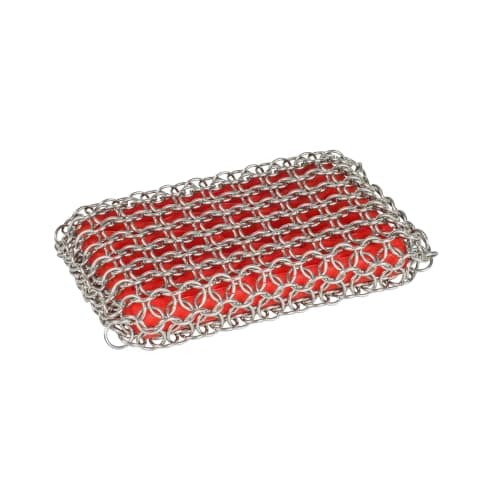
One tool does the mechanical part without gouging the metal, and it is the chainmail pad in the picks below. Everything else in a restoration is a bucket, a hardware-store chemical and patience.
The brand is back, sort of
Worth knowing before you search: as of 2022 the Wagner name was reintroduced by Wagner Cast Iron with guidance from the Wagner family, producing reissues of vintage designs, starting with the Long Griddle No. 1148. These are new pans sold direct, not Sidney castings, and they are not on Amazon — so they are not in our registry and we have no live price to show you. We mention it because a “new Wagner” listing is otherwise confusing, and a direct-only brand is a legitimate thing to buy; we just cannot price-check it here. The same situation applies to Smithey, which we cover without a buy button for exactly the same reason.
What to buy new if you want a Wagner and cannot find one
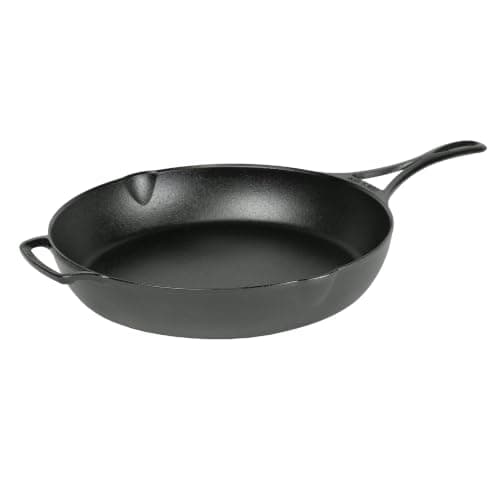
Be clear about what you are chasing. A good Wagner is thin, light and smooth. Those are specs, not mystique, and two modern pans publish them:
Ranked properly: best smooth cast iron skillets and best lightweight cast iron skillets. The spec sheet that lets you compare a modern pan against a vintage one on published numbers is the skillet comparison table.
Where a Wagner beats anything new
Two places, and they are real. Price per quality: a NATIONAL or LONG LIFE skillet in sound condition costs a fraction of a boutique pan and performs like one once restored. Character:a pan with somebody's seventy years in it is a different object from a new one, and that is a legitimate reason to buy.
Where it loses: no warranty, no flatness guarantee, no returns, and a weekend of work before you can cook. If that is a cost rather than a pleasure, buy new. If you are deciding what to give someone else, heirloom vs starter cast iron gift is the page that weighs exactly this, and cast iron gifts under $50 is the practical fallback.