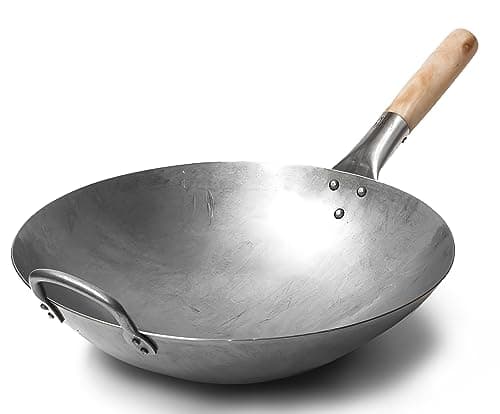
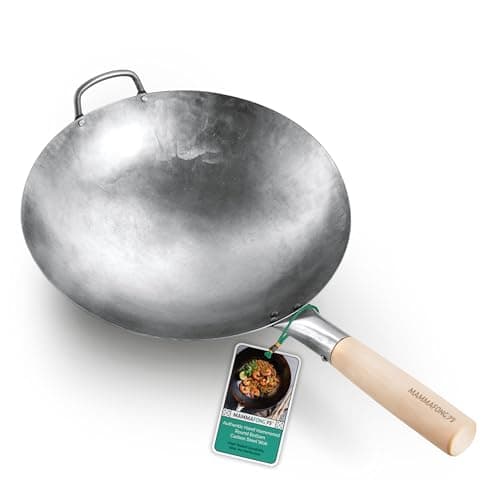
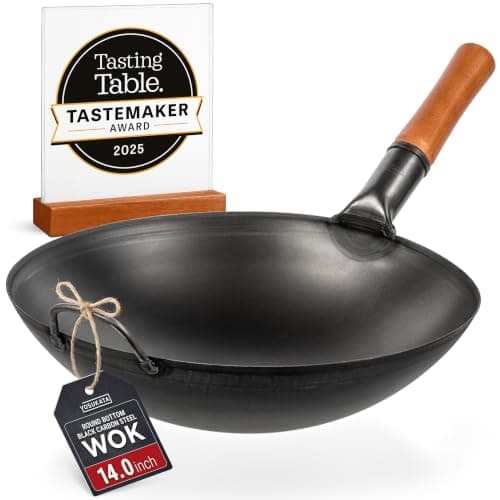
Get the Yosukata if you want a wok that works the day it arrives; get the Craft Wok if you want the genuine hand-hammered article and will do the seasoning yourself. Both are 14-inch round-bottom carbon steel woks, both want a gas flame and a ring on a Western stove, and the food comes out the same. This is a day-one decision, not a cooking one.
Fourteen inches is the standard family size — Wikipedia puts a 14-inch wok at “suitable for a family of 3 or 4” — and both of these are that size, in the same material, with the same round bottom. What separates them is how the bowl was formed and what the factory did to the surface before boxing it.
Hand-hammered vs spun: what the difference does
Wikipedia's wok article lays out the quality ladder in carbon steel: the lowest-quality woks are stamped by machine from a single ply and have a higher tendency to deform and to cook with a hot spot; better mass-produced woks are heavy-gauge, machine-hammered or spun; and the best are almost always hand-made, pounded into shape from sheets of carbon steel. It also notes that hammered woks are sometimes flipped inside out after shaping, giving a gentle flare to the edge that makes it easier to push food up onto the sides.
That flare and those dimples are the real argument for a hand-hammered Craft Wok: in a busy stir-fry you are constantly parking cooked food on the upper walls while something else sears in the middle, and a hammered interior gives it somewhere to sit. The spun Yosukata bowl is smoother, which makes it marginally easier to wipe out and marginally more slippery to park food on. Neither difference will change your dinner.
The seasoning difference is the real one
A raw carbon steel wok is not usable as shipped. It carries a factory anti-rust film that has to come off, and then the pan needs several rounds of heating and thin oiling before food stops welding itself to the metal — the layer you are building is polymerized oil, and it takes heat and patience. On a hand-hammered wok that is an hour or two of work, usually under a strong extractor or outdoors, before the first stir-fry.
The Yosukata skips that step: it is sold pre-seasoned, so it arrives with a usable base layer and you build on top of it by cooking. Wikipedia also flags that carbon steel woks in general tend to be more difficult to season than cast iron ones, which is exactly the chore the Yosukata removes. If you have never seasoned a pan, start there. Our carbon steel seasoning guide walks through the raw-pan version step by step if you choose a hammered wok anyway.
What they share, and what it means for your stove
Both are round-bottomed, and that is a hard constraint. Over a gas hob a round bottom gets hotter than a flat one and is better for stir-frying; on a flat electric or induction top it cannot make full contact and will never get properly hot. If your stove is a smoothtop, neither of these pans is your answer — read the flat-bottom wok roundup for glass-top and electric stoves instead. If you have gas, you also want a ring so the bowl does not rock.
Both are thin, light and quick to answer the flame, which is the whole case for carbon steel over iron; if you would rather have mass and heat retention, the cast iron wok vs carbon steel wok comparison makes that case properly. And both will rust within a day if you put them away damp.
Where Mammafong fits
The Mammafong is the same proposition as the Craft Wok — a genuine 14-inch hand-hammered round-bottom pow wok, shipped uncoated, needing a full seasoning — for less money. If the hammered shape is what you want and budget is the constraint, it is the rational pick; the trade-offs are a shorter track record and intermittent stock. It is ranked third here on that basis, not because it cooks worse.
Our honest position on “authenticity”: a hand-hammered wok is a better-made object and a nicer thing to own. It is not a better dinner. If somebody tells you a spun pre-seasoned wok cannot produce a good stir-fry, they are describing a burner problem, not a pan problem.
How to choose between two good woks
Answer the day-one question first
Are you willing to spend an evening stripping a factory coating and building a seasoning layer before you cook? If yes, the hammered pans are open to you. If no, buy the pre-seasoned Yosukata; a wok you are slightly dreading is a wok that stays in the cupboard.
Check your burner, not the pan
A round-bottom wok rewards a powerful gas flame and punishes everything else. If your gas burner is modest, a smaller 12-to-12.5-inch wok concentrates what heat you have; if your stove is flat, buy flat. This single decision affects your enjoyment of wok cooking more than any brand choice.
Handles: stick, loop, or both
A long stick handle is what makes one-handed tossing possible, and all three woks here are light enough for it. A helper loop opposite the handle makes lifting a full wok off the ring far less alarming. Check the photographs for that loop; day to day it is worth more than the hammering.
Budget honestly
All three are inexpensive pans by cookware standards and the gaps between them are small. Spend the difference on a decent long-handled wok spatula and a ring before you spend it on a fancier bowl.
Then look after it
Dry it on the burner after washing, wipe a trace of oil in while it is warm, and cook in it often — frequent use is what turns a dull gray wok dark and slick. The routine is in how to use a wok, and the rust rules are the same as for iron: see how to keep iron from rusting.