For most people the answer is: buy online, because the breadth and the return policy are better, and the pot you want is almost never the one a given store happens to stock. Go in personfor one specific reason — to pick a pot up and find out whether you can actually lift it full — and for two specific buyers: anyone with grip or wrist limitations, and anyone choosing a color they will look at for twenty years. Those are genuinely worth a trip. Everything else about the in-store experience is worse than shopping from your kitchen.
A note on what this page does and does not do. Retail stock changes weekly and varies by location, so we make noclaim about what any particular store has on its shelves today — any such claim would be wrong by the time you read it. What follows is what each buying route is structurally good and bad at, which does not change, plus how to check a pot before money leaves your hands.
Online: the default, and why
Three structural advantages, none of which a shop can match.
Breadth. A dutch oven is a commodity shape sold in perhaps forty meaningful variants — four capacities, two shapes, bare or enameled, four price tiers. A store carries a handful. Online you can buy the specific pot that suits your cooking rather than the nearest thing in the aisle, which matters because size is the decision that determines whether you enjoy the pot.
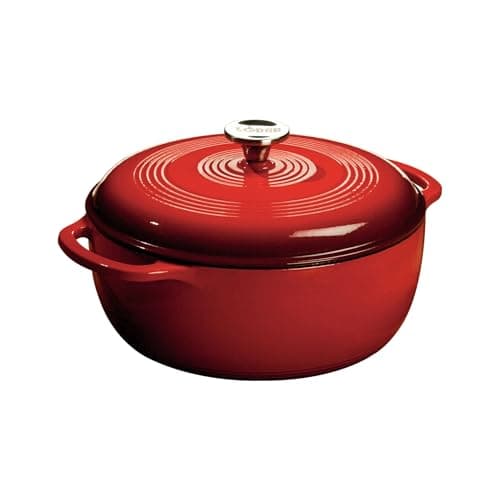
Published specifications.You can read the maker's own figures before you commit — Lodge, for instance, publishes its 6-quart enameled pot as compatible with any stovetop including induction or an oven up to 500℉, with a stainless steel knob, and also publishes that the line is made by partners in China or Vietnam. Shelf tags tell you none of that. The oven ceiling in particular is worth checking, because it is often set by the knob rather than the pot.
Returns. A dutch oven is heavy and enamel chips. A route with a no-argument return window is worth real money on an object where a transit knock is a possibility, and it is the reason we would rather you bought an enameled pot online than carried one home from a clearance bin.
The one thing online genuinely cannot do is tell you how the pot feels. Which brings us to the exception.
In person: go for the weight, not the price
The single most under-weighted spec in this category is mass. A 6-quart enameled pot is heavy empty and a two-handed lift when full and hot, and no listing conveys that. If you have any doubt about your wrists, go and pick one up — and pick up the size above the one you are considering too, because the jump from 6 to 7.5 quarts is bigger in the hand than on paper.
The second good reason is color. Enamel colors photograph inaccurately, and this is an object that sits on a stovetop for decades. If the color matters to you, see it under real light.
What to check while you are there, in order — this works on any pot, in any shop:
- Lift it empty, then imagine it full. Add roughly eight to ten pounds for a 6-quart braise. If that is a problem, size down now rather than regretting it.
- Run a fingertip around the entire interior rim and base. Chips happen in transit and in stockrooms. An interior chip is a dead pot; an exterior chip is cosmetic.
- Look into the interior against the lightfor crazing — a fine web of hairline cracks in the glaze. New pots should not have it.
- Set the lid on and nudge it. It should sit flat and heavy with no rocking. A poor lid seal is the difference between a braise and a casserole.
- Check the knob material.Stainless or metal means a higher published oven ceiling. Plastic or phenolic usually means a lower one — and the knob is the part that caps the pot.
- Put it on a flat surface. It should not rock. A warped base is rare in enamel and fatal on a glass or induction hob.
- Hold it by the loop handles. They should be wide enough for an oven mitt, which is not a given.
- Check the box for pot protectors.Some pots include them, some do not, and they are the cheapest protection against the pot's main failure mode.
The routes, compared
| Route | Structurally good at | Structurally bad at | Best for |
|---|
| Large online retailers | Breadth, published specs, returns, price visibility | You cannot touch it; color renders inaccurately | Almost everyone |
| Big-box and supermarket | Buy it today; handle it first; easy local returns | Thin selection, usually the budget tier and a couple of sizes | Needing a pot this week, or checking weight |
| Specialist cookware stores | Staff who know the range; premium brands in the flesh | Highest prices; small-store stock gaps | Buying a French pot you want to see first |
| Brand factory outlets | The only reliable discount on premium enamel | Seconds-grade cosmetics; limited sizes and colors | Wanting Le Creuset or Staub for less |
| Direct from the brand | Full range, every color, the real warranty terms | Rarely the cheapest; no cross-brand comparison | A specific line sold nowhere else |
| Warehouse clubs | Genuinely low prices when they carry it | Seasonal and unpredictable; membership required | Opportunistic buyers who can wait |
| Secondhand and thrift | Occasional remarkable value on enamel and vintage iron | No returns, no warranty, condition risk | Patient buyers who can inspect in person |
Factory outlets: the one real discount on premium enamel
If you want a French pot and the price is the obstacle, a brand outlet is the honest route. What you are typically buying is a cosmetic second — a glaze blemish, a color being discontinued — at a real reduction, with the brand standing behind it. The trade is that you take the size and color available rather than the one you wanted, and you should run the same inspection list above, because “cosmetic” is the outlet's judgment rather than yours. Whether the premium tier is worth it in the first place is argued in are expensive dutch ovens worth it and the best Le Creuset alternatives.
Secondhand: where the money is, and where it goes
Two very different propositions share this shelf.
Secondhand enameled potscan be a genuine bargain, and they are also the easiest way to buy a dead pot. The failure mode is interior chipping and crazing, both of which a photo hides and neither of which can be repaired — chipped enamel cast iron explains why. Buy enamel secondhand only when you can run a finger round the inside. Heavy staining, by contrast, is cosmetic and often reversible: how to remove stains.
Secondhand bare iron is the opposite: almost everything wrong with it is fixable. Rust is a surface reaction and old carbon comes off, so a filthy bare pot is usually a good pot. Only warping and cracks are terminal. The checklist is how to buy vintage cast iron, with how to restore cast iron for afterwards and when cast iron is not worth restoring before you spend a weekend on it.
Two ways people waste money
Buying on color in a shop and discovering the size is wrong. This is the commonest one. The aisle offers two sizes in six colors, so the decision quietly becomes a color decision, and you end up with a 7.5-quart pot for a two-person household that reduces every sauce to nothing. Decide the capacity before you leave the house.
Buying a boxed set.A multi-piece enamel set spreads your money across pieces you will not reach for. One well-chosen pot plus a bare skillet covers vastly more cooking — cast iron set vs individual pieces.
When to buy
Dutch ovens are a gift-season product, so the deepest discounting clusters around late November and December, with a second wave in spring. If you are not in a hurry, that is worth waiting for — and because every price on this site comes live from the price layer with the date it was fetched, the numbers on this page reflect today rather than whenever it was written. In qualitative terms the field spans about a seven-fold range from the cheapest competent enameled pot to the French flagships, and most of that gap buys finish and warranty rather than cooking.
What to buy, once you know where: the best dutch ovens for the ranked field, best budget dutch ovens at the cheap end, and our review of the Lodge 6-quart for the pot we recommend most often.