If your stove is a glass-ceramic smoothtop, a coil electric or an induction hob, buy a FLAT-bottomed wok — and buy the Souped Up Recipes 12.5-inch carbon steel one. That is the whole decision. Everything else (hammered or spun, iron or steel, 12 inches or 14) is preference. A round-bottom wok on a flat burner is not a compromise; it is a pan touching its heat source along a narrow circle.
A wok is a bowl, and the bowl is the technology: stir-frying works because a screaming-hot center and cooler sloping walls let you move food between two temperatures in one pan. Traditionally that bowl is round and it sits down into a gas ring, which wraps flame up the sides. Wikipedia's wok article states the Western problem plainly: flat-bottomed woks exist specifically because a round one cannot make full contact with an electric element. On induction it is worse than inefficient — induction needs close contact to couple with the pan at all, so a round bottom barely heats.
A wok ring is not the fix on a smoothtop
The usual advice is to buy a wok ring and carry on. Over a gas burner that is reasonable. On a glass or coil electric top it is wrong twice over: the ring lifts the pan off the only hot surface you have, so you lose conduction that was already marginal, and it traps heat against a glass-ceramic panel that is engineered for near-zero thermal expansion but is still glass. On induction a ring does nothing at all, because the burner is not producing heat for the ring to redirect. If your cooktop is flat, the base of your wok has to be flat.
What you gain, and what you give up
Be clear-eyed about the ceiling. A flat-bottom wok on a domestic electric element will not produce restaurant wok hei— that comes from a jet of flame and a burner rated many times what a home hob delivers, not from any pan. What a flat-bottom wok does give you is a deep, sloped, high-walled vessel with room to move food, which beats a frying pan at the same job, on a base that actually touches your burner. For most home cooks that is the difference between a stir-fry that sears and a stir-fry that steams.
There is one real compensation available on a weak element, and it is why cast iron is on this list at all: mass. A heavy pan stores heat, so when a handful of cold broccoli lands in it the temperature falls less far and recovers sooner. Wikipedia's wok article makes the same point in favor of iron pans for electric-stove stir-frying, because they hold enough heat for the sustained high temperatures the technique needs. A thin carbon steel wok answers the burner faster; a cast iron wok refuses to be cooled by the food. On a strong gas flame the steel wins easily. On a slow electric coil the iron's stubbornness is genuinely useful.
The glass-top rule nobody tells you
Weight is not only about your wrist. Cast iron and a glass cooktop coexist perfectly well as long as you never slide the pan — Field Company's own guidance is “Do NOT shuffle or slide” , and to lift and set the pan down gently instead. The trouble is that moving the pan is half of what a wok is for, and a 14-inch cast iron wok full of dinner is not a pan you toss. That is the strongest argument for carbon steel on a smoothtop: you can pick it up. If you do buy the iron, cook by stirring with a spatula and leave the pan where it is. The same rules we set out in best cast iron for glass-top and electric stoves apply here unchanged, and the longer cooktop-compatibility guide covers induction specifically.
Why these four
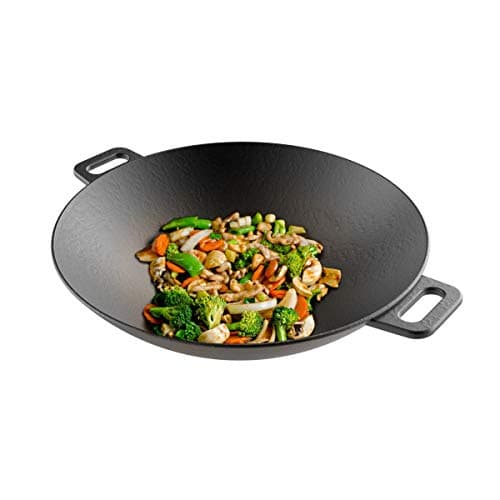
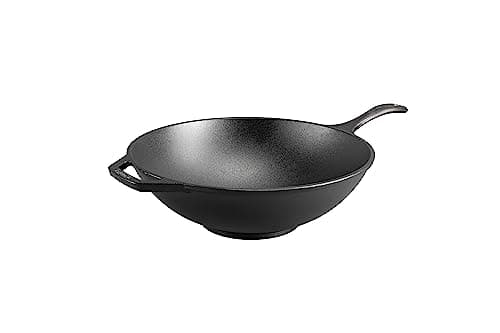
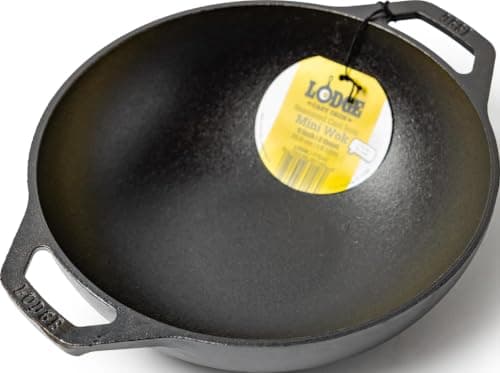
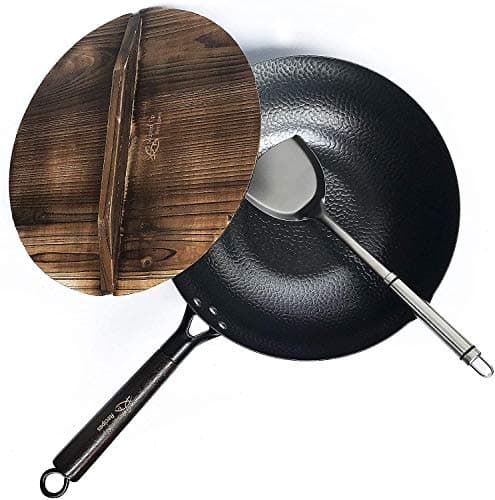
The shortlist is everything in our registry with a base that works on a flat burner, ranked for that job and no other. The Souped Up Recipes 12.5-inch leads because it is the only one that is both flat and light, and because the included lid turns it into a steamer and a braiser too. The Classic Cuisine 14-inch is the cheapest genuine full-size flat-bottom wok we can find live, and it is cast iron, so it is the heat-retention choice on a slow element — just know you are buying a pan you stir in, not one you toss. The two Lodge woks are here because Lodge publishes their cooktop compatibility explicitly: the Chef Collection 12.5-inch is “compatible with any stovetop (including induction), oven, grill, or campfire” at a published 9.72 lb, and the 9-inch mini wok is the one-person version that doubles as a sizzling serving dish.
What is deliberately absent: every round-bottom wok. Our best carbon steel woksroundup is led by a 14-inch round-bottom Yosukata and it stays there, because over gas that pan beats anything on this page. If you have a gas burner, read that list instead. If your cooktop is flat, the round-bottom pans are not a trade-off you are weighing — they are the wrong tool.
Both materials need seasoning. Carbon steel and cast iron are both bare metal, so both rely on polymerized oil for release and rust protection. Our carbon steel seasoning guide and how to use a wok cover the break-in; the short version is heat it, oil it thinly, repeat, and never put it away wet.
How to choose a wok for a flat cooktop
1. Flat base, non-negotiable
Look for the words “flat bottom” and check the side-on photograph. A flat-bottom wok is closer in profile to a deep frying pan with high sloped walls, and that is exactly what you want on a smoothtop. If the product photos show the pan resting on a ring, it is a round-bottom pan and it is not for your stove.
2. Size to your burner, not to your family
A 14-inch wok suits a family of three or four, but on a domestic electric hob the heated zone underneath is usually six to nine inches across, so the outer third of a 14-inch pan is warmed only by conduction through the metal. A 12-to-12.5-inch wok wastes less of itself. If you routinely cook for more than three, cook in two batches rather than buying a pan your burner cannot light up.
3. Carbon steel for agility, cast iron for stubbornness
Carbon steel is rolled sheet: thin, light, quick to heat, quick to answer the dial, and light enough to lift off glass. Cast iron is a thick casting with far more thermal mass, so it is slow to heat, slow to adjust, and very hard to cool down with cold food. On a strong element, steel. On a weak one where your real enemy is temperature crash, iron. The full material argument is in cast iron wok vs carbon steel wok.
4. Handles decide how you actually cook
A long stick handle lets you shake and toss one-handed, which is the traditional technique; two loop handles mean you lift with both hands and stir instead. Most cast iron woks use loops because of the weight, and most light carbon steel woks use a stick handle with a small helper loop. On a glass top, where you want to lift the pan rather than drag it, that helper loop is worth more than it looks.
5. A lid is worth more than another inch of diameter
With a lid a wok also steams dumplings and fish, braises, and finishes thick vegetables after a sear — and on a weak burner that last one matters, because you can cover the pan and let retained heat do the work. It is the main reason the Souped Up Recipes pick leads this list over a cheaper bare pan.
6. What not to buy
Skip nonstick woks: the newest coatings withstand about 500°F, which is below what hard stir-frying wants, and a coated surface cannot carry seasoning or give you the character of a bare pan. Skip clad stainless woks, which can cost five to ten times a carbon steel wok, heat more slowly and are not used in most professional kitchens. And skip plug-in electric woks if searing is the point — like nonstick woks, they are limited to lower temperatures than a traditional wok over a burner.