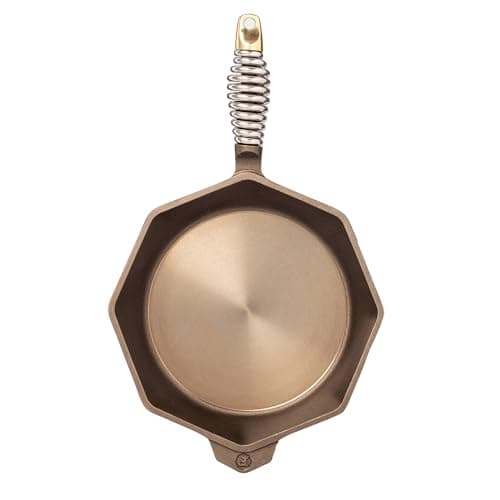
Buy the Finex if you want the most interesting object in cast iron and a handle you can actually hold — octagonal, eight spouts, a coiled stainless spring that runs cooler than solid iron, and a listing with a live price you can check right now. Buy the Smithey if you want the polished, lighter, quieter heirloom and you are happy to buy it through the company's own channels. Neither sears better than the other, and neither sears better than a Lodge costing a small fraction of either. You are choosing between two very different objects that cook the same dinner.
This is the premium matchup nobody resolves properly, because most of what gets written about these two brands is really written about how they look. So here is the frame we use, applied in this order: the cooking surface, the weight, the handle, the shape, and how you actually buy the thing. Those are the five places these pans genuinely differ. Everything else — the crust on a steak, the cornbread, the oven work — is a tie, and below we show you why it has to be.
What each company actually is
Both are small American makers and both arrived in the same decade. Smithey Ironware was founded in 2015 in Charleston, South Carolina, and Finex in 2012 in Portland, Oregon. Smithey publishes that it designs and crafts its cookware in the USA, says every pan is individually inspected multiple times during manufacturing, and guarantees the quality of each piece for life.
Finex has a detail that matters to buyers and that a lot of reviews skip: it is not independent any more. Lodge acquired Finex in August 2019 — the first acquisition in Lodge's 123-year history — and Lodge's own chief executive described the deal at the time as gaining “entry into the luxury cast iron cookware segment.” The same reporting notes Finex production was being transitioned to Lodge's South Pittsburg, Tennessee foundries.
Read that honestly and it cuts both ways. If you are buying Finex as a scrappy independent Portland startup, that story ended in 2019. If you are buying it as a luxury pan whose quality control and warranty now sit behind the largest cast iron manufacturer in the country, that is arguably a stronger position than it was in before. Smithey, by contrast, is still the small Charleston house it was — which is exactly what some buyers are paying for.
Criterion 1: the cooking surface
This is the headline difference, and the one most worth understanding before you spend luxury money.
A mainstream skillet comes out of a sand mold with the familiar faintly pebbly as-cast texture. Boutique makers mill or polish that texture away; mainstream makers leave it and let seasoning — polymerized oil fill it in over time. Smithey sits firmly in the first camp: its cast iron line is sold on exactly that promise, and the company's own shorthand for it is “Polished, Pre-seasoned, Perfected”. A new Smithey arrives with a visibly smooth, bronze-dark interior. It is the smoothest-looking new pan most people will ever handle.
Finex is smoother than a standard pebbly pan but it is not selling a mirror. Its interior is finer than a classic Lodge and it ships pre-seasoned in flaxseed oil, so it releases food well early in its life — but the pan's identity is the geometry, not the polish. If a glass-smooth surface out of the box is specifically what you are buying, Smithey wins this criterion outright, and so do Stargazer and Field.
One caveat we will keep repeating because it saves people real money: a pebbly pan does not stay pebbly. Seasoning fills the texture, and after a few months of regular cooking the release gap between a well-used mainstream pan and a polished boutique one narrows a long way. We lay that out in smooth vs rough cast iron. The polish is real and it is lovely; it is not a different category of cooking.
Criterion 2: weight
Here the two pans separate hard, and in the opposite direction to what the prices suggest.
Finex casts thick. Its skillets are among the heaviest in their sizes — the 8-inch alone runs around four and a quarter pounds, which is more than some 10-inch pans weigh. That mass buys genuine thermal mass: drop four cold burger patties onto a properly preheated Finex and the surface temperature barely sags, which is the whole mechanism behind a hard crust. It also means two hands, every time, and a pan you will not enjoy lifting one-handed over a sink.
Smithey is the lighter pan of the two, though nobody should buy it expecting a featherweight: it is still thick, planted cast iron, and heavier than the pans actually built around lightness. If low weight is the thing you need most, neither of these is your answer — Field and Lancaster are the makers whose entire pitch is lighter, smoother iron, and our lightest cast iron skillets roundup ranks that category properly.
Criterion 3: the handle
Cast iron handles get hot, because iron conducts heat slowly but it does conduct it. Every solid cast handle eventually becomes a thing you need a towel for, which is why the stubby Lodge handle is the most common complaint in the whole category.
Finex's answer is the best in the business: a coiled stainless “Speed Cool” spring over the handle core. It is not a gimmick. The coil gives the handle far more surface area to shed heat from, and it puts a stainless spring rather than solid hot iron against your palm. It is genuinely nicer to hold than any cast handle we know of, and it is a real part of what the Finex premium buys.
Smithey's handles are cast iron, shaped in the vintage idiom of the pans it honors — the Griswold-era tradition of a long, elegant handle with a hanging hole. They are better than a stock Lodge handle and they are beautiful. They still get hot. Budget for a leather or silicone sleeve either way, and if you are buying for someone with wrist trouble, the handle rather than the finish is the thing to think hardest about.
Criterion 4: shape, and the eight spouts
The Finex is octagonal, and this is the one feature in the matchup that changes a daily task rather than a feeling. Eight flat sides means eight places to pour from, so draining bacon fat or pouring off a pan sauce does not require rotating a hot pan to find the one spout pointing the wrong way. Round pans give you two spouts if you are lucky. Once you have lived with eight, two feels like an oversight.
The cost of the octagon is that a lot of kitchen gear is built for circles. A round lid from another pan will not fit it, a glass splatter lid will not sit flush, and round accessories can leave the corners under-contacted on a small burner. Smithey's round pans do everything a round pan has always done, and they fit the universe of round lids and accessories that already exists.
Criterion 5: how you buy it — and why that matters here
This criterion rarely appears in comparisons, and at this price it deserves to.
Finex is listed on Amazon, and all three of its skillet sizes returned a live price when we refreshed this page. That means you can see today's number before you commit, compare it against every other pan on this site, and use a return path you already understand. The live Finex price is at the top of this page.
Smithey we have no verified Amazon listing for, so there is no price for it anywhere on this page and we are not going to print a remembered one. You buy a Smithey through the company's own shop or through its listed retail stockists. That is a perfectly good way to buy a pan — it is how most boutique makers sell, it is the cleanest route to the company's lifetime quality guarantee, and the brand controls the condition the pan arrives in. It is simply a different purchase: fewer discounts, no marketplace price history, and you should read the current shipping and returns terms before you order.
Where they are identical: the sear
Now the part that decides how much you should care about any of the above. Put a steak in each pan, properly preheated and properly dried, and the crust is the same. Browning is the Maillard reaction, it fires when a hot dry surface meets food, and both of these are thick cast iron holding a lot of heat. A polished surface changes how food releases and how a spatula feels; it does not brown harder. A heavier pan recovers temperature slightly faster when you load it cold, which is a genuine advantage to the Finex — and a smaller one than preheating properly for five minutes instead of two.
Both will take any heat source cast iron takes, both go in the oven, both will do cornbread, a frittata, a roast chicken and a pan pizza. And both are beaten on pure value by a pre-seasoned Lodge made in Tennessee that costs a fraction as much and does all of it. We say so in is cast iron worth it, and we are not going to stop saying it on a page about luxury pans.
The honest case against each
Against the Finex:it is heavy, and in the smaller sizes the weight is out of proportion to the pan — an 8-inch at over four pounds is a lot of iron for eggs. The octagon locks you out of round lids and accessories. The independent-Portland story a lot of the brand's appeal was built on ended with the 2019 Lodge acquisition, and if that was part of the romance for you, know it before you buy. And its interior, while finer than a standard pan, is not the mirror the smooth-surface crowd is actually shopping for.
Against the Smithey:there is no verified marketplace listing in our data, so you cannot price-shop it the way you can price-shop nearly everything else on this site, and this page cannot show you a number for it. Its handles are cast iron and get hot like all cast iron handles. It is heavy enough that it will not solve a weight problem. And the polish — the thing you are most paying for — is the feature that seasoning on a cheap pan slowly imitates for free.
The verdict
Buy the Finex if the handle and the pouring matter to you, if you like owning an object with a real design idea in it, if you want maximum thermal mass for searing, or if being able to see a live price and buy through a channel you already use is worth something. It is the more practical luxury pan, and it is the one this page can actually price for you.
Buy the Smithey if the polished interior is the specific thing you want, if you would rather own the pan still made by the small Charleston house than one made inside a larger company, and if buying from a maker directly is part of the appeal rather than a hurdle.
Buy neither if what you actually want is the best cooking per dollar. That is a 10.25-inch Lodge, it is the pick on our best first skillet page, and we work through exactly what each premium bracket buys you in are expensive cast iron skillets worth it.
How to decide between them
Answer the handle question first
It is the fastest way to end this decision, and it is the one difference you will feel every single time you cook. If a cooler, more comfortable handle sounds like the upgrade you have been wanting, the Finex spring handle is the only thing in premium cast iron that genuinely delivers it, and the decision is made. If you do not mind reaching for a towel, the criterion drops out and the surface should decide instead.
Be honest about whether you are buying a surface or an object
If you want a polished mirror interior, say so and buy for it — but then also price Stargazer and Field, because both sell machined surfaces and Stargazer publishes that it machines, finishes and seasons in Allentown, Pennsylvania. If you want an object with a design idea in it, the octagon is the only one of its kind. Those are two different purchases, and conflating them is how people end up disappointed by an expensive pan.
Size down, not up, in this bracket
Luxury iron is thick iron, and thick iron in a big diameter gets heavy fast. A 10-inch is the size most households actually cook in and the size we would buy in either brand; a 12-inch with a lid is a two-handed proposition that needs counter space and a big sink. Our skillet sizes guide has the full argument, and 10-inch vs 12-inch covers this exact fork.
Check the price on the day, on both sides
The Finex price on this page is live from Amazon, inside our freshness window. Smithey has no verified listing here, so check its current price at the source before you compare — and do not assume the premium pans move in step. They are separate companies with separate pricing, and at this level a single sale can change which one is the better buy.
Do not buy a luxury pan as your first cast iron pan
This is the most expensive mistake in the category. Cast iron asks for a habit: dry it, oil it lightly, do not soak it. Plenty of people discover they do not want that habit. Find out on a pan that costs very little, then upgrade deliberately. We say exactly this in is Smithey worth it and is Finex worth it, and it is still the right advice on a page comparing the two.