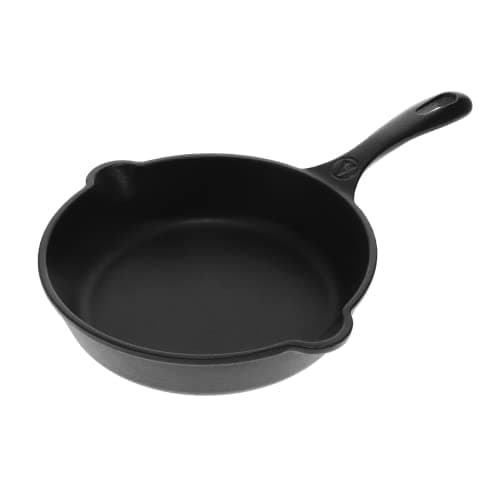
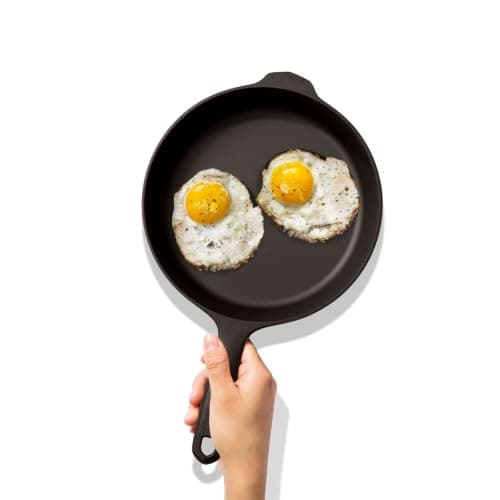
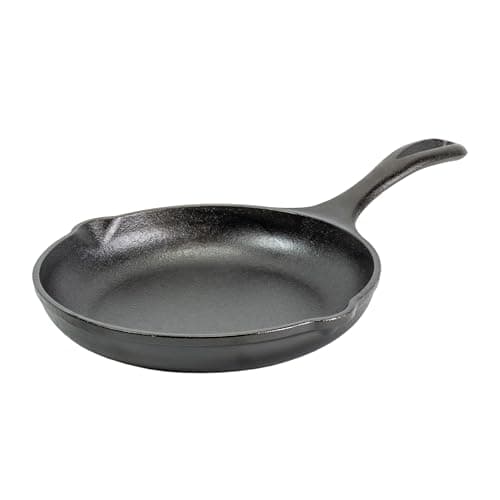
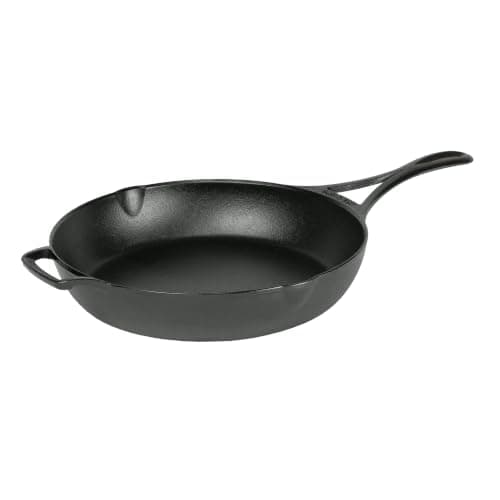
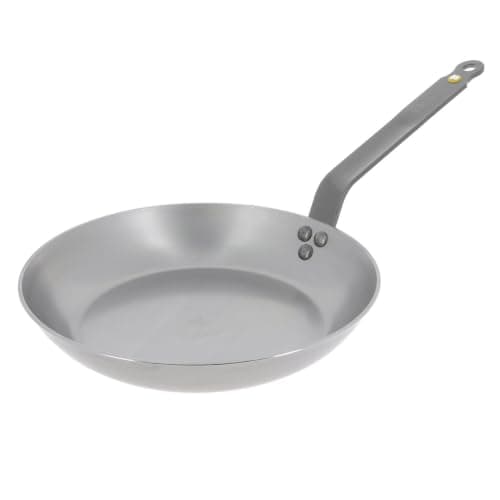
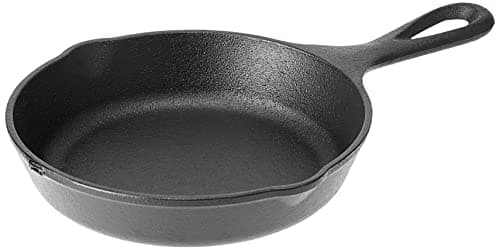
The lightest genuinely useful cast-iron skillet you can buy is the 6.5-inch Lodge, published at 1.94 lb — and if you want a light pan with real cooking area instead, it is the Field Company No. 6 at a published 3 lb. Those are the two answers. Everything below is about which one your hands and your cooking actually want, and about the one trade that nobody selling you a “lightweight” pan mentions: a lighter pan holds less heat, so it recovers more slowly when cold food hits it.
This page exists because weight is the most under-discussed spec in cast iron and the most common reason a pan quietly stops being used. People do not abandon a skillet because the seasoning failed. They abandon it because lifting eight pounds of hot iron out of an oven with one hand, at arm's length, stopped being something they were willing to do — after a wrist injury, with arthritis, in a small kitchen, or just on a Tuesday.
Almost nobody ranks pans this way, so the numbers are scattered across listings and spec pages. We have collected the ones that are actually published, and we have not filled in the ones that are not.
What to look for before you look at the picks
Diameter is the biggest lever, not brand
Iron is dense and a skillet is mostly a flat disc, so weight scales with roughly the square of the diameter. That is why stepping from a 12-inch Lodge (listed at about 8 lb) to a 10.25-inch (about 4.5 lb) nearly halves the load, and why the 6.5-inch lands under two pounds. Before you spend five times as much on a thin-cast boutique pan, check whether you simply need a smaller one. Our guide to skillet sizes is the companion to this page: it answers how much pan the food needs, and this one answers how much pan your arm wants.
Wall thickness is the second lever — and the expensive one
The other way to lose weight is to cast thinner. Pre-war American pans were notably thinner and lighter than modern ones, and sand casting a thin wall well is harder and slower than casting a thick one — which is why thin modern castings come from boutique foundries at boutique prices. Field publishes “thinner sidewalls and a balanced handle” as the design intent, and the 3 lb figure for a pan with a 7-inch cooking surface is the receipt.
The physics cost: less stored heat
A lighter pan has less thermal mass, and thermal mass is most of why anyone buys cast iron. Drop two cold steaks into a thin pan and the surface temperature falls further and climbs back more slowly, which is exactly the moment that decides whether you get a browned crust or gray, steamed meat. This is a real trade, not a quibble. If hard searing for a family is your main job, buy the heavy 12-inch and a handle sleeve, and use two hands. If your main jobs are eggs, one or two portions, cornbread, and a chop, a light pan costs you nothing you will notice.
Balance, not just mass
Two pans of the same weight do not feel the same. A long handle multiplies the load at your wrist, and a usable helper handle on the far side lets you share it between hands. Field builds its case on a “balanced handle”; Lodge's Blacklock line has an extended, raised handle. Where a pan wins on leverage rather than mass, we say so in its entry below.
When to stop buying iron
There is a limit. A full-size 10-inch pan cannot be made featherweight in cast iron, and the honest alternative is carbon steel — the same seasoned, iron-based cooking surface pressed from sheet instead of poured into sand, so a full-diameter pan comes in far lighter. That is why a carbon-steel pan is ranked last here rather than left out: for some readers it is the correct answer and pretending otherwise would be selling. See cast iron vs carbon steel for the full trade-off.
How we read the published numbers
Three of the figures on this page come straight from the maker — Lodge publishes 1.94 lb for the 6.5-inch, Field publishes “3 lb total weight” for the No. 6, and de Buyer's spec sheet gives 1,930 g with a 3 mm base. Two are approximate figures carried on the Amazon listings (the 8-inch Lodge and the 8-inch Victoria), and we mark them as listing figures rather than foundry specs.
One is a blank. Lodge markets Blacklock as “engineered to be lighter than traditional iron” but does not publish a 10.25-inch weight anywhere we can retrieve, so this page does not print one. A number we cannot source is worse than no number, because you would plan a purchase around it. The full read on that pan is in our Blacklock review.
Who each of these is really for
Reduced grip strength, arthritis, a wrist you are protecting: the 6.5-inch Lodge, and a second one if you cook for two. Two small pans you can lift beat one big pan you cannot.
You want light but you cook actual meals:the Field No. 6. Three pounds for a 7-inch machined cooking surface is the best ratio on this page, and it is the pan we would hand someone who said “light, but I am not giving up cooking.”
You want light and cheap:the 8-inch Victoria or the 8-inch Lodge Chef Collection. Both land in the three-pound region for a fraction of boutique money, and the Lodge's Chef Collection finish is smoother than the classic line.
You need a full 10-inch pan and weight is still the blocker: Blacklock if you want it to be cast iron, de Buyer Mineral B if you are willing to switch material and want the lightest full-size seasoned pan here.
You are shopping for someone older as a gift: read our gift-set page first, and default to the small pan. A heavy pan is a bad present.
The weight ladder, in one place
Using only published or listed figures, the practical ladder looks like this: about 2 lb gets you a 6.5-inch Lodge; about 3 lb gets you an 8-inch pan from Victoria or Lodge, or a machined 8.38-inch Field; about 4.25 lb gets you a full-size 10.25-inch de Buyer in carbon steel; about 4.5 lb gets you the standard 10.25-inch Lodge; about 5.2 lb gets you a machined 10.5-inch Stargazer; and about 8 lb gets you the 12-inch Lodge that started this whole conversation.
Read that ladder twice before you spend. The step from 12-inch to 10.25-inch is free — it costs you nothing but pan area and saves three and a half pounds. The step from 10.25-inch Lodge to a thin boutique 10.5-inch costs several hundred per cent and saves you nothing on weight at all, because a machined pan is not necessarily a lighter pan. Smooth and light are different products, sold in the same sentence. Ours is a separate page.
Three things that cut felt weight without changing the pan
Use the helper handle. It is not decoration. Two hands on a hot 10-inch pan is both safer and dramatically easier on the wrist than one hand at full extension, and the main reason people do not do it is that nobody told them the little loop was for that.
Slide, do not lift, inside the oven.Pull the rack out and transfer at the rack edge rather than carrying the pan at arm's length across the kitchen. Most wrist-ending moments in cast iron happen in that walk.
Leave it on the stove.The pan that lives on the hob is the pan that gets used. Storage lifts are most of the lifting, and a pan kept out needs none of them — see how to store cast iron for doing that without inviting rust.
What we are not claiming
We did not put any of these pans on a scale. Every figure above is either the manufacturer's own published specification or the weight carried on the live Amazon listing, and each is labeled as one or the other in the comparison table. We also make no claim about the Blacklock 10.25-inch weight, because Lodge does not publish one. Our methodology page says exactly what our scores are and are not; prices are live from the Amazon API with the as-of date printed under every table.