You cannot buy a new Griswold. The company cast iron in Erie, Pennsylvania from 1865 and the Erie plant closed in December 1957, so every Griswold pan in existence is at least sixty-eight years old and comes from a private seller, an estate sale or an antique dealer. This page is therefore about the three things that decide whether a given pan is worth buying: reading the logo to date it, spotting a reproduction, and judging whether the condition is recoverable. The gear you actually need is at the bottom, and it is cheap.
Why Griswold has the reputation it does
Griswold started as a hardware company — Matthew Griswold and his cousins J.C. and Samuel Selden founded it in 1865, making separable butt hinges and stove furniture in a building known as the “Butt Factory”. It only began making skillets, pots, grinding mills and waffle irons in the 1870s, was chartered as the Griswold Manufacturing Company in 1887, and built a world-wide reputation for high-quality cast-iron cookware over the decades that followed.
The reputation is deserved, and it is also partly an artifact of when the pans were made. Pre-war pans were cast thinner than modern ones and finished smoother, so a good Griswold is lighter in the hand and slicker out of the gate than a new mainstream skillet of the same diameter. That is the whole substance of the vintage-iron argument, and it is real. What it is not is magic metallurgy: the iron is grey cast iron, the surface is polymerized-oil seasoning, and a modern pan cooked on for a year behaves much more like a Griswold than the forums suggest.
One footnote worth knowing, because it explains why so many Griswold waffle irons survive: stovetop waffle irons were among the company's earliest and most successful products and were manufactured into the 1930s. If you have inherited one, it still works — see the cast iron waffle maker page for how the modern equivalents compare.
Dating a Griswold by its logo
This is the part worth memorising before you go to a sale. Griswold modified its easily-recognised “cross” logo several times, and historians and collectors use those modifications to date pieces. In sequence:
| Marking | Period | What it means to a buyer |
|---|
| “ERIE” only, no cross | Before the cross logo | Earliest and scarcest; collector territory, not cooking |
| Cross with slanted, italicised “Griswold” | 1910s to early 1920s | The “slant logo”. Among the most desirable, and priced accordingly at antique malls and fairs |
| Cross with block lettering | 1920s–1930s | The most popular and well-known variant — the image most people picture when they picture antique cast iron |
| “Small logo” cross | Early 1940s to 1957 | Late Erie production; the most affordable genuinely-Erie pans |
| Griswold logo, no “ERIE PA.” mark | 1957 to mid-1960s | Cast at the Wagner foundry in Sidney, Ohio after the brand was sold. Still Griswold-badged, not Erie-made |
| Dual Griswold + Wagner logos | Early-to-mid 1960s | The transition pans. The Griswold name was phased out by the late 1960s |
The 1957 handover is the detail most price guides gloss over. McGraw-Edison acquired Griswold in March 1957 and sold the Griswold brand and housewares division to the Wagner Manufacturing Company of Sidney, Ohio later the same year. So a “Griswold” pan can legitimately be a Wagner casting. Whether you care is up to you — they are good pans — but it should be reflected in the price. The two marques side by side: Wagner vs Griswold, and the Wagner brand guide.
Spotting a reproduction
Reproductions exist and they are the main way people lose money here. The documented tell is the casting and the lettering: reproductions generally have a grainy finish and uneven, blurred lettering. A genuine Griswold has crisp, sharply-defined markings and a cooking surface that is smooth under your thumb even when it is filthy. Grainy iron plus mushy letters means walk away, at any price.
Two further checks that cost nothing at a stall: set the pan on a flat surface and look for rocking or a visible gap at one edge, which means it has warped and will never sit flat on a hob; and run a finger around the rim looking for a crack, which is terminal. Our wider vintage-buying checklist is how to buy vintage cast iron, and how to identify vintage cast iron covers the markings on the other old American marques.
What drives the price
In rough order of effect, from what sellers actually ask:
- Logo era.Slant-logo and pre-cross “ERIE” pieces command multiples of a small-logo pan of identical size and condition.
- Size and rarity.The common everyday sizes are the cheapest. Unusual numbers, large skillets, and specialist pieces — waffle irons, the Tite-Top Dutch Oven, cornstick and muffin pans — carry a premium because fewer survived.
- Condition, but only to a point.Surface rust and a century of carbon are cosmetic and come off. Warping, cracks, pitting deep enough to feel, and a previous owner's grinder marks do not.
- Provenance theatre.“Rare”, “seasoned by my grandmother” and a hand-written tag add nothing you can verify. Price on the logo and the metal.
We deliberately do not publish a price table. Griswold prices are set in a thin, regional second-hand market that moves with whatever sold last week on an auction site, and any numbers we printed here would be wrong within a season. Check completed listings for your exact logo and size on the day you buy — that is the only honest price guide there is.
Should you cook on it?
Yes, if it is flat and uncracked. That is the whole test. A pan that was cast in 1930 and cooked on until 1985 is not fragile, and rust is a surface reaction between iron, water and oxygen rather than rot — it comes off and the iron underneath is unchanged. See is rusty cast iron safe to use.
Buy it to cook on, not to display. A genuinely collectible slant-logo piece in mint condition is arguably better left alone, but the ordinary small-logo Griswold you found for not much money is a better everyday pan than most things sold new, and leaving it in a cabinet is a waste of it.
What you need to bring one back
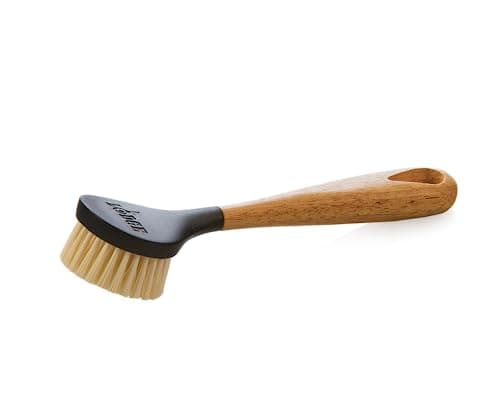
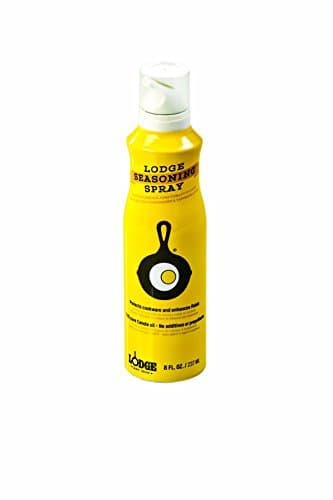
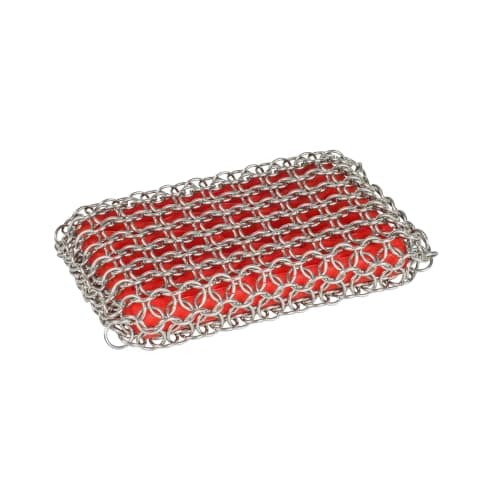
Here is the honest part: the kit is three cheap items and none of them is Griswold-specific. A century of baked-on carbon needs either a lye bath or electrolysis— both covered on their own pages, both using materials from a hardware store, neither of which we sell. What you then need is something to take the loosened rust off without gouging, something to clean with week to week, and oil to lay the first new layers of seasoning. That is the three picks below.
The sequence, in full, is how to restore cast iron, then how to season cast iron. And before you start, read when cast iron is not worth restoring — a warped or cracked Griswold is a wall ornament, and there is no shame in that.
If you want the Griswold experience without the hunt
This is a reasonable thing to want, and it is worth saying plainly: what people like about a Griswold is a thin, light, smooth-surfaced pan. You can buy that new. Field Company publishes 3 lb and a polished cooking surface for its No. 6 and is explicitly working in the vintage tradition; Lodge publishes Blacklock as engineered lighter than its traditional iron at a fraction of boutique money. Neither is a Griswold, and both arrive flat, uncracked, warrantied and seasoned.
The modern field, ranked: best smooth cast iron skillets, best lightweight cast iron skillets and best American-made cast iron— Lodge still operates two foundries in Tennessee, so US casting has not gone away with the old marques.
Buying a Griswold as a gift
It is a wonderful present and a slightly risky one. A vintage pan arrives needing work, which is a gift of a project rather than a gift of a pan — delightful for the right person, an obligation for the wrong one. The honest comparison is heirloom vs starter cast iron gift, and if the answer is “something that works on Christmas morning”, best cast iron gifts is the better page.
If you do give a restored one, give it with the chainmail and the oil. The pan is the easy part; knowing what to do when it looks sticky after a fortnight is the part people give up on — why is my cast iron sticky.