A dutch oven is a heat battery with a lid, and the lid is the whole point. It is a thick-walled lidded pot that does three things better than anything else in a domestic kitchen: braise tough cuts until they give up, bake bread with trapped steam, and cook a whole dinner start to finish in one vessel. Every recipe below is in one of those three groups. The rule that runs through all of them: brown hard with the lid off, then cook low with the lid on. Most disappointing dutch oven cooking is one of those two halves done impatiently.
Braising: the thing the pot was designed for
The rule: sear in batches, then barely simmer. Braising is combination cooking — a dry, hard sear for flavour, then a long moist cook to break down connective tissue. The pot is good at the first half because it holds temperature when cold meat lands in it, and good at the second because it holds a gentle, even heat for hours without scorching.
The temperature people get wrong is the second one. A braise should be at a bare tremble, not a rolling boil; a hard simmer squeezes the muscle fibres tight and you get dry meat in delicious sauce, which is the classic failure. Oven at 300–325°F, lid on, and leave it.
One material note that matters here: enamel is glass fused to iron and is chemically inert, so tomato, wine and vinegar do not touch it. A three-hour tomato braise in bare iron will dull the seasoning and can taste faintly metallic. If most of your cooking looks like the list above, buy enamel — bare vs enameled dutch oven.
Bread: trapped steam, nothing else
The rule: preheat the empty pot, lid on for the first half.A loaf in a covered pot makes its own steam from the dough's own water. That steam keeps the crust soft and pliable while the inside expands — the crumb setting as starch gelatinises — and then you take the lid off and the dry heat crisps and colours it. A home oven cannot inject steam; a lidded pot is the workaround, and it is the entire reason this pot became a baking tool.
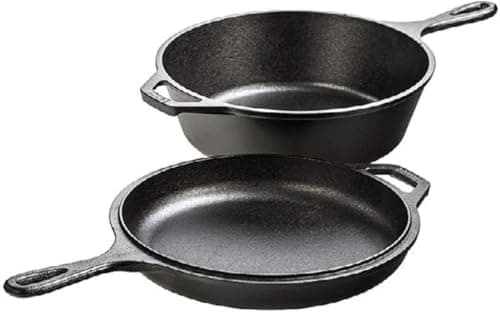
For sourdough specifically, the loading problem dominates every other consideration: lowering a proofed boule into a tall, blisteringly hot pot is awkward and slightly dangerous, which is why a shallow combo cooker beats a deep pot for this one job — Lodge publishes it as a deep pan with a shallow skillet lid, so you load on the flat and cover with the dome. The full ranking is the best dutch oven for sourdough bread, and the vessel comparison is dutch oven vs bread cloche.
One-pot dinners: start to finish without a second pan
The rule: build in layers and do not wash up in between.The pot's real domestic argument is that it takes a sear, a sweat, a deglaze, a simmer and an oven stint without ever being emptied. Everything that sticks to the bottom in step one dissolves into the sauce in step three. That is not a technique so much as a sequence.
Over a fire: the oldest version of all this
The rule: coals above and below, and count them. A camp dutch oven has legs and a flat flanged lid precisely so you can stand it over coals and pile more coals on top, which turns an open fire into an oven with heat from both directions. The flat-lidded, legged shape that makes this possible is exactly what makes a camp oven clumsy on a kitchen hob, which is why it is a second pot rather than a first one.
Three mistakes that flatten a dutch oven recipe
Crowding the sear. Browning six pieces of beef at once in a 5-quart pot produces steam, not crust. Two batches, a minute of patience, and the browning reaction actually happens.
Too much liquid. A braise is not a soup. Liquid should come a third to halfway up the meat; drown it and you dilute everything you built in the sear.
Peeking.Every time the lid comes off, the steam and the temperature leave. Set a timer and trust the pot — it is the one piece of equipment in the kitchen that genuinely rewards being ignored.
Skillet recipes are a separate index: cast iron skillet recipes. And if the pot itself is the question rather than the food, the best dutch ovens and what size dutch oven are the two pages to read.
Which pot suits which recipe group
| If you mostly cook | You want | Because |
|---|
| Braises, chili, stews, pot roast | A 5–6 qt enameled pot | Inert surface, so tomato and wine are fine for hours |
| Bread, mostly | A shallow bare-iron combo cooker | You load the loaf on the flat instead of lowering it into a well |
| One-pot dinners for 4–6 | 6 qt, round | Fits a chicken plus vegetables and still has freeboard |
| Cooking for two | 3–4 qt | A big pot half-full reduces badly and takes forever to heat |
| Over a campfire | A legged camp oven, bare iron | Legs and a flanged lid; enamel and open fires do not mix |
| A long-roasting joint or a bird | An oval pot | The shape matches what you are putting in it |
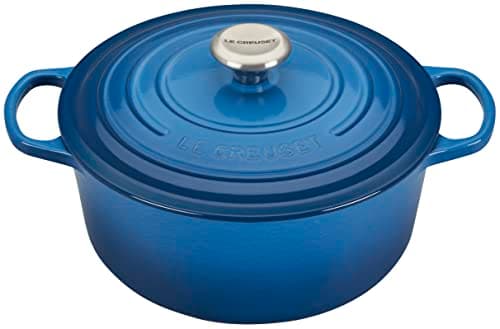
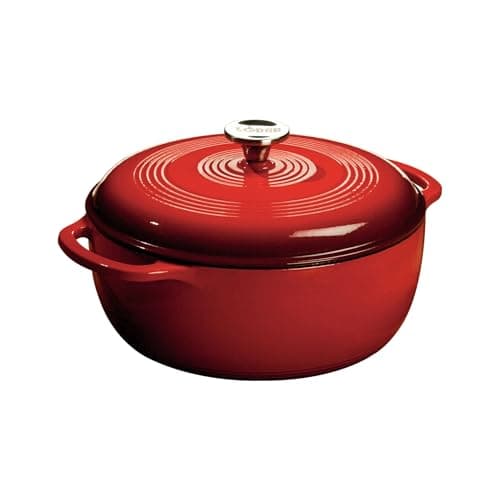
The three pots below cover the whole index: the value enameled pot for braising, the combo cooker for bread, and the heirloom French pot if you want the one you will hand on. Deeper shopping: best budget dutch ovens, the best bare cast iron pots, best oval dutch ovens and best small dutch ovens.
Two tools that matter more than the recipe
An oven thermometer.Domestic ovens are routinely out by 25°F or more, and a braise at 350°F when you asked for 300°F is the difference between silky and stringy. This is the cheapest upgrade in the kitchen.
Something to lift it with. A full 6-quart pot straight out of a hot oven is a two-handed, both-mitts job, and enamelled knobs and bare iron handles are both brutally hot. See best cast iron accessories.
After the cooking, the care differs by material: enameled cast iron care, removing stains from enamel and how to season a dutch oven for a bare pot.