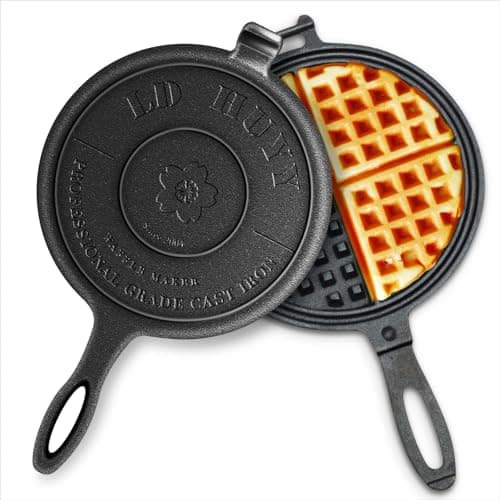
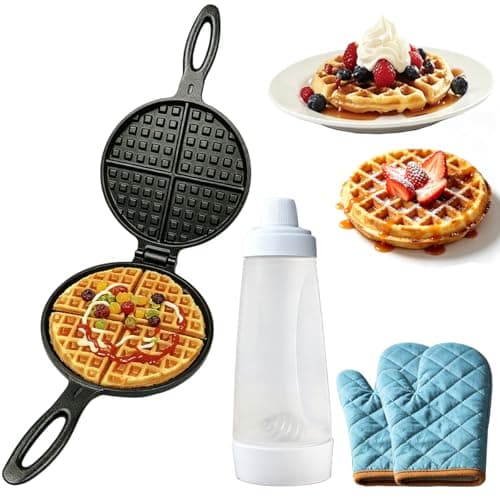
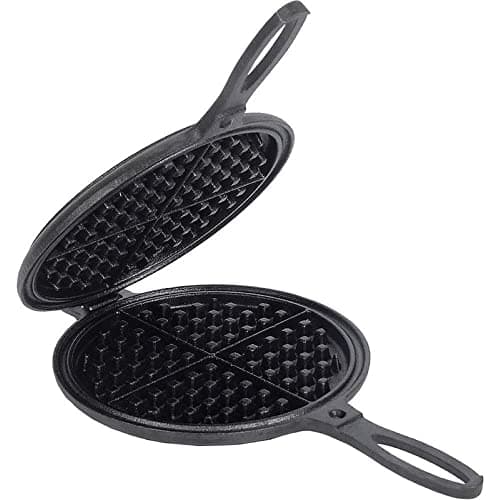
Buy an electric waffle maker if you want waffles on a Tuesday with no thought: it has a thermostat, it tells you when it is ready, and it is nearly impossible to get wrong. Buy a cast iron stovetop iron — the Lehman's two-piece 7-inch is the one to get — if you want a crisper, sturdier waffle with no coating to wear out, a tool that works on a campfire, and something you will still own in forty years. Those are the two honest cases, and which one is “better” depends entirely on whether you want an appliance or a pan.
Start from what each thing actually is. Wikipedia's waffle iron article describes the traditional iron as two hinged plates on tongs, held over an open flame or set on a stove, and the modern one as a self-contained tabletop appliance using electric heating elements controlled by internal thermostats, often with a light that goes out when it reaches temperature. It also notes the material split that matters for this decision: professional waffle irons are usually uncoated cast iron, while domestic models — particularly cast aluminum ones — are often Teflon coated.
What the electric iron genuinely does better
Three things, and they are not small. First, temperature control: a thermostat holds the plates at one temperature, batch after batch, with no judgment required from you. Second, the indicator light, which removes the only real skill in waffle-making — knowing when to pour. Third, both plates heat at once from the inside, so you do not have to flip anything, and a big Belgian-style iron can cook a thick, deep-pocketed waffle that a shallower cast iron iron will not.
For a household with children and a weekday schedule, that combination is worth a lot. We are not going to pretend otherwise just because our registry is full of iron.
What cast iron genuinely does better
Crust. Cast iron is dense and holds a large amount of stored heat, and thermal mass is exactly what browning wants: when cool batter hits hot iron the plate barely drops in temperature, so the surface sets and browns hard instead of steaming. That is the Maillard reaction getting the heat it needs, and it is why a cast iron waffle has a crisper shell and a sturdier structure that holds syrup instead of collapsing into it.
No coating to fail.A domestic electric iron's nonstick plates are usually PTFE, and a coating has a service life: scratch it, overheat it, or use it for a decade and it stops releasing. A cast iron iron's release comes from seasoning — polymerized oil you can always rebuild. One of these gets worse with age and one gets better.
It works without electricity. A stovetop iron cooks on gas, on an electric coil, on a camp stove, or straight over coals. The long-handled Rome Chuckwagon pattern exists precisely for a fire. If camp breakfast or power-cut cooking is part of your life, the electric is simply not in the running — see best cast iron for camping and enameled or bare cast iron for camping.
It will outlive the appliance. An electric waffle maker is an appliance with a thermostat, a cord and a coating, and all three eventually fail. A cast iron iron is a lump of iron.
The honest costs of going cast iron
You become the thermostat. There is no light, so you learn the pan: preheat on medium-low for a few minutes a side, test with a drop of water, and watch the steam at the seam — when it stops venting, the waffle is done. Expect to sacrifice the first waffle while you find your stove's setting; that is normal, and it is the same first-pancake tax we describe in best cast iron for pancakes.
You also have to flip the iron halfway through so the top plate cooks the other face, which is why these irons have hinges and long handles. And you have to care for it: a waffle iron's grid has far more surface area than a skillet, so it wants a well-built seasoning and a brush rather than a scrub. Lodge's own hand wash, dry, light oil routine applies here as it does to every bare iron piece. Our seasoning guide is the place to start, and why food sticks to cast iron covers the failure mode people blame on the iron when it is actually the heat.
| | Cast iron stovetop iron | Electric waffle maker |
|---|
| Temperature control | You judge it — no thermostat | Internal thermostat, usually with a ready light |
| Release surface | Seasoning you rebuild as needed | Usually a PTFE coating with a finite life |
| Heat source | Any stovetop, camp stove, grill or coals | A wall socket |
| Flipping | Required — that is what the hinge is for | Not required |
| Crust and structure | Crisper shell from stored heat | Softer, often thicker and deeper-pocketed |
| Service life | Effectively indefinite with care | Limited by coating, cord and thermostat |
The characteristics above come from the sources cited on this page and from the makers' own published specifications. We have not run plate-temperature tests — we do not have a lab, and our methodology says so plainly.
Which cast iron iron, if you go that way
We rank three stovetop irons below. The Lehman's two-piece 7-inch leads for everyday stovetop use because the separable design makes it far easier to clean and store than a fixed-hinge iron. The 8-inch thickened iron is the one to buy for bigger, deeper waffles. The Cococheers is the cheapest way in. If you want the full field, including the two long-handled Rome irons built for an open fire, that is our best cast iron waffle makers roundup, and the cast iron bakeware roundup covers the rest of the batter-and-oven family.
One thing we will not do is rank electric waffle makers. This site covers cast iron and carbon steel cookware; we do not review small appliances, and we are not going to pad a page with products we have no business having an opinion on. If the electric case above is the one that fits your kitchen, buy an electric iron from somebody who actually covers them.
If you only cook waffles twice a year, buy neither for now. A cast iron iron that lives in a cupboard will quietly rust, and an electric one takes up the same shelf for the same two mornings. Both are purchases for people who have decided waffles are a habit.
How to choose a stovetop cast iron waffle iron
Two-piece or fixed hinge
A two-piece iron separates into two plates, which makes washing, drying and re-oiling the grid vastly easier and lets both halves dry properly. A fixed-hinge iron is sturdier and usually cheaper, but you are cleaning into a closed hinge forever. For a stovetop iron used indoors, two-piece is the better daily tool.
Size, and what it does to the batter
Most stovetop irons make one 7-inch round waffle at a time; the thicker 8-inch pattern makes a bigger, deeper one. Neither is a Belgian-depth appliance waffle, and that is a real difference in the result, not a marketing one. If deep pockets are what you are after, an electric Belgian iron is the honest answer.
Handle length tells you what it is for
Short handles are for the stovetop. Long handles exist so you can hold the iron over coals without cooking your hand — the Rome Chuckwagon pattern is the classic. Buy the handle that matches where you will actually cook.
Seasoned or raw on arrival
A waffle grid has a lot of surface, and a raw one needs a real seasoning session before it will release — thin oil, high heat, repeated. A pre-seasoned iron still wants a couple of maintenance coats on the grid before the first batch. Either way, read how to season cast iron first and do it before breakfast, not during.
Heat it properly, then be patient
Preheat the closed iron over medium-low for several minutes a side. Too hot and the outside burns before the inside sets; too cool and the batter steams and sticks. Grease the grid lightly for the first few cooks even on a seasoned iron. If you want the physics of why preheating matters this much, see how to preheat cast iron.
Cleaning without wrecking the grid
Let the iron cool, brush the grid, rinse, dry it fully over low heat, and wipe a trace of oil in. Don't soak it, don't put it in the dishwasher, and don't attack it with steel wool — see chainmail vs steel wool for what to scrub bare iron with and what to keep away from it.