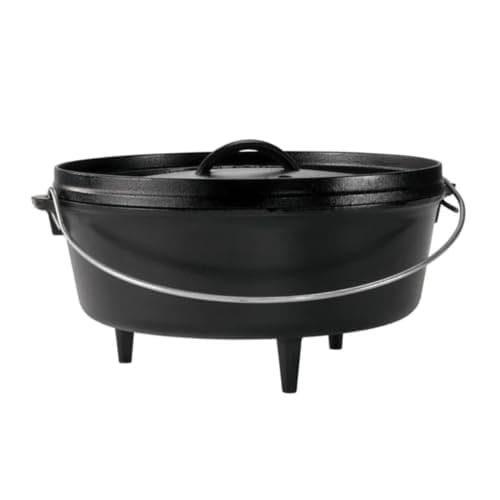
If you cook over a real fire, buy the 6-quart Lodge camp dutch oven: its three legs stand it over a bed of coals and its flat, flanged lid is built to hold coals on top, so heat comes from above and below and a campfire becomes an oven that bakes, braises, and roasts. It is the one piece of cast iron designed from the ground up for the outdoors.
Cast iron and open fire go together for a simple reason: bare iron does not care about direct flame, glowing coals, grit, or being dropped, and its thermal massholds a steady temperature outdoors where the "burner" is a gusty, uneven fire. A nonstick pan would be ruined by the first flare-up; a thin pan would scorch and warp. The trade is weight — cast iron is heavy, so this is car-camping and base-camp gear, not ultralight backpacking. Everything below assumes you are cooking near where you can park.
We ranked these five by how well each earns its weight in a real campsite, from the purpose-built camp oven to the everyday pieces that happen to be superb over a fire. If you are only cooking indoors, most of these are the wrong shape — start instead with our best dutch ovens and best skillets guides.
How the picks break down
| Piece | What it is | Best for |
|---|
| Lodge 6 qt camp dutch oven | Footed pot, flanged lid | Baking and braising over coals |
| Lodge combo cooker | Deep pan + skillet lid | Two pans in one, packs light |
| Lodge 10.25-inch skillet | The everyday skillet | Frying and searing over a fire |
| Lodge double dutch oven | Flat-bottom pot + skillet lid | Camp stove and grill-grate cooking |
| Rome Chuckwagon waffle iron | Long-handled waffle iron | Campfire breakfast |
Why the footed camp dutch oven wins
The Lodge 6-quart camp dutch oven is the piece the whole category is named after, and it is the one that does what no kitchen pot can: it cooks with fire above and below. The three cast legs lift the pot off the ground so you can rake a bed of coals underneath, and the lid is flat with a raised rim so you can pile more coals on top without them rolling off. That is the entire trick of Dutch-oven camp cooking — surround the food with even, radiant heat and you can bake bread, roast a chicken, simmer a chili, or turn out the classic cobbler that is practically the official campground dessert. A wire bail handle lets you lift it or hang it over a fire, and the whole thing is near-indestructible made-in-USA seasoned iron.
The honest knocks are the flip side of that design. The legs and flanged lid that make it brilliant outdoors make it clumsy on a flat home stovetop, so it is an outdoor tool first. It is heavy to pack. And managing coals top and bottom is a skill — your first camp bake involves some guessing before you learn the rough rule of thumb for how many coals give you what temperature. None of that is a defect; it is the price of turning a fire into an oven, and no other piece here does it.
Coals, roughly:the common starting point is to use about twice as many charcoal briquettes as the oven's diameter in inches, split with more on the lid than underneath for baking. It is a guideline, not a law — wind, air temperature, and your fire all move it. Bring more coals than you think you need.
The two-in-one that packs light: Lodge combo cooker
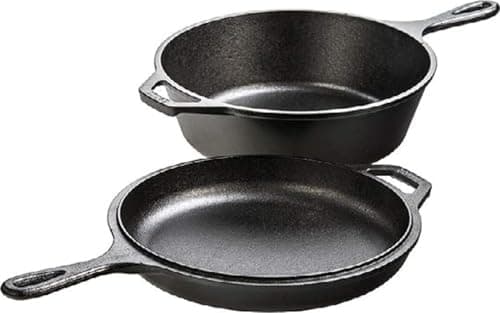
When you want to keep the load down, the Lodge combo cooker is the smart camp pick because it is two pans in one: a deep 3.2-quart pan and a shallow 10.25-inch skillet that doubles as its lid. That means one object cooks breakfast in the skillet, simmers a stew in the deep pan, and covers a one-pot dinner — the versatility of two pans at close to the weight and packed size of one. It has a flat bottom, so unlike the footed camp oven it also works fine on a camp stove or a home range. The trade is that it is not built to take coals on its lid the way the true camp oven is, so it is a stovetop-and-grill-grate tool, not a bury-in-the-fire baker.
The piece everyone needs: Lodge 10.25-inch skillet
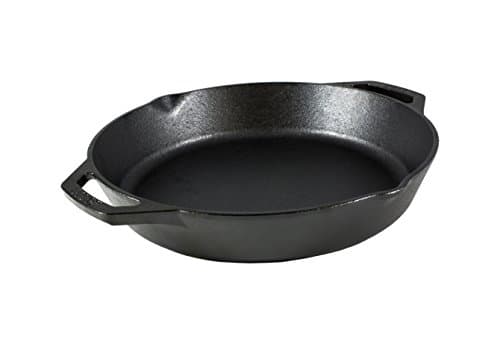
No camp kit is complete without a plain cast iron skillet, and the 10.25-inch Lodge is the default for the same reasons it is the default everywhere: it fries eggs and bacon, sears a steak, bakes cornbread, and shrugs off a campfire, for the price of a couple of restaurant breakfasts. Over a fire it wants a grate or a stable ring of stones to sit on, and a leather or silicone handle sleeve is close to essential because the whole pan gets fire-hot. It is the piece you will use every single morning of the trip.
The flat-bottom pot: Lodge double dutch oven
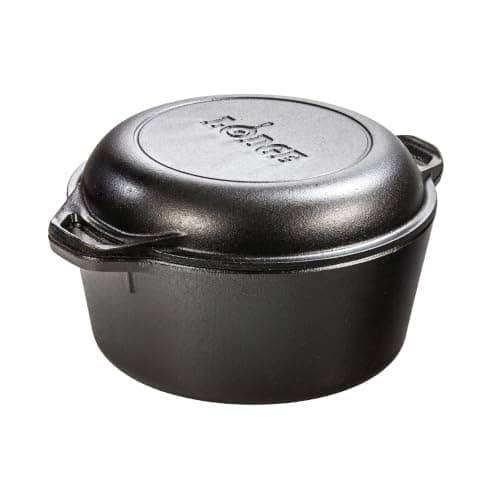
The Lodge double dutch ovenis the flat-bottomed cousin of the camp oven: a 5-quart bare pot whose lid is a full 10.25-inch skillet. Because the base is flat rather than footed, it is the better choice when you are cooking on a camp stove or a grill grate rather than directly in coals, and it comes home to double as a kitchen pot and an extra skillet. You lose the pile-coals-on-top baking ability of the true camp oven, but you gain a pot that is equally at home on a burner. If your camping is more "stove at the campsite" than "fire in a pit," this is arguably the more useful pot.
Campfire breakfast: Rome Chuckwagon waffle iron
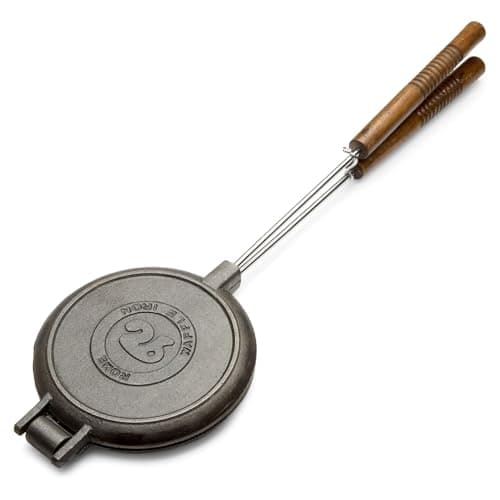
The Rome Chuckwagon is the fun one, and it earns its place: long 23-inch wood-and-steel handles hold a two-plate cast iron waffle iron out over the coals so you can bake a crisp waffle without roasting your knuckles, from a brand that has made around-the-fire cookware since 1964 and backs it with a 10-year warranty. It is a slow, social, one-waffle-at-a-time ritual rather than a fast way to feed a crowd — which is exactly the point of a camp breakfast. It is a specialist, but a genuinely delightful one; see our full best cast iron waffle makers guide for the alternatives.
How to choose cast iron for camping
Fire, coals, or camp stove?
This decides the shape. If you cook directly in a fire or on coals and want to bake, you want a footed camp dutch oven with a flanged lid. If you cook on a camp stove or a grill grate, a flat-bottomed pot and skillet are the better tools — legs get in the way on a flat burner. Many people carry one of each: the camp oven for fireside baking, a skillet for the stove.
Size and weight are the real limit
Cast iron is heavy, so this is car-camping gear. A 6-quart camp oven feeds a family or a small group and is about the largest most people want to lift full and hot; a 4-quart is plenty for two. Do not over-buy capacity you then have to haul — the piece you actually carry beats the enormous one you leave at home.
Seasoning, and keeping it alive outdoors
Every piece here is bare iron, so it arrives pre-seasoned and needs the usual care, with one camp-specific wrinkle: it is easy to leave a pan wet in a damp campsite, and wet iron rusts. Wash with hot water, dry it fully over the dying fire or the stove, and wipe on a thin film of oil before it goes back in the box. If a pan does surface-rust between trips, it is completely rescuable — see how to remove rust from cast iron. The full routine is in how to season cast iron.
The accessories that actually matter
A camp dutch oven is far easier to use with a lid lifter (a hook to lift a coal-covered lid without dumping ash into the food) and a pair of heat-proof gloves; a skillet wants a handle sleeve. A small folding trivet keeps a hot pot off the ground. None of that is strictly required, but a lid lifter in particular turns coal-baking from awkward to easy.
When not to bring cast iron
If you are backpacking and counting grams, leave it home — cast iron's weight is the deal-breaker, and titanium or thin steel is the answer there. Cast iron is the right call when you can drive to the site, when you want to bake and braise over a fire, and when you want gear that survives being used hard and handed down. For the indoor version of this kit, see our best cast iron cookware guide.