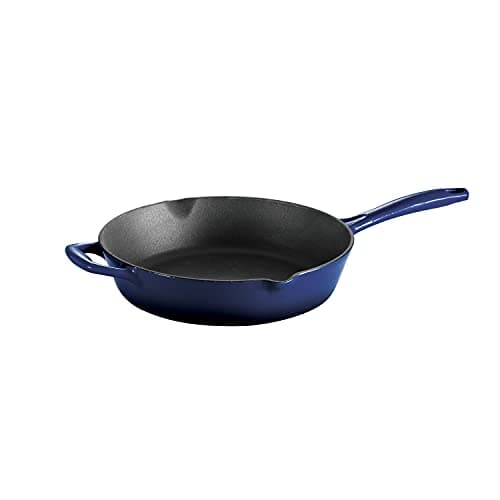
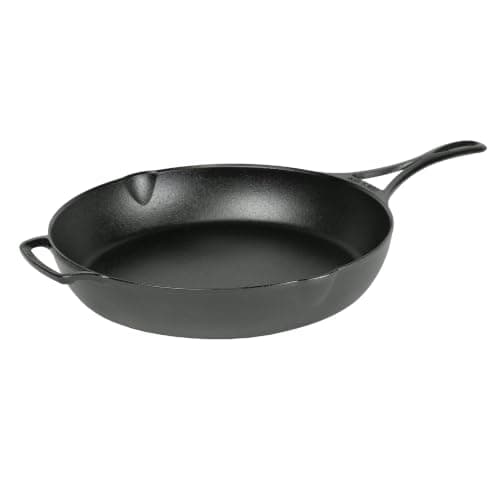
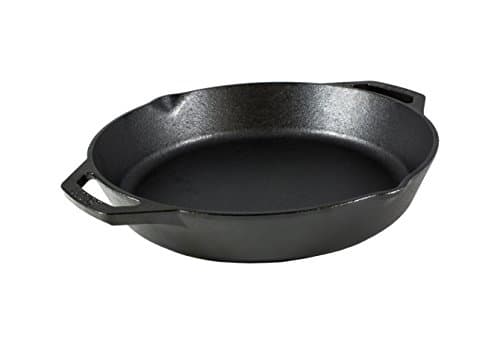
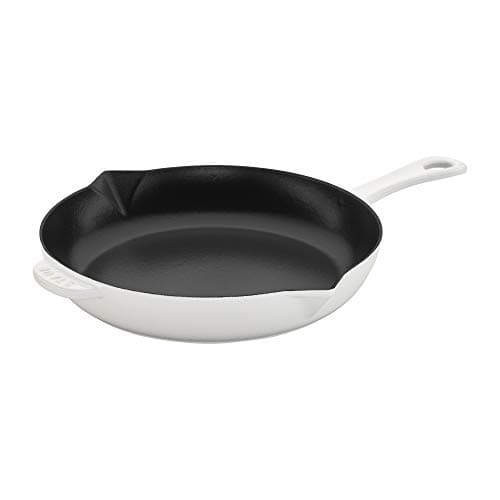
The best Le Creuset skillet alternative is the Staub 10-inch enameled fry pan, best for a cook who wants the French enameled skillet from the other French maker. The budget pick is the Tramontina 10-inch enameled, best for anyone trying an enameled skillet before committing. And the most useful thing on this page may be the uncomfortable one: if you wanted a pan that sears hard and releases a fried egg, an enameled skillet of any badge is the wrong tool, and a bare Lodge at a tenth of the price is the right one.
This is a different question from the one our Le Creuset alternatives page answers. That page is about the pot. The skillet is its own decision, because an enameled frying pan is a stranger object than an enameled dutch oven: it is bought for the same reasons and used for completely different ones.
What the Le Creuset Signature skillet is known for
Four published things, taken from Le Creuset's own Signature Skillet page, read as we wrote this.
The interior enamel.“The interior surface is finished with a black satin enamel” — a tougher, darker vitreous enamel than the pale sand-colored interior on the brand's pots, chosen precisely because a frying pan takes more abuse than a braising pot does.
No seasoning, ever.“Ready to use, requires no seasoning.” That is the central promise of enameled iron and it is entirely true: there is no break-in, no drying ritual, no rust, and no reaction with an acidic pan sauce. Le Creuset's own care guidance is dishsoap-and-water simple by comparison with bare iron.
Oven range and warranty.“Oven-safe up to 500°F” and a “Limited Lifetime Warranty”. The warranty is not decoration — it is a meaningful part of what the price buys, and so is the resale value that follows from it.
French manufacture, in four sizes.The pan is “individually crafted by French artisans”, with France as the listed country of origin, and it comes in 6.33, 9, 10.25 and 11.75 inches. Le Creuset shows a $150-$275 range across those four sizes rather than a price per size, so this page does not quote one for the 11.75-inch.
The brief an alternative has to meet
That gives four tests: a hard, non-reactive enameled cooking surface that never needs seasoning; enough oven range to finish a roast or a frittata; iron underneath it, so the pan actually holds heat; and a maker you would trust to honor a problem. Two pans below meet all four. Two deliberately fail the first one, for a reason that is worth half this page.
Matching it on enamel: Staub and Tramontina
Staub is the straight swap. It is the other French enameled cast iron house — now part of Zwilling — and its dark matte interior enamel is its signature: it hides the marks a pale interior shows, browns food well, and never needs seasoning. Honest cons: enamel is not naturally non-stick the way seasoned iron is, so eggs and delicate fish want enough fat, and it is a heavy pan with one long handle and a short helper. Our Le Creuset vs Staub page argues the pair in full.
Tramontina is the value answer, and it is a genuine one rather than a knockoff. Tramontina is a large Brazilian manufacturer, not a badge on someone else's casting, and its enameled 10-inch skillet cooks much the way the French pans do for a fraction of the money. What you give up is finishing and hardware refinement, and the long-term enamel durability that is exactly what a lifetime warranty is insuring. For finding out whether you want an enameled skillet at all, it is the right purchase. Our is Tramontina worth it page makes that case at length.
The bare-iron answer, and when to take it
Here is the part a merit roundup has no reason to say out loud. A large share of people shopping for an enameled skillet are buying it for the wrong job.
An enameled surface is glass. It is wonderful for a tomato-and-wine pan sauce, for a frittata, for anything acidic, and for a cook who refuses to maintain a pan. It never becomes slick the way a polymerized-oil seasoning layer does, so a fried egg is a struggle in any of them, Le Creuset included. If what you actually pictured was a hard sear and an egg sliding out, the alternative is not a cheaper enameled pan. It is a bare one.
The Lodge Blacklock is the version of that with the fewest compromises: lighter than traditional Lodge iron, triple seasoned at the foundry so it starts closer to slick, and cast in Lodge's own Tennessee foundries. Its honest cons are that thinner walls store less heat than a classic Lodge of the same diameter, and that Lodge makes no machined-surface claim for it.
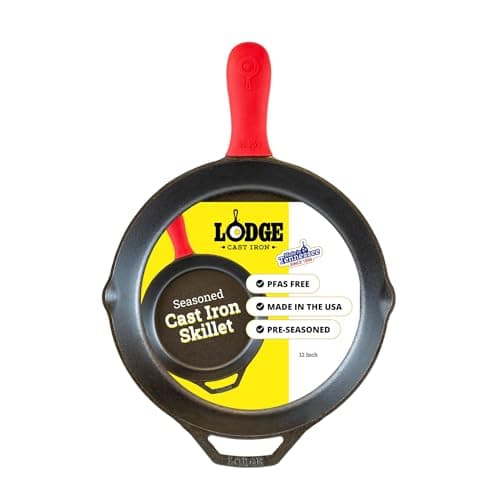
If you are specifically replacing the 11.75-inch Signature skillet, the Lodge 12-inch is the size match and the cheapest sensible swap on this page: more searing room than any 10-inch, a published roughly 8 lb that makes one-handed tossing a non-starter, and a silicone handle holder in the box. The classic 10.25-inch is there as the control: it is the most useful single size in cast iron, it costs about what a large pizza does, and it will outlive the pan you are comparing it with. Our enameled vs bare cast iron page is the decision in full, and if what you want is a premium bare pan with a polished interior rather than a glazed one, the best Smithey alternatives is the roundup for that.
What none of these fixes
Weight, and the warranty. Every pan here is cast iron under whatever is on top of it, so all of them are heavy, all of them have metal handles that get hot, and none of them is a pan you toss one-handed. And none of the cheaper picks carries anything like Le Creuset's limited lifetime warranty or its resale value. If the badge, the warranty and the color are a meaningful part of why you want the pan, buy the pan — an alternatives page cannot talk you out of those, and it should not try.
Decide the surface before the brand
Enameled or bare is the real fork, and it decides more than price does. Enamel: no seasoning, acid-safe, soap-and-water, never truly non-stick. Bare: builds its own slick surface, sears harder, costs a fraction, and needs drying and a wipe of oil. Everything on this page is one or the other, and a cook who picks the wrong side will be unhappy with a $230 pan. Our enameled vs bare cast iron page is the short version.
Match the size, not the brand
Le Creuset publishes four sizes for the Signature skillet — 6.33, 9, 10.25 and 11.75 inches — and the alternatives are not all offered in the same spread. The Staub and the Tramontina here are 10-inch pans, which replaces the 10.25-inch Le Creuset, not the 11.75. For the big one, the Lodge 12-inch is the closest match on this page. Our skillet sizes guide explains why a flared pan's flat cooking area is always smaller than the number on the box.
Chips, and why an interior chip is different
Enamel is glass fused to iron, so it chips rather than wears. A chip on the rim or the outside is cosmetic; a chip inside the cooking surface exposes bare iron under a glaze that cannot be repaired at home, and that pan should be retired from acidic cooking. This is the one real durability risk the cheaper enameled pans carry more of, and it is worth knowing before you choose on price alone — our chipped enamel guide has the detail.
The limits of what we can tell you
We have not cooked side by side on these pans and we do not run a test kitchen. The Le Creuset figures above are quoted from its own product page, read on the date in the sources list, including the fact that it publishes a price range across four sizes rather than a figure per size. Every price on a pick comes from the live Amazon API with an as-of date under the table, and our methodology page states plainly that our scores are judgments from published specifications and owner reports, not lab measurements.