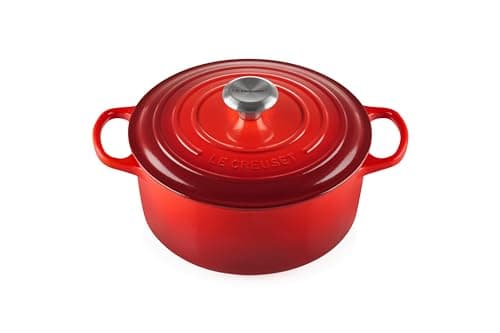
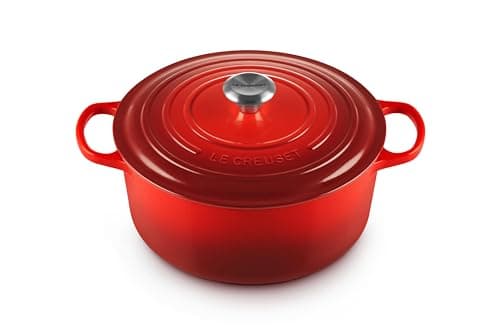
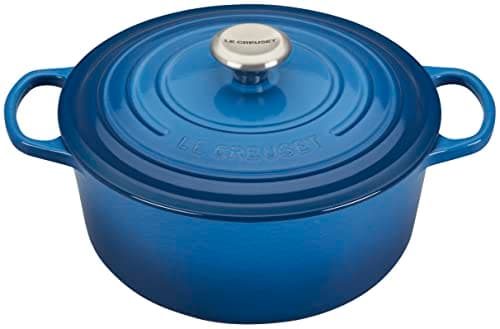
With Le Creuset the pot is a known quantity — the only real decision is the size. For most households the 5.5-quart round is the sweet spot: big enough for a family stew, a whole chicken or a large boule of bread, without being unwieldy. Size down to the 4.5-quart for a lighter everyday pot, up to the 7.25-quart if you batch- cook or entertain, or to the 2.75-quart if you cook for two. All of them are the same heirloom-grade pot with a lifetime warranty. And all of them cook a braise a Lodgematches for a third of the price — so buy Le Creuset for the object and the warranty, not for a better dinner.
Le Creuset has poured enameled iron at its Fresnoy-le-Grand foundry since 1925 (the company history walks the timeline), and the pot's cooking comes down to physics that do not vary with the color or the badge: a heavy iron body that holds a low, even simmer via its thermal mass, and a tight lid that traps moisture. What the Le Creuset premium genuinely buys is a harder, more chip-resistant enamel, larger and more comfortable handles, a light sand-colored interior you can read the fond in, a 500°F-safe knob, a lifetime warranty and real resale value. Those are real things — they are just not cooking things, which is exactly what our is Le Creuset worth it guide is for.
Size is the whole decision
Because every size is the same well-made pot, choosing a Le Creuset is really choosing a capacity. The 5.5-quart is the default for a reason: it is the most useful single size for a family and the one most recipes assume. The 4.5-quartis the underrated pick — nearly as capable, noticeably lighter and easier to lift, ideal for two-to-four cooking. The 7.25-quart is for batch-cooks and entertainers, but it is a heavy, two-armed pot most nights. The 2.75-quart is a genuine two-person pot or a second small vessel. Our dutch oven size guide and 5 vs 7-quart comparison go deeper on matching capacity to your household.
Round or oval, and which color
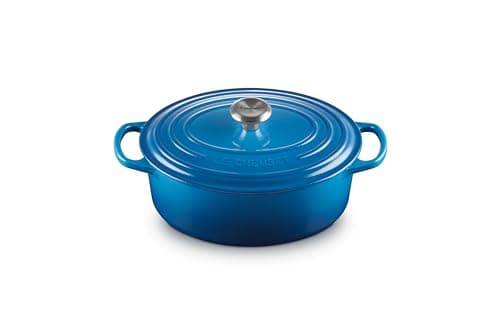
After size, the only other real choices are shape and color, and neither is a cooking decision. A round pot heats evenly over a round burner and suits bread and most cooking; an ovalis a niche shape for long roasts and whole birds that overhangs the flame and heats a touch less evenly. For a first pot, buy round — our round vs oval guide explains why. Color is pure aesthetics: every enamel shade cooks identically, so buy the one you will be happy to see on the stove for the next thirty years, and do not pay a premium for a limited-edition hue you like no better.
Why a Le Creuset lasts, and the honest caveat
The reason a Le Creuset commands its price is longevity backed by a lifetime warranty: the enamel is hard and chip-resistant, the hardware is built to outlast you, and the resale value is real if you ever move one on. Treat it gently — wood or silicone tools, no thermal shock, no empty high heat — and it becomes the pot a family hands down. The light interior will stain to a tea-brown over years, which looks like wear and is not; it wipes back with a little baking soda. The honest caveat remains: none of that is a cookingadvantage over a good budget pot. You are buying an heirloom object with a warranty, and if that is what you want, the Le Creuset is a wonderful thing to own; if you just want the braise, spend a third as much and eat just as well.
How to choose a Le Creuset dutch oven
Pick the size for your household, not the biggest
A 5.5-quart suits most families; a 4.5-quart is the lighter everyday choice; go to 7.25 only if you routinely cook for a crowd, and to 2.75 for one or two. A pot too big for your cooking is heavy and mostly empty, and it lives in the cupboard.
Round for versatility, oval for long roasts
A round pot heats evenly and suits bread and most cooking; Le Creuset also makes ovals for long roasts, at the cost of slightly less even heating. For a first pot, round is the more versatile choice — see round vs oval.
Color is cosmetic; the warranty is not
Every color cooks identically, so buy the shade you love. What genuinely differs from a budget pot is the enamel hardness, the hardware, and the lifetime warranty and resale value — the reasons to buy Le Creuset at all, laid out in are expensive dutch ovens worth it.
Or buy the value pot and pocket the difference
Be honest with yourself: if you want the cooking and not the object, a budget enameled pot braises, bakes and simmers nearly identically for a fraction of the price. There is no shame in it, and the food will not know the difference.