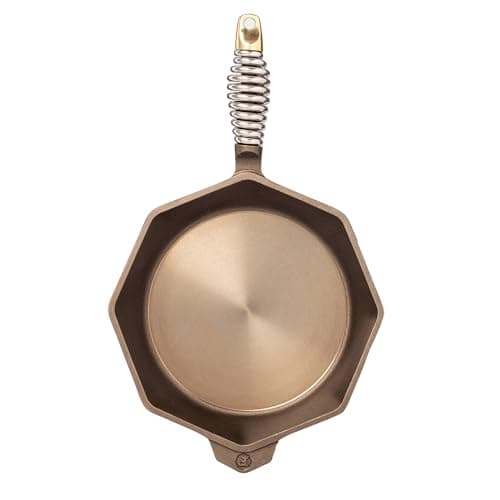
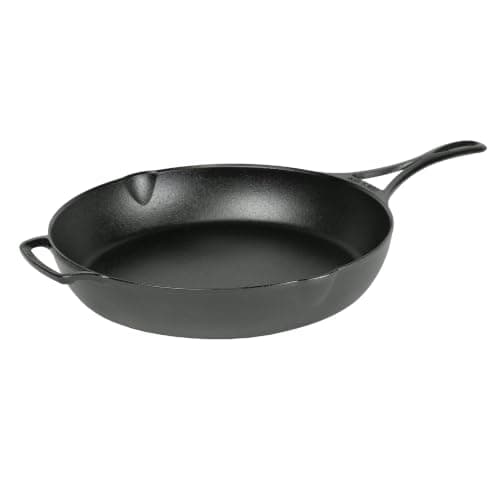
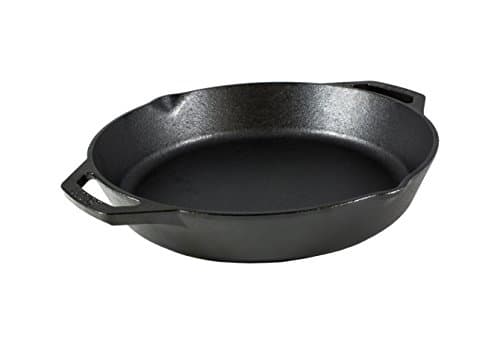
Buy the Lodge. Finex and Lodge are the same company — Lodge announced its acquisition of the Portland, Oregon maker in August 2019, the first acquisition in its 123-year history, with the CEO describing it as entry into the luxury cast iron cookware segment — and that word, luxury, is the honest summary of the difference. Both pans are American-cast iron with the same thermal mass and the same searing behavior. What Finex sells on top of that is design: an octagonal body with pour spouts at its corners, a coiled stainless spring handle, and a finer finish than a standard Lodge. Those are real, pleasant things. They are not performance.
That makes this an unusually clean comparison, because there is no hidden technical trade-off to uncover. The question is not which pan cooks better. It is whether you want to spend luxury money on a kitchen tool, and that is a legitimate thing to want — we just refuse to dress it up as a cooking upgrade.
The companies, and why they are now one company
Lodge was founded in 1896 by Joseph Lodge, and most cast iron Lodge sells is produced in its foundry in South Pittsburg, Tennessee. It is the volume manufacturer of American cast iron and the reason a lifetime-grade skillet costs about as much as a takeaway meal.
Finex is a far younger thing: founded in 2012 and based in Portland, Oregon, it arrived in the modern wave of American boutique smiths alongside Smithey, Stargazer, Field and Lancaster, all founded within a few years of each other. Where the others competed on a machined-smooth cooking surface, Finex competed on form: the octagon and the spring handle are its signature, and nothing else in the category looks like it.
In August 2019 Lodge bought it. Finex's sales, marketing and small-scale production stayed in Portland; most manufacturing moved to Lodge's Tennessee facility, and the brand continues with its headquarters in Portland. So when you weigh Finex against Lodge today you are weighing two lines from one firm, mostly cast in the same state. That is worth knowing before you pay a premium for a different company.
Difference 1: the cooking surface
A standard Lodge has an as-cast surface. It comes out of a sand mold, which leaves the faintly pebbly texture every Lodge owner knows, and the factory seasons it from there. Finex casts to a finer finish and pre-seasons with flaxseed oil, so it releases food more readily early in its life.
That early-life gap is real and it is temporary. The working non-stick layer on any bare pan is seasoning — a stick-resistant coating created by polymerized oils and fats, and it builds with use on both pans until the texture underneath stops being the deciding factor. A Lodge you cook on for a few months behaves very much like a pan that started smoother. This is the single most important thing to understand before paying for finish, and we make the same argument at more length in smooth vs rough cast iron.
One honest clarification: Finex is finer than a standard Lodge, but it is not the same proposition as a milled pan. Stargazer publishes that its cooking surface is CNC-machined. If a glassy machined interior is specifically what you are shopping for, Finex is not the pan that delivers it — see the best smooth cast iron skillets.
Difference 2: the shape, and whether the spouts matter
The octagon is Finex's whole identity. Because the body is many-sided rather than round, the corners act as pour spouts, so you can drain rendered fat or pour a sauce from several directions without rotating the pan in your hand. Retailer listings do not agree on how many of those corners count as spouts, so we are not going to put a number on it — what matters practically is that there is more than one, and a round Lodge has none at all.
Is that useful? Mildly, and more often than you would guess. Draining bacon fat into a jar, pouring off a deglazed sauce, tipping browned butter over a steak: all of them are easier with a spout than without. Is it worth the price difference by itself? No. But it is the one functional advantage Finex has over a round pan, and it deserves to be named rather than dismissed.
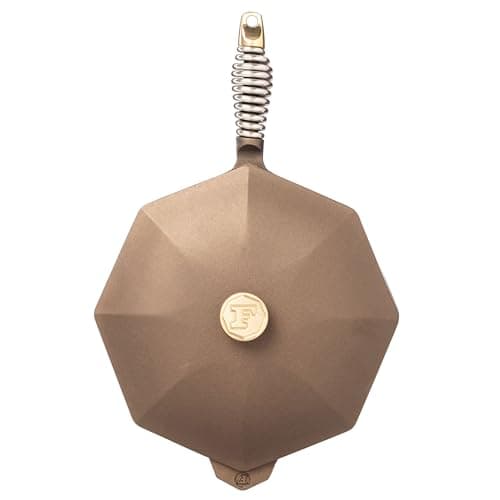
The octagon costs you something too. A many-sided pan does not nest with round pans, lids designed for round pans do not fit it, and the flat faces are slightly awkward against a round burner ring. None of these are serious. All of them are the sort of thing you notice in week three.
Difference 3: the handle
This is the Finex feature that converts people. The handle is a coiled stainless spring rather than a solid bar of cast iron, and the stated reason is heat: a coil has far less mass in contact with the hot pan body than a cast handle does, so it stays usable longer and cools faster. Finex calls it Speed Cool. In practice it is genuinely more pleasant to hold than a bare Lodge handle, and it looks like nothing else on a stove.
It is not magic, and nobody should read “cool handle” as “bare-handed.” Any handle attached to a 400-degree pan gets hot, and a pan that has been in the oven is hot all over. The honest framing is that it buys you a margin, not immunity.
The Lodge counter-argument is a leather or silicone handle sleeve for a few dollars, which solves the same problem differently and comes off for oven work. That is the trade in miniature: Finex engineers the problem away and charges for it; Lodge leaves it to a cheap accessory.
Difference 4: weight, and the thing most reviews get backwards
The modern boutique pitch is usually “lighter and smoother than a Lodge.” Finex is the exception: it casts thick, and its pans are among the heaviest in their sizes. Our registry entry for the 8-inch puts it at around 4.2 lb, which is a lot for a small pan.
So if your reason for leaving Lodge is weight — a real and very common reason — Finex is the wrong direction entirely. The pans that answer that complaint are the thin-cast boutique skillets and, much more cheaply, Lodge's own Blacklock line, which Lodge engineers to be lighter than its traditional iron and triple-seasons at the foundry. It is the honest middle of this comparison, and it is covered in our Blacklock review and the best lightweight cast iron skillets.
Weight is not purely a downside. More iron means more stored heat, and a thick pan recovers temperature faster when you drop cold food into it. Finex's mass is a genuine cooking asset; it is just paired with a genuine handling cost, and only you know which side of that you fall on.
Difference 5: price, and what you are buying with it
The gap is large — a multiple, not a percentage. Check the live prices in the cards above rather than trusting any number written into prose, because these move. What that money buys, stated plainly:
- Design. The octagon and the spring handle. A pan people comment on.
- Finish. A finer surface and a flaxseed pre-season, so better release in the first months.
- Pour spouts. The one functional win.
- Mass. More stored heat, at the cost of a heavier pan.
What it does not buy: a better sear, a more durable pan, a longer life, or a surface that stays ahead of a well-used Lodge. Both are cast iron cookware, and both will outlive you. We put the same argument across every price bracket in are expensive cast iron skillets worth it. The manufacturing side of the same question — how the cheap pan can possibly be this cheap — is why Lodge cast iron is so cheap.
Where Finex is the right answer
Three cases, and they are real:
You want the object. Some people want beautiful tools and get daily pleasure from them. That is a sufficient reason to buy a Finex, and anyone who tells you it is irrational is pretending cookware is purely functional. Buy it knowingly, not because a review implied it cooks better.
You are buying a gift that should feel like a gift. A Lodge is the better pan to give someone who will use it hard and the worse pan to unwrap. A Finex is an occasion.
You want a covered pan that is also a centerpiece.The 12-inch comes with a matching cast-iron lid, so it works as a shallow braiser and a covered roaster as well as a skillet. It is also the heaviest pan in this comparison by a distance — two hands, always.
Where Lodge is the right answer
Nearly everywhere else, and specifically:
It is your first cast-iron pan. Learn the material on a cheap pan. If the ritual sticks, upgrade with real knowledge of what you want; if it does not, you are out very little. This is the core argument of is Lodge worth it.
You cook hard and often. A pan you are not precious about gets used more, and a used pan seasons better. Lodge invites abuse in a way a luxury pan does not.
You need more than one size. For the price of one Finex you can own a Lodge 8-inch, a 10.25-inch and a 12-inch and still have money left. Three sizes beat one beautiful pan for almost every real kitchen.
You want American-made iron on a budget. Both qualify, but only one does it at twenty-odd dollars. See the best American-made cast iron.
The verdict
Buy Lodge unless you specifically want the design object. It cooks the same, costs a fraction, and is the pick on the best cast iron skillets for that reason.
Buy Blacklockif your actual complaint about Lodge is weight or the as-cast texture. It is lighter and starts slicker, at a fraction of boutique money — and Lodge makes no machined-surface claim for it, so neither do we.
Buy Finex if you want the octagon, the spring handle and the spouts, and you are buying them with your eyes open. It is a lovely pan. It is not a better pan.
If you are weighing Finex against the other boutique names rather than against Lodge, that comparison is Finex vs Smithey, and the pure value question is is Finex worth it.
How to decide, in five questions
1. Is this your first cast-iron pan?
If yes, buy the Lodge and stop reading. Nobody should learn seasoning, preheating and heat management on a pan they are afraid to scratch. Come back to the boutique question in a year, when you know from experience which part of the experience you want improved.
2. What is your actual complaint about Lodge?
Be specific, because each complaint has a different answer. If it is texture, a few months of cooking fixes it for free, and a machined pan fixes it instantly — which is Stargazer or Smithey, not Finex. If it is weight, Finex is heavier, not lighter; Blacklock or a thin-cast boutique pan is your answer. If it is the handle, a sleeve costs a few dollars. If it is how it looks, that is the one complaint only Finex answers.
3. Will you pour out of it?
The corner spouts are Finex's one functional edge. If you regularly save bacon fat, pour off a sauce, or baste with browned butter, you will use them more than you expect. If you mostly sear and serve from the pan, they are decoration.
4. How many pans do you need?
Cast iron rewards owning a few sizes more than owning one nice one. An 8-inch for eggs, a 10.25-inch for everything, a 12-inch for a family: that trio costs less than one luxury pan and covers more cooking than any single pan can. If your budget is fixed, spend it on coverage.
5. Can you lift it comfortably, loaded and hot?
This is the question people skip and regret. A thick 12-inch pan with a cast-iron lid is a real lift, and a pan that intimidates you gets left in the cupboard. Weigh the heaviest size you are considering against your own wrists before you buy, not after.
One thing that applies to both
Whichever pan you choose, it is bare iron: dry it promptly, keep a thin film of oil on it, and do not leave it wet in the sink. Our how to season cast iron guide is the same for a $25 pan and a luxury one, because the chemistry does not care what you paid.