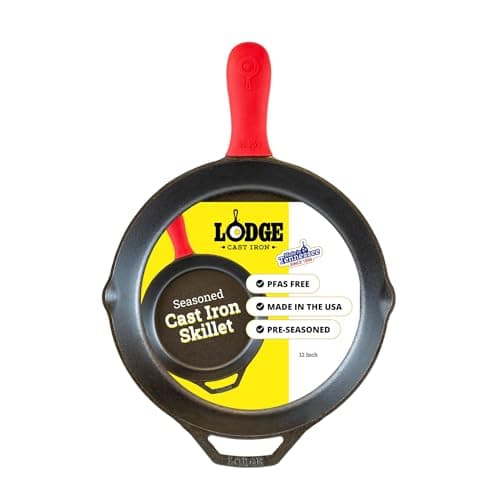
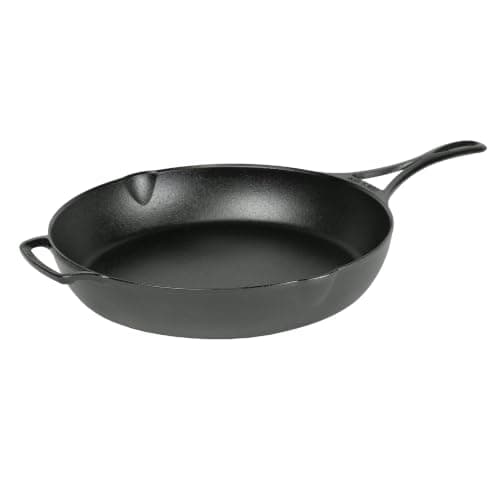
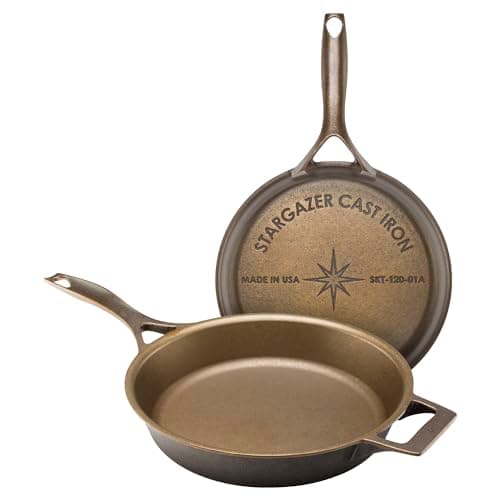
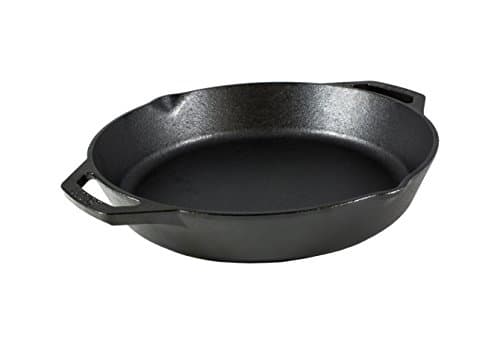
Lodge is cheap for three reasons, and none of them is the metal. First, scale: Lodge has been casting since 1896 and now runs two foundries in the same Tennessee town, so the fixed cost of a foundry is spread across an enormous number of pans. Second, automation: it says it was the first American company to use a Disamatic molding machine on U.S. soil, in 1965, and vertical molding of that kind is specifically the technology that its maker says has offered the lowest cost-per-casting for medium-to high-volume production. Third, finishing: a Lodge is sold with the surface it came out of the sand with, and the boutique pans are not. Same iron, radically different process cost.
This is a question people ask suspiciously, and the suspicion is reasonable — in most categories a tenth of the price means a tenth of the product. Cast iron is one of the few places where it genuinely does not, because the material is commodity gray iron and nearly all of the price difference between a cheap pan and an expensive one is machining, casting weight and brand. Below is each reason, in order of how much it actually saves.
Reason 1: volume, and two foundries in one town
Lodge is not a small company making a boutique object. Its own history page says Joseph Lodge started the Blacklock Foundry in 1896, that a fire in May 1910 led to the company being “reborn down the road” as Lodge Cast Iron, and that it currently operates two foundries in South Pittsburg, Tennessee. The second of those, a 127,000-square-foot facility it calls the 3rd Street Foundry, opened in late 2017 and raised manufacturing capacity by 75%.
A foundry is an enormous fixed cost: furnaces, molding lines, sand handling, pouring, cleaning, a seasoning line. Divide that cost by a few thousand pans a year and each pan carries a large share of it. Divide it by millions and each pan carries very little. That is the whole of reason one, and it is why a company founded in the nineteenth century can undercut a company founded in 2015 without cutting a single corner.
It is also why most cast iron Lodge sells is produced in its foundry in South Pittsburg, Tennessee and still competes on price with imported cookware. American manufacturing is not inherently expensive; small-batch American manufacturing is.
Reason 2: automated molding, since 1965
Every bare cast-iron skillet starts as a sand casting: a mold is formed in sand, molten iron is poured in, the sand is broken away. The cheap part is the sand, which is reusable. The expensive part is the labor of making the molds — unless a machine makes them.
That is exactly what Lodge bought into early. It credits itself as the first American company to use a Disamatic molding machine on U.S. soil, in 1965. Disamatic is a vertical molding system, and DISA, the company that makes it, says vertical molding “produces hard, accurate moulds at outstanding speeds”, that its lines reach “up to 555 moulds per hour without cores”, and that the technology has “offered the lowest cost-per-casting for medium-to high-volume production” for decades. Those rates are the machine maker's figures for its current lines, not a published figure for Lodge's output — we do not have Lodge's production numbers and will not invent them. The point stands at the level of principle: an automated line removes most of the per-mold labor from the most labor-intensive stage of making a skillet.
Sixty years of a head start on that automation is a real competitive moat, and it is most of why nobody has undercut Lodge on price.
Reason 3: the surface is left exactly as cast
This is the one that most directly explains the gap between a Lodge and a boutique pan, and it is the one most buyers misread as a quality shortfall.
A sand mold leaves a faintly pebbly texture on the metal. Modern pans are sold either as-cast or with a machined cooking surface. Lodge sells as-cast: the pan you get has the texture the sand gave it. The boutique makers machine it away — Stargazer publishes that its cooking surface is CNC-machined, and that its pans are cast, machined, finished and seasoned in Allentown, Pennsylvania.
Machining is slow, it is done one pan at a time, it needs tooling and skilled setup, and it throws away metal you already paid to melt and pour. It is a genuinely expensive step. Removing it is the single biggest saving in the whole comparison.
Is the machined surface better? Out of the box, yes — food releases earlier in the pan's life. Permanently, no, and this is the part worth internalizing: the working non-stick layer on any bare pan is seasoning, a stick-resistant coating created by polymerized oils and fats, and that layer builds on a Lodge until the texture underneath stops deciding how food behaves. You are paying to skip a few months of cooking. We lay the whole argument out in smooth vs rough cast iron.
Reason 4: Lodge invented its way out of the other expensive step
There is a fourth saving that is easy to miss, because it now looks like an industry standard rather than an advantage. Lodge credits itself with being the first to season cast iron in its own foundry, and says “the process was finalized, and Lodge debuted seasoned cast iron” in 2002, an industry first.
Before that, a bare pan arrived bare and the buyer did the seasoning. Doing it on a line, at the end of the casting process, as part of the same run, is far cheaper than any other way of doing it — and it is why a Lodge arrives seasoned with 100% natural vegetable oil and ready to cook. It was a cost innovation that turned into a usability feature, which is the best kind.
What is NOT cheaper about a Lodge
This is the part the question usually gets wrong. The savings are all process. Specifically, none of the following is true of a Lodge:
- Thinner or inferior iron. Lodge pans are not light. They have the same thermal mass as comparable pans and hold heat just as well; modern pans in general are cast thicker than pre-war ones, Lodge included.
- A coating that wears out. There is no non-stick film to fail. The surface is iron plus the seasoning you maintain, which gets better rather than worse.
- A shorter life. A Lodge outlives its owner with basic care. Vintage Lodge from the mid-twentieth century is still in daily use, which is the only durability test that counts.
- Offshore manufacturing of the bare iron.The bare cast iron is American. Lodge's enameledline is made overseas, and we say so on every enameled page — that is a real distinction and we do not blur it.
- Worse searing. A crust comes from a hot, dry, heavy pan. A Lodge is a hot, dry, heavy pan.
So what does a premium pan actually get you?
Four things, all real, none transformative:
A machined surface, so better release in the first months of ownership.
Less weight,on the thin-cast boutique pans — the upgrade most cooks actually notice day to day. Worth knowing: not every premium pan is lighter. See Finex vs Lodge, where the luxury pan is the heavier one.
Better handles and balance, which on a heavy pan matters more than it sounds.
An object you enjoy owning. A legitimate thing to buy, as long as nobody sells it to you as a cooking upgrade.
If you want the cheapest route to the first two, it is not a boutique pan at all — it is Lodge's own Blacklock line, which Lodge engineers to be lighter than its traditional iron and triple-seasons at the foundry. Lodge makes no machined-surface claim for it, so neither do we. Our Blacklock review covers it, and Lodge Classic vs Chef Collection vs Blacklock puts the three Lodge tiers side by side.
Does cheap mean low quality here?
No, and this is the one place we will be blunt. “Cheap” in cast iron means a mature manufacturer with amortized equipment selling a simple product at volume. There is no corner to cut in a cast-iron skillet that would not be immediately obvious: it is one piece of metal with no coating, no mechanism, no electronics and no consumable parts.
The honest criticisms of Lodge are narrow and we make them on the product cards above: the as-cast surface needs a few months of use before it is truly slick, the standard handle is short and gets hot, and the 12-inch is genuinely heavy. Those are trade-offs, not defects. The full case is in is Lodge worth it, and the whole range is reviewed on our Lodge brand page.
The verdict
Lodge is cheap because of sixty years of automated volume molding, two foundries carrying their fixed costs across a very large number of pans, a cooking surface left exactly as it comes out of the sand, and a foundry-seasoning process it developed itself. Every one of those is a process saving. None of them is a material saving.
Which is why the recommendation across this whole site keeps landing in the same place: buy the Lodge, cook on it for a season, and only then decide whether the things a premium pan fixes are things that bother you. Most people find they do not. If you want to see what each bracket buys before you spend, read are expensive cast iron skillets worth it.
What to do with this information
Buy the 10.25-inch first, whatever your budget
The price is low enough that the usual budget logic does not apply: you are not compromising to save money, you are buying the pan a majority of experienced cast-iron cooks reach for daily. If the ritual sticks, you will know exactly what you want from a second pan. If it does not, you have lost very little.
Expect to build the surface, not receive it
A new Lodge is slightly grabby. That is the as-cast texture, and it is normal. Cook fatty food in it for the first few weeks — bacon, burgers, anything that renders — and keep a thin film of oil on it after every wash. Within a couple of months it behaves like a much more expensive pan. Our how to season cast iron guide is the whole routine.
Budget for a handle sleeve, not a better pan
The most common genuine complaint about a Lodge is the handle: short, and it gets hot. A leather or silicone sleeve costs a few dollars and fixes it, and it comes off for oven work. That is a far better use of money than upgrading the whole pan over one grip. Our accessory picks cover it.
Size before finish
If you have money to spend beyond the first pan, spend it on a second size before you spend it on a smoother surface. An 8-inch for eggs and a 12-inch for a family cover far more cooking than one beautiful 10-inch ever will. See cast iron skillet sizes.
Know which Lodge line you are buying
Lodge sells three bare-iron tiers and they are not the same product. Classic is the as-cast workhorse. Chef Collection is a refined casting with a better handle. Blacklock is the thinner, lighter, triple-seasoned line. And the enameled pots are a separate line made overseas. The comparison is in Lodge Classic vs Chef Collection vs Blacklock.
Do not read price as a proxy for quality in this category
It works in most categories and it fails badly in this one. The honest ladder in cast iron runs: as-cast volume pan, then thinner or better-seasoned volume pan, then machined small-batch pan, then design object. Performance barely moves across that ladder. Convenience and pleasure do.