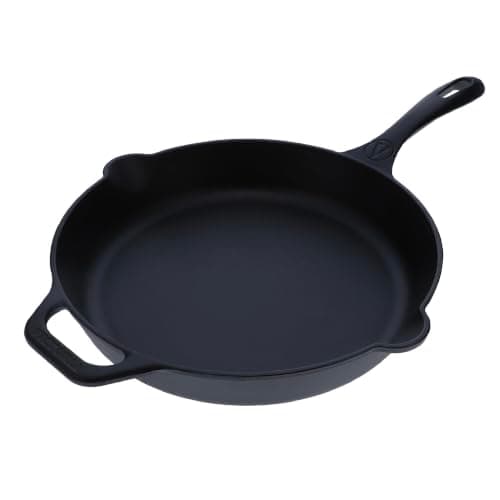
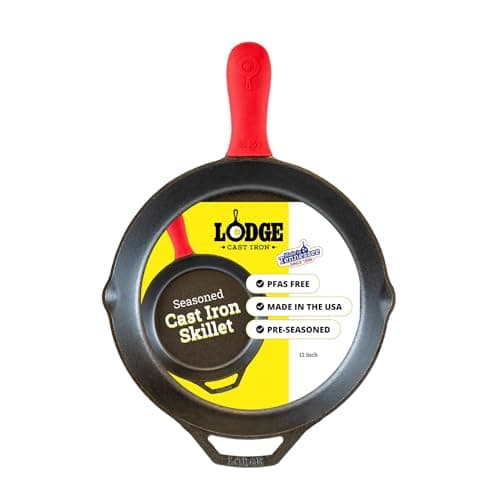
Buy the Lodge if you want the safest default — decades of consistent casting, the widest support network, and a resale of parts and accessories nobody else matches at the price. Buy the Victoria if its longer, angled handle and its flaxseed factory seasoning appeal to you, because it sits at essentially the same price and is a genuine value, not just a cheaper pan. Both are pre-seasoned, both are pebbly rather than machined smooth, and both will outlive you with basic care. This is a close call decided by handle feel and brand trust, not by cooking.
Lodge and Victoria play the same game: a heavy, honest, pre-seasoned cast-iron skillet at a price almost anyone can justify. Lodge is the American default, made in Tennessee since 1896; Victoria is made in Colombia and has built a following as the value challenger. Neither is a premium pan — if you want a machined-smooth surface, that is a different tier entirely, covered in the Field versus Stargazer comparison. Between these two, the decision is smaller and more personal than the internet makes it sound.
The handle is the real difference
The most cookable difference between them is the handle. Victoria's is long and angled, which gives you more leverage and keeps your hand a little further from the heat — genuinely more comfortable to lift a heavy, full pan. Lodge's standard handle is shorter and stubbier; a silicone or leather sleeve closes most of the gap and is a near-essential add-on either way. If you have wrestled a full 12-inch skillet off a back burner and disliked it, the Victoria handle is a real, everyday improvement.
Seasoning and surface
Victoria seasons its pans with flaxseed oil, a drying oil that polymerizes into a hard film, so a Victoria can start a touch closer to a slick, release-ready surface out of the box. Lodge uses a vegetable-oil seasoning that is a little thinner from the factory. In practice this evens out within a few weeks of cooking — both pans are pebbly, not smooth, and both reward you for building your own seasoning on top. Neither will fry an egg like a boutique pan on day one, and both will get impressively close with use. The full picture is in how to season cast iron.
| Lodge 12" | Victoria 12" |
|---|
| Handle | Short, stubby | Long, angled (more comfortable) |
| Factory seasoning | Vegetable oil | Flaxseed oil |
| Made in | USA | Colombia |
| Surface | Pebbly cast | Pebbly cast |
| Reputation | Decades of consistency | Credible value challenger |
Consistency and support
Where Lodge pulls ahead is boring and important: consistency. Across a huge production run, Lodge's casting quality and finish are remarkably even, and its enormous US presence means accessories, replacements and answers are always a click away. Victoria's casting is a notch below Lodge's in owner reports — still good, occasionally less even — and its support network is smaller. If you value the certainty that the pan you order will be as good as the last one, that is Lodge's quiet advantage.
So which should you buy?
For most people, Lodge remains the safe default, and it is the pan we anchor the best cast iron skilletsaround. Choose Victoria with a clear conscience if the longer handle sells you and the price is the same — it is a real value, not a compromise. Whichever you pick, buy the size you will actually reach for: a 12-inch is a family pan, while a 10.25-inch is the everyday default for one or two people.
What they share: weight, care and lifespan
For all the small differences, these two pans are far more alike than not. Both are heavy bare iron with real thermal mass, so both sear beautifully and both are genuinely heavy to lift when full — a 12-inch of either brand is a two-hand pan for many cooks. Both need the same simple care: a hot rinse, dry on the burner, a wipe of oil, and no long soaks or dishwasher. Both take and hold seasoning the same way, and both will, with basic upkeep, outlast the person who buys them. Neither is fragile, neither is fussy, and neither will let you down.
That shared foundation is exactly why the choice comes down to handle feel and brand trust. You are not choosing between a good pan and a bad one; you are choosing between two good pans that cook the same, so buy the one whose handle you prefer and whose reputation reassures you, and put the saved energy into seasoning it well.
Either way, buy for the size, not the badge. A 12-inch skillet that lives in the cupboard because it is too heavy to bother with is worse than a 10.25-inch you use daily. Both brands make every size; pick the one that fits your cooking.