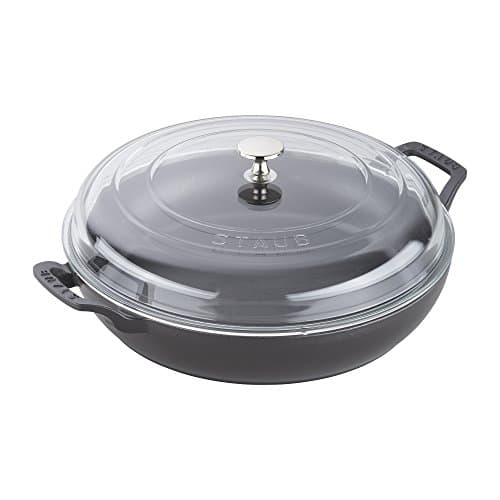
The best Le Creuset braiser alternative is the Staub 3.5-quart braiser, best for a cook who wants the identical shape in French enameled cast iron for less. The budget pick is the Lodge 3-quart enameled dutch oven, best for one or two people who want a non-reactive pot and will live with taller walls. And if what you actually need is the braiser’s wide lidded footprint rather than its enamel, the Lodge 5-quart covered deep skillet does that job in bare iron for roughly a sixth of the original’s suggested price.
People search for a braiser alternative for one reason, and it is a reasonable one. Le Creuset publishes a suggested retail price of $400.00 to $460.00 for the Signature Round Braiser, across the 3.5-quart and 5-quart sizes, on its own product page. That is a lot of money for a pot you may use once a week, and it is worth being precise about what you would be replacing before you replace it.
What the Le Creuset braiser is known for
Four things, all of them published by the company itself rather than inferred by us.
First, the geometry. Le Creuset describes a wide base that “allows ingredients to be placed in a single layer for searing without crowding”, and a domed lid that “circulates steam to lock in moisture and flavor” once liquid is added. That is the whole design brief of a braiser in two clauses, and it is the part an alternative has to reproduce.
Second, the material and the provenance. The same page states enameled cast iron, country of origin France, and cookware “individually crafted by French artisans from the finest quality materials since 1925”. Third, the handling claim: Le Creuset publishes “lightest weight cast iron by quart on the market”, which is a real differentiator in a category where everything is heavy. Fourth, the ownership terms — compatible with all cooktops, oven-safe to 500°F, dishwasher-safe, and a limited lifetime warranty, with care guidance that the enamel interior needs no seasoning.
None of that is marketing fluff and none of it is in dispute here. If you want the full argument about whether the premium is worth paying, that is is Le Creuset worth it, and our Le Creuset brand page covers the range. This page is for the reader who has already decided to look elsewhere.
What a braiser actually does, and why the shape is rare
Braising is a two-stage method: brown the food in fat at high heat, then finish it covered, at low heat, in a small amount of liquid that does not submerge it. Both stages make demands. The browning stage wants surface area, because a tough cut that goes into the pot pale never recovers and crowding steams it instead of searing it. The covered stage wants a heavy pot and a lid that sends condensed moisture back down onto the food rather than out of the pan.
A wide shallow pot with a domed lid does both. The reason you cannot find one for forty dollars is that the shape is inefficient to make and to ship — it is a large-diameter casting for a small volume, so you pay for a lot of iron and a lot of enamel per quart of capacity, and it packs badly. Tall pots are the opposite, which is why the budget end of enameled cast iron is almost entirely round dutch ovens. That single economic fact shapes this entire page: every alternative below the Staub gives up some width, some enamel, or some capacity, and the ranking is about which of those you can most afford to lose.
The like-for-like: Staub
The Staub braiser is the only pick here that is the same object as the original: wide, shallow, enameled cast iron, made in France, in the same 3.5-quart size Le Creuset sells as its three-to-four-serving braiser. Its dark matte interior enamel browns aggressively and hides stains, which is a genuine difference from Le Creuset’s light-colored interior — Le Creuset’s own page makes the case for the light enamel, that it “allows easy monitoring of cooking progress”, and both arguments are true depending on whether you care more about watching a sauce reduce or about not seeing every stain.
The real trade is the lid. Staub puts glass on this one, so you can watch a braise without lifting it, and glass caps the oven temperature you can use and can fail on thermal shock in a way a solid cast iron lid will not. If your braises live at 325°F that is irrelevant. If you want a lidded pot that will also take a 500°F oven for bread, it is not. Our Le Creuset vs Staub comparison takes the two brands apart properly, and best Staub alternatives is the mirror image of this page.
Trading enamel for width: the bare-iron route
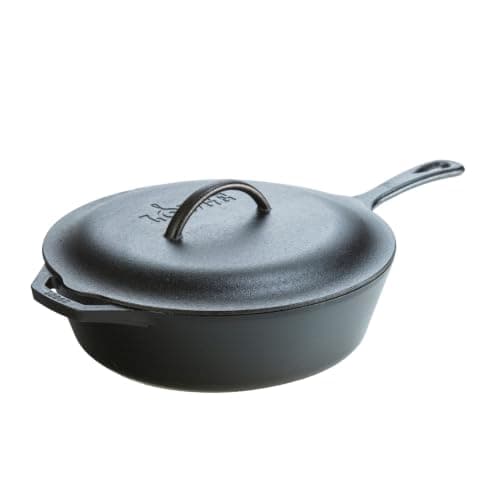
The Lodge 5-quart covered deep skillet is the pick that most people underestimate. It is a wide, lidded cast iron pan with a solid iron cover and a genuinely large footprint, made in the USA, at a small fraction of the braiser’s suggested price. For the browning stage it is arguably better than any enameled pot on this page, because thick bare iron holds its temperature when cold food lands in it and there is no enamel layer between the food and the metal.
What you give up is the enamel itself, and that is not a small thing for this particular job. Bare iron is protected by a polymerized-oil seasoning layer that acid eats, and a great many braises are acidic — wine, tomato, vinegar, cider. A two-hour wine braise in a bare pan will strip seasoning and can leave a metallic edge on the sauce. It also needs drying and re-oiling after every wash, and it is heavier than the shape suggests. Buy it if your braises are stock-and-aromatics rather than wine-and-tomato, or if you are happy to keep the acidic ones for an enameled pot. Our enameled vs bare cast iron page is the full version of that decision.
Trading width for enamel: the small enameled pot
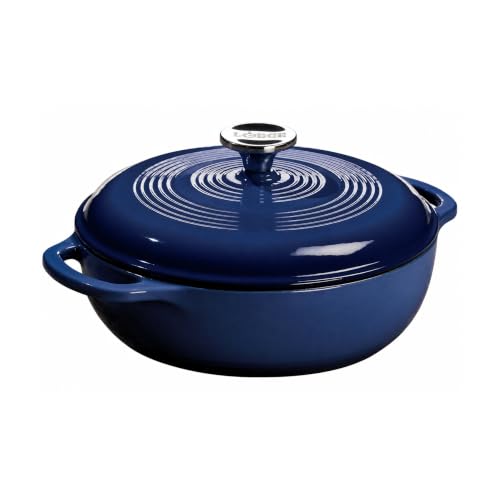
The Lodge 3-quart enameled dutch oven is the budget pick, and it is a deliberate swap of the braiser’s best feature for its material. You get a non-reactive interior that needs no seasoning, a knob rated for the oven temperatures Lodge publishes for its enameled line, and roughly the same capacity as the smaller Le Creuset braiser, for the least money of anything here.
What you lose is the single-layer searing room, because the volume is in the height rather than the width. In practice that means browning in two batches and accepting that the pot steams a little more than a wide one does. For one or two people cooking chicken thighs or a small shoulder, that is a perfectly reasonable trade. For a flat single layer of short ribs it is the wrong shape, and our dutch oven vs braiser page explains exactly where the line falls.
The big-batch answer
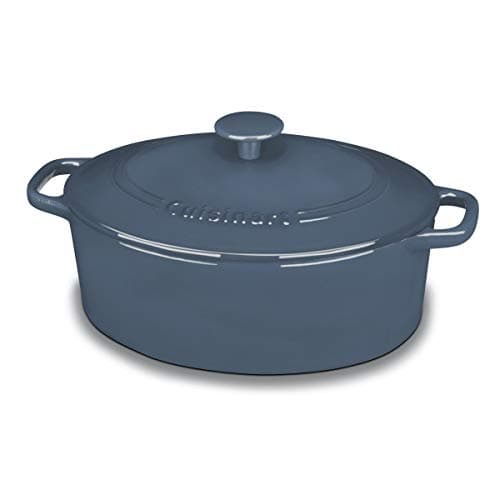
If the reason you were looking at a braiser is that you cook for six, none of the 3-quart options is right and the Cuisinart 7-quart oval casserole is the pick. An oval is the shape for a long cut — a whole chicken, a rolled shoulder, short ribs laid end to end — and at seven quarts it swallows a roast that would not physically fit in a 3.5-quart braiser. It is enameled, induction-ready and oven-and-broiler-safe to 500°F, with a lifetime warranty against defects.
It is also a thinner casting than the French pots, which means slightly less even heat and less retained heat once it is off the burner, and the enamel is more chip-prone over years. That is the honest shape of a value pot. If the oval is what you want, best oval dutch ovens ranks that field, and round vs oval settles which one your cooking wants.
The cheapest trick: the combo cooker
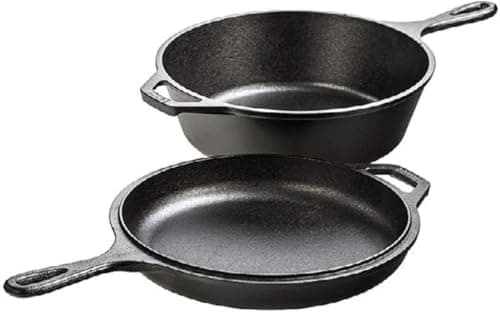
The Lodge Combo Cooker is not a braiser and we are not going to pretend it is. It is a 3.2-quart deep pan with a 10.25-inch skillet that doubles as its lid, sold for sourdough. Used the other way up, though, it is the only cheap thing in cast iron that gets the braiser geometry right: sear in the shallow skillet, invert the deep pan over the top as a domed cover, and you have a wide base under a tall lid for less than a fifth of the original’s suggested price.
The limits are real. It is bare iron, so the acid problem applies. The skillet half is shallow enough that a generous braising liquid will reach the rim. And 3.2 quarts is one or two servings of a braise, not a dinner party. But as the cheapest honest way to find out whether you like cooking this way before committing hundreds of dollars, it has no competition — and it is the best-value piece of cast iron this site ranks, for completely different reasons, on best dutch oven for sourdough.
What none of these match
Three things, and you should know them before you buy a substitute. Le Creuset publishes the lightest cast iron by quart on the market, and nothing here claims to beat it — the bare-iron picks are frankly heavier. Le Creuset’s limited lifetime warranty and its color range are part of what the money buys, and the value pots offer narrower versions of both. And the light interior enamel that lets you watch a sauce reduce is specific to Le Creuset among the picks on this page; Staub deliberately goes the other way.
If after all of that the original is what you want, buy the original — that is a legitimate outcome of reading an alternatives page, and our braiser ranking includes it. We would rather you spend more and be happy than buy a cheaper pot in the wrong shape.
How the prices on this page work
Every live number here comes from the Amazon listing at the date stamped under the comparison table, never from a figure typed into our files. The one price we quote in prose — the $400.00 to $460.00 range for the Le Creuset braiser — is the suggested retail price published on Le Creuset’s own product page, read on the date this page was written, and it is quoted because the original is the thing this page is measured against. Street prices for all of these move; check the stamp.