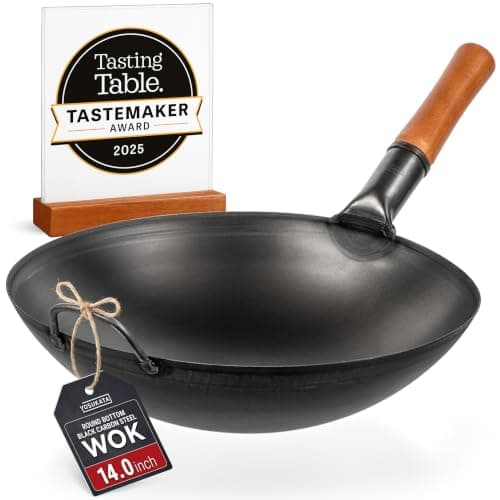
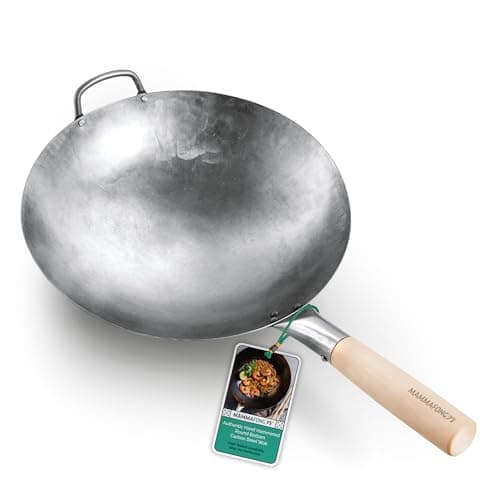
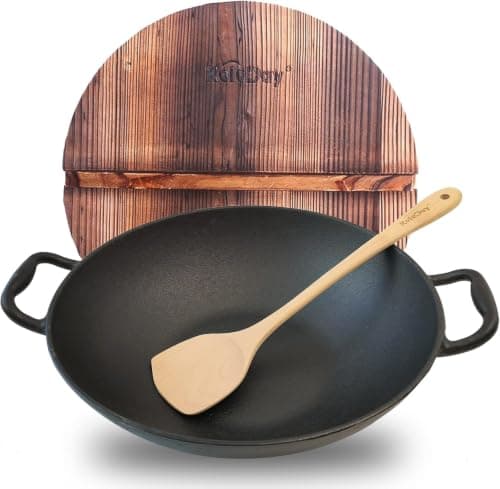
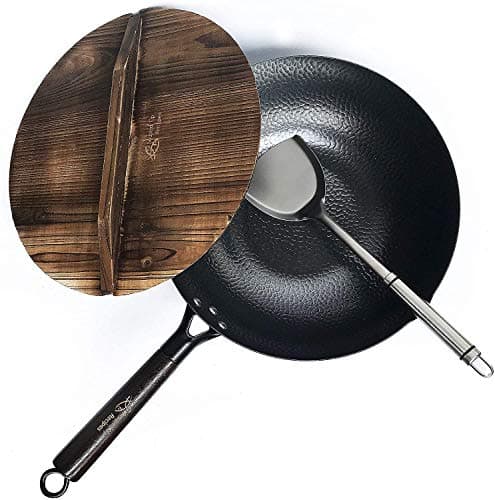
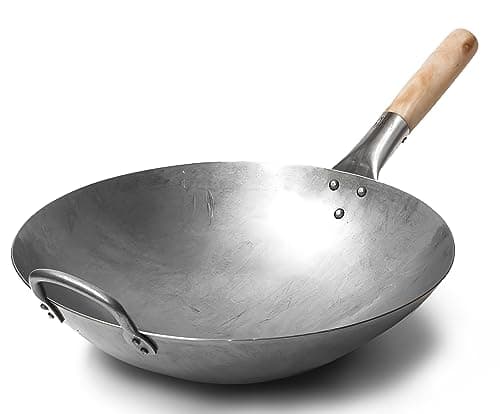
On gas, buy a round-bottomed carbon steel wok: the Craft Wok 14-inch hand-hammered is the pick, best for a cook who wants a real wok and will season it themselves. The budget pick is the Keleday 14-inch cast iron wok, best for a cook who wants a lid and a low price and does not care about weight. Everyone cooking on glass or induction has to buy a flat-bottomed compromise; a gas ring is the exception, so if you have gas, this is the one cooking decision where you get to buy the original shape.
Why gas is the one burner a round wok works on
A wok is not a deep frying pan. It is a vessel built around a single hot point at the very bottom, with walls that climb away from the heat so that the constant tossing and stirring a stir-fry depends on has somewhere to toss things to. Food that is done gets pushed up the side, out of the fierce zone, while the next handful goes into the pool. That only works if the hot pool is genuinely small and genuinely hot.
A flat electric or induction hob can only heat what touches it, so a round base on glass makes contact at a coin-sized point and wobbles. A gas flame does not care about contact: it wraps the curve. Put a wok ring on the grate and the pan sits down into the flame, which heats the bottom third of the bowl instead of a disc. That is the whole reason the glass-top wok page ranks completely different pans from this one: there, flatness is the single non-negotiable spec, and here it is a downgrade.
Carbon steel or cast iron on a gas ring
Both work, and they fail differently. Carbon steel is steel with carbon as its main alloying constituent and essentially no chromium, so it rusts and it takes a polymerized-oil seasoning layer exactly the way bare cast iron does. The difference is thickness. A spun carbon steel wok is thin, so it heats in under a minute, drops temperature the instant you add cold food, and climbs straight back up — which is precisely the responsiveness a stir-fry wants. A cast iron wok has far more thermal mass, so it takes several minutes to come up and then holds that heat stubbornly. That is wrong for a fast stir-fry and right for shallow-frying or for keeping food hot at the table.
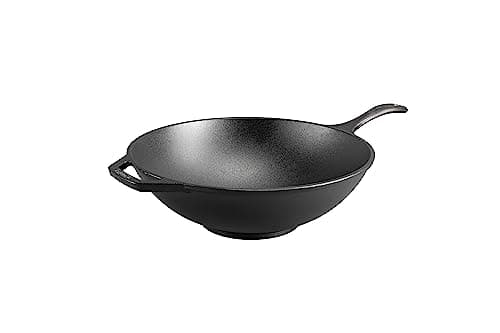
If you have never cooked in a wok before and want it to behave like a wok, buy carbon steel. If you already own cast iron, like the weight, and mostly plan to fry rather than toss, the Lodge Chef Collection cast iron wok is the lighter of the two iron options we carry. Our cast iron wok vs carbon steel wok comparison takes that argument apart properly.
Hand-hammered, spun, or pressed
Hand-hammered woks — the Craft Wok and the Mammafong here — are beaten into shape, which leaves shallow dimples all over the inside wall. Those dimples are not decorative: they give you a lip to brace food against when you push it up the side, and they are the traditional finish for a reason. A spun or machine-pressed wok like the pre-seasoned Yosukata has a smooth interior, which is slightly easier to clean and slightly more slippery to work in. Neither affects how hard the pan sears.
The real divide is seasoning. An unseasoned carbon steel wok arrives with a protective factory coating that has to be scrubbed off and replaced with your own seasoning before you cook in it — a genuine first-evening job, not a five-minute one. A pre-seasoned pan skips that, at the cost of starting with someone else's base layer. Our how to use a wok guide covers the first-cook sequence either way.
Size: 14 inches, and why not 12
Four of the six picks here are 14-inch woks, which is the standard home size and the smallest that still gives you a genuinely cool upper wall. A 12-inch wok has so little side that food you push out of the way is still in the heat, which turns a stir-fry into a crowded saute. Go smaller only if your burner grate is genuinely tiny or you are cooking for one — and in that case the 12.5-inch flat-bottomed Souped Up is the one to take, because it is also the pick that survives a move to an induction kitchen.
What a gas ring cannot fix
Home gas burners put out a fraction of a restaurant wok range, and no pan closes that gap. The practical consequence is batch size: a single 14-inch wok on a domestic ring will char a portion for two beautifully and steam a portion for five into a gray, steamed mess, because the browning reaction that makes a stir-fry taste like a stir-fry needs the pan to stay above the boiling point of the water coming out of the food. Cook in two batches. That is a technique fix, not a buying fix, and no wok on this page will rescue an overloaded pan.