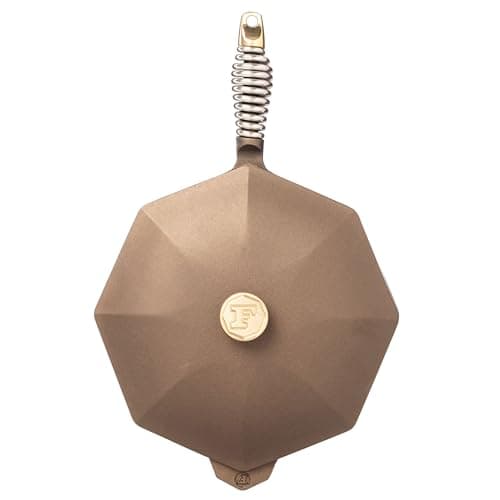
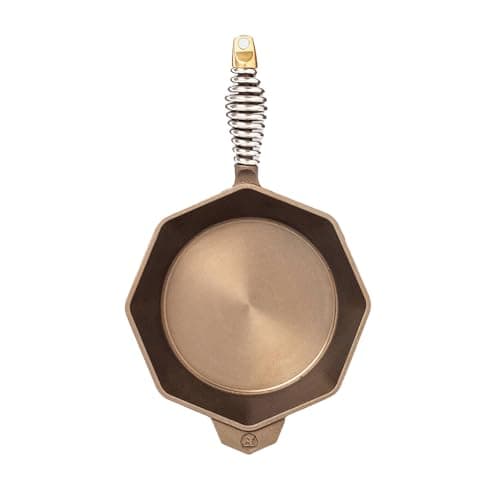
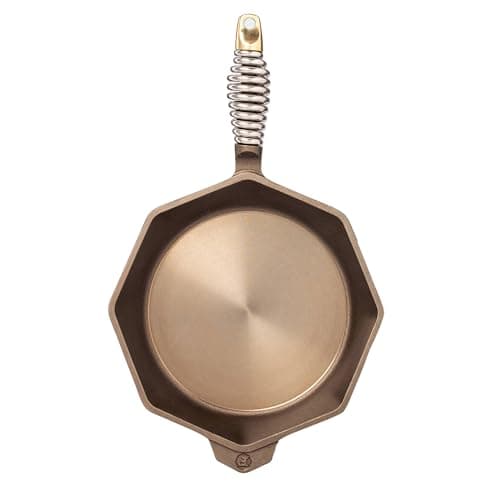
Finex makes the most distinctive-looking cast iron you can buy — a patented octagonal pan with eight pour spouts and a coiled stainless spring handle — and it is among the priciest and heaviest iron on the market. If you want a skillet that is also an object, and the price does not scare you, a Finex is a joy to own. If you want the best pan for the money, that is still a Lodge. Finex is a design-led luxury, and to its credit it does not pretend the octagon makes food taste better.
We cover the three octagonal skillets here — the 8-inch, the 10-inch and the 12-inch (which ships with a matching cast-iron lid). They are the same pan in three sizes, and the decision between Finex and everything else comes down to one question: do you want the design, and will you happily carry the weight to get it?
The octagon is not a gimmick
Finex's signature is a patented eight-sided shape. In practice, the eight corners become eight little pour spouts, so you can tip fat into a can or pour a pan sauce from whatever side faces you without rotating a heavy pan over the stove. It is a small, genuinely useful thing, and it is the rare piece of cookware design that is both a look and a function (Finex's own history walks through how the shape came about). The octagon also gives the pan more straight edge to press a spatula against than a perfect circle does.
The cooking surface is finer than a modern Lodge's pebbly cast finish, and every Finex arrives pre-seasoned with organic flaxseed oil, so it releases food reasonably well from the start. It is not the mirror-machined glass of a Smithey, and it does not need to be — like any bare iron, a Finex only gets slicker the more you cook on it.
The Speed Cool spring handle
The other thing you notice immediately is the handle. Instead of a solid cast loop, Finex fits a coiled stainless-steel "Speed Cool" spring — inspired by old wood-stove door handles — that dissipates heat and stays comfortable to hold longer than a bare iron handle. It is a real ergonomic upgrade and part of why the pan feels like a designed object rather than a commodity casting. The brass accents are pure jewelry, and unapologetically so.
The weight is the honest trade-off
Here is the thing the marketing photos do not tell you: a Finex is heavy. Finex casts thick, so its pans are among the heftiest in their size — the little 8-inch weighs around 4.2 pounds, more than a Lodge of the same diameter and far more than a featherlight Field. Add the cast-iron lid to the 12-inch and it is a genuine two-hands-always pan. That mass is wonderful for a steady, even sear and for holding heat, but it is the opposite of the light, toss-and-flip character that Stargazer and Field built their pans around. If a heavy pan is a problem for your wrists, this is not your skillet.
Reality check:the Finex advantage is design, finish and feel, not cooking ability. The physics of the sear — store heat, dump it into the food — is the same in a $25 Lodge. You are buying an heirloom object you will enjoy owning for decades, not a better-tasting steak. If that trade sounds right to you, it is a lovely pan; if it does not, spend a tenth as much and cook exactly as well.
Where the price lands
There is no soft-pedaling it: Finex sits at the top of the price range, a large multiple of a Lodge and, size for size, generally dearer than Field or Stargazer — especially the 12-inch, whose included cast-iron lid pushes it well past the others. You are paying for the patented design, the spring handle, the made-in-USA manufacturing and the object itself. None of that is a con so long as you know what you are buying. It is a con only if you were told the octagon cooks better, and we will not tell you that.
A short history: Portland, Kickstarter, then Lodge
Finex was founded in Portland, Oregon in 2012 by Mike Whitehead, who reverse- engineered his favorite vintage pans and worked with a designer to arrive at the octagon. A 2013 Kickstarter blew past its goal, and the brand built a following as a design-forward American cast-iron maker in the smooth-and-thin tradition of pre-war foundries like Griswold. In 2019, heritage giant Lodge acquired Finex and moved production to its Tennessee foundry — the pans are still 100% made in the USA, and Lodge wisely left the octagon, the spouts and the spring handle exactly as they were.
Living with a Finex: seasoning and care
Under the design, a Finex is bare cast iron, so it lives by exactly the same rules as any other seasoned pan — nothing about the octagon or the spring handle changes the routine. It arrives seasoned with flaxseed oil and works out of the box, then like any bare iron it gets slicker the more you cook fat into it. Cook, rinse warm, dry thoroughly on the burner, wipe a whisker of oil, and it will outlive you; our seasoning guide and cleaning guideapply to it unchanged. The one Finex-specific note is the spring handle: it stays cool longer on the stovetop, but it is still metal, so in a hot oven it heats up like the pan — use a mitt, the same as you would with a bare Lodge handle.
Two small practical things worth knowing. First, the eight-spout octagon means there is no single "lip" to rest a splatter screen or a round lid on cleanly — if you want a lid, buy the matching Finex one (the 12-inch here already includes it). Second, the thick, heavy casting that makes a Finex hold heat so well also makes it slow to change temperature: give it a couple of extra minutes to preheat, and do not expect the quick responsiveness of a thin carbon- steel or aluminum pan.
Beyond the skillet: the rest of the range
Finex is best known for these octagonal skillets, but the line also includes cast-iron dutch ovens, grill pans, griddles, stand-alone lids and a grill press, all carrying the same spring handle and design language. We cover the three skillets here because they are the pans most people are choosing between and the clearest expression of what Finex is; the same verdict carries across the range, though — every piece is beautiful, heavy, made in the USA, and priced as a design object rather than a value buy. If it is a pot you are really after, an enameled Lodge or Le Creuset dutch oven is the more practical (and far cheaper) choice; buy Finex when the object itself is part of the point.
Finex vs the other boutique pans
If you are shopping in the premium tier, here is how Finex sits against the pans it competes with.
| Pan | Character | Best if… |
|---|
| Finex | Heavy, octagonal, spring-handled design icon | You want the most distinctive object and love a hefty pan |
| Smithey No. 12 | Heavy, mirror-polished, sold direct | You want the smoothest, most jewel-like finish |
| Stargazer 12" | Lighter, machined-smooth, best handle in the category | You want one smooth pan to actually cook family meals in |
| Field No. 6 | Featherlight, thin, vintage-smooth | You want the lightest heirloom small pan |
| Lodge 10.25" | Pebbly but unkillable and cheap | You want the most pan per dollar, full stop |
Among the heavy boutique pans, Finex and Smithey are the two objects of desire: Finex wins on distinctiveness and that clever spouted octagon, Smithey on the mirror-polished surface. If you want a smooth pan you will really cook family meals in without the weight, the Stargazer 12-inch is the more practical buy. All of them show up in our roundup of the best cast iron skillets.
Who should buy a Finex
Buy a Finex if you already love cast iron, you have a workhorse pan covered, and you want to add a beautiful, distinctive, made-in-USA skillet you will keep for life — and the price and the weight are both fine with you. Do not buy a Finex as your first pan or your only pan. Start with a Lodge, learn how you cook, and if the ritual sticks and you want to treat yourself to an object, this is one of the most characterful ways to do it. Just go in clear-eyed: you are buying design and heft, not a better sear.