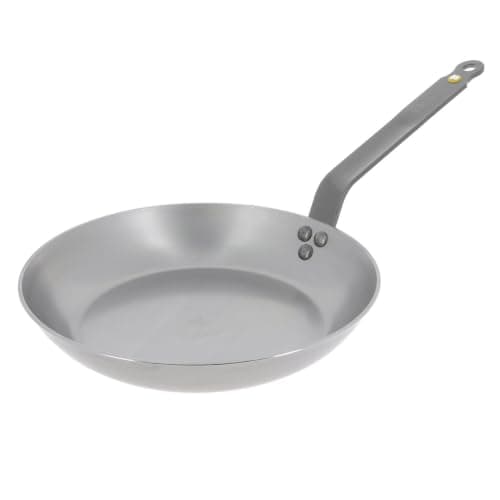
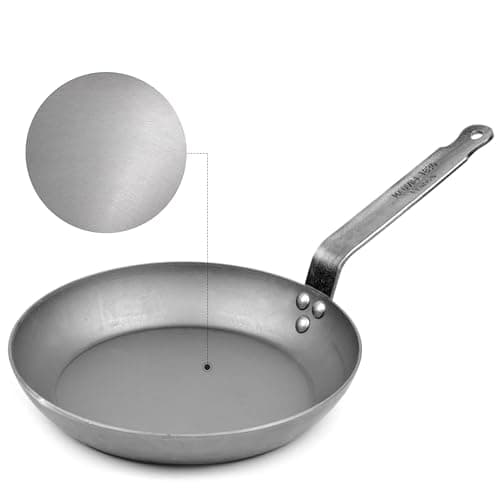
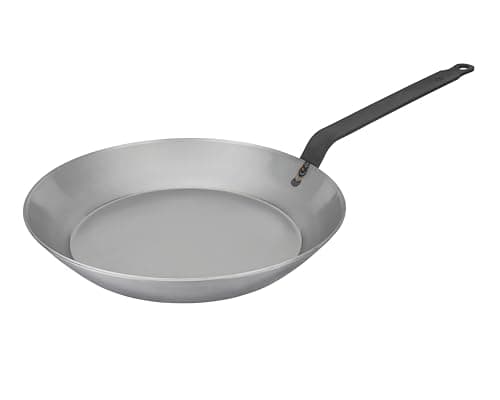
Buy the Matfer Bourgeat. It is the better pan for most people for one unglamorous reason: the handle is welded on rather than riveted, so there is nothing protruding into the cooking surface, and over years of use that is the difference you keep noticing. Buy the De Buyer Mineral B instead if you want the thicker pan with a published 3 mm base and the classic sloped French profile, and you are happy to scrub beeswax off before first use. Both are made in France, both are carbon steel, and neither is a mistake.
This comparison keeps coming up because the two pans look interchangeable on a product grid. They are not. They differ on exactly three things that matter, and on about six things that do not. Below is the short list of what actually decides it — and then, because the specifications are thin on both sides, an honest account of which numbers are published and which are not.
What carbon steel is, and why these two pans exist
Carbon steel is iron with a small fraction of carbon — chemically a close cousin of cast iron, but rolled from sheet rather than poured into a mold. That one manufacturing difference drives everything a cook feels. A rolled pan can be made thin, so it is lighter than a casting of the same diameter and responds much faster to the burner. It also starts out smooth, which means it takes seasoning — polymerized oil — faster and more evenly than an as-cast iron pan does.
What you give up is thermal mass. A thin steel pan dumps heat into cold food quickly and has less stored energy to recover with, which is why cast iron still wins a long, hard, multi-steak sear. For eggs, fish, omelettes, crêpes and anything where you want the pan to obey you within seconds, steel is the better tool. The full material comparison is here.
Both De Buyer and Matfer Bourgeat are long-established French manufacturers selling essentially the same professional object: an uncoated steel fry pan with a steel handle, oven-safe, induction-compatible, and sold bare for the cook to season. The decision between them is a decision about hardware and first-use ritual, not about cooking performance.
Difference 1: the handle, and why it is the whole page
Matfer's published handle type is “Welded”, with an “extra-strong steel strip handle” joined without rivets. De Buyer's Mineral B uses a riveted steel strap. Both are secure; both survive an oven.
The difference is inside the pan. Rivet heads sit slightly proud of the cooking surface, and two things happen over time: food catches on them when you are sliding an omelette or a fillet out, and seasoning builds up in the little annulus around each head, eventually going sticky or flaking. Matfer's own pitch for the welded joint is that it is free of rivets to prevent stuck or burned pieces of food. If you intend to cook eggs in this pan — and most people buying carbon steel do — that is the specification to buy on.
If you mostly sear, roast and pan-sauce, rivets will never bother you and you can disregard this entire section.
Difference 2: thickness, and what it does to the cooking
De Buyer publishes a 3 mm base and a 1,930 g pan weight for the 26 cm Mineral B. Matfer does not publish a thickness we can retrieve, and the only weight on its distributor sheet is a 4.77 lb shipping weight — which includes packaging and is not a pan specification. We are not going to convert it into one.
So the honest statement is: De Buyer publishes a thickness, Matfer does not, and anyone telling you the exact gauge difference between the two is estimating. What a thicker base does, in general, is buy you a little more stored heat and a little less responsiveness — the same trade cast iron makes against steel, in miniature. Three millimetres is toward the thick end for a home carbon-steel pan, which is why the Mineral B is the one we recommend to someone coming straight from cast iron and missing the heft.
Difference 3: what happens in the first twenty minutes
Both pans arrive coated, because bare steel rusts in transit. The coatings are different and so is the chore.
The Mineral B ships with a beeswax finish, which de Buyer presents as aiding the first seasoning. In practice you still want it off before you build your own layers: hot water, a scrub, a thorough dry. The Matfer ships “with a protective oil coating to prevent rusting before their first use” and the instruction is to wash it thoroughly and then season. Oil comes off more easily than wax.
Neither is difficult, but both are a step, and the number of people who cook their first egg in an unstripped pan and conclude that carbon steel is terrible is not small. Our carbon steel seasoning guide walks the whole first-use sequence, and how to cook with carbon steel covers the fortnight after that.
What does not differ, and should not sway you
Both are made in France by established manufacturers. Both are induction-compatible and oven-safe. Both have an all-metal handle that gets hot — you will want a towel or a handle holder for either. Both are hand-wash only. Both will turn mottled brown then black over the first month, which is the seasoning developing and not a defect. Both will warp if you plunge them from high heat into cold water, and neither likes a long acidic simmer any more than bare cast iron does.
Mauviel's M'Steel is the honest third option and sits in the picks above for that reason: French, riveted iron handle, listed as working on all cooktops including induction. Mauviel's own site was unreachable when we checked this page, so we quote no figures for it, and we would not pick it over either of the two above without them.
The verdict, in one line each
Buy Matfer Bourgeat if eggs, omelettes and fish are why you are buying a carbon-steel pan, you want the largest cooking surface of the three, and you would rather not have rivet heads in the pan for the next twenty years.
Buy De Buyer Mineral B if you want the thicker pan with a number attached to it, you like the sloped Lyonnaise shape for tossing and sliding, and the one-time wax strip does not put you off.
Buy neither ifyour main job is searing several thick steaks at once. That is cast iron's job, and the pan for it is on the steak page.
If you are choosing a size as well as a brand
Carbon steel pans are usually quoted by top diameter, and the cooking surface is much smaller because the walls flare. Matfer's 062005 is published at 11¾ inches across the top with an 8¾-inch cooking surface — a three-inch difference. De Buyer's 26 cm pan is quoted with a 1.7 L capacity. Buy one size up from the flat area you think you want, or you will end up with a pan that looks big and cooks small. The same arithmetic, applied to cast iron, is in our skillet sizes guide.
Where this pan sits next to your cast iron
These are not a replacement for a skillet; they are the fast pan next to the slow one. A 10-inch cast-iron skillet and an 11-inch carbon-steel pan is one of the most complete two-pan kitchens you can assemble, because they fail in opposite directions: iron holds heat and bullies food into a crust, steel responds instantly and lets you back off. If you are building from nothing, read building a cast iron collection before you buy either.
The limits of what we can tell you
Neither manufacturer publishes much, and we have not measured either pan. Every figure above is attributed to the spec sheet it came from, the Matfer weight is explicitly a shipping weight rather than a pan weight, and no thickness is quoted for the Matfer because none is published. We have not run a side-by-side cook test, we do not have a lab, and our methodology page says so in those words. Prices come from the live Amazon API with the as-of date under every table.