Skip to content
Hearth & Patina

The Dutch Ovens

The Best Dutch Oven Brands

Six brands make almost every dutch oven worth buying, and they sort into three camps: the value giant, the two French houses, and the budget makers. Here is what each is genuinely good at.

By Stephen V.Updated How we research
#ad

We earn a commission when you buy through our Amazon links, at no extra cost to you. It never affects our rankings, and we say so when the cheaper pan is the better buy. How this works.

If you want the short version: buy Lodge. It is the brand that gives most people the most pot for the money, and the braise that comes out of it is not meaningfully different from the braise that comes out of a French pot costing four times as much. Le Creuset and Staub are genuinely better objects — harder enamel, better handles, real warranties, real resale value — and those are legitimate reasons to spend the money. They are not cooking reasons, and any brand guide that tells you otherwise is selling something.

A dutch oven is a thick-walled pot with a heavy, tight-fitting lid. That is the entire technology. The mass holds a low, steady temperature for hours, which is what turns a cheap cut into something worth eating; the tight lid traps steam, which is what makes the pot double as a bread oven. Every brand below sells that same physics. What separates them is the enamel, the hardware, the warranty and the price — and it is worth being precise about which of those you are actually buying.

The six brands here are the ones with a serious, reliably available enameled dutch oven you can buy today. They fall into three camps, and once you see the camps the decision gets much easier.

The three camps

The value giant. Lodge alone occupies this slot. It is big enough to have real quality control and a support line, cheap enough that you will not be precious about the pot, and good enough that most buyers never need to look further.

The French houses. Le Creuset and Staub. Both cast and enamel in France, both charge a large premium, and both are buying you refinement and longevity rather than a better dinner. They are also the only two brands here with meaningful resale value.

The budget makers. Tramontina, Cuisinart and Amazon Basics. These compete almost entirely on price. They braise perfectly well. Where they give ground is enamel durability over years, hardware refinement, temperature ratings and what happens when something goes wrong.

Lodge — the brand most people should buy

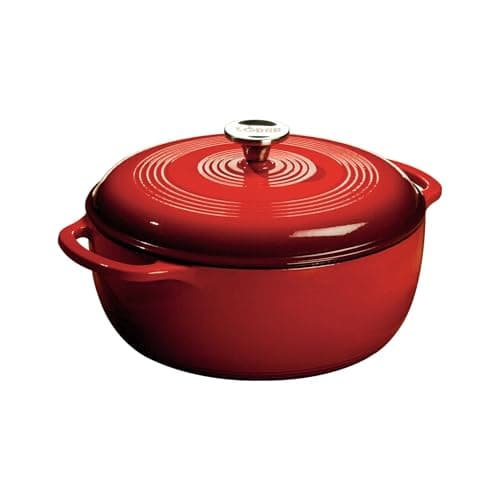
Lodge has been casting iron in South Pittsburg, Tennessee since 1896, and it was the first manufacturer to season its cookware in the foundry rather than leaving the job to the buyer — a change it made in 2002 that the whole industry then copied. Its enameled line is newer and separate from that American bare-iron heritage: Lodge introduced enameled cast iron in 2005 specifically to compete with the European makers. Worth knowing, because buyers often assume the enameled pots come out of the same Tennessee foundry as the skillets.

What you get is a pot that does the job without drama. Lodge publishes a clear 500°F oven rating for its enameled cookware, which clears essentially any bread recipe — and that single number is the most practically useful spec in this entire comparison, because it is where several cheaper pots quietly fall short. The capacity is generous, the enamel is decent, and the price is low enough that the pot gets used instead of admired.

The honest cons.The enamel and hardware are visibly a step below the French pots — the finish is thinner, the handles are smaller and less comfortable in oven mitts, and the colors are flatter. Over many years of hard use Lodge enamel is more likely to stain, craze or chip than Le Creuset's. And there is no lifetime warranty and essentially no resale market. You are buying a working pot, not an asset.

Le Creuset — the reference, and the price of it

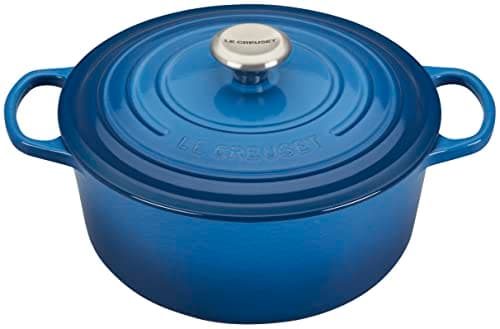
Le Creuset was founded in 1925 in Fresnoy-le-Grand, and every piece of its cast-iron cookware is still cast at that same French foundry — which, in a category where almost everything else has moved offshore, is not nothing. The Signature range gets a minimum of three coats of enamel, and you can feel it: the surface is denser and glossier than anything else here, and the pale sand-colored interior makes it genuinely easier to read how far your fond has browned.

The rest of the premium is in the parts you touch. The handles are wider and take a mitted hand properly. The knob is rated to the same 500°F as the pot. The lid seats with a weight and precision the budget pots do not match. And the lifetime warranty plus a real secondhand market mean the money is partly parked rather than spent — a used Le Creuset in good condition retains value in a way no other brand here does.

The honest cons. It is a luxury purchase, several times the price of a Lodge that cooks the same. The pale interior enamel stains with use — cosmetic, but it bothers people who paid this much. And it is heavy; a full 5.5-quart pot coming out of a hot oven is a two-handed, full-attention job. If you are buying on cooking performance alone, this is the wrong pot, and we say so at length in is Le Creuset worth it.

Staub — the browning specialist

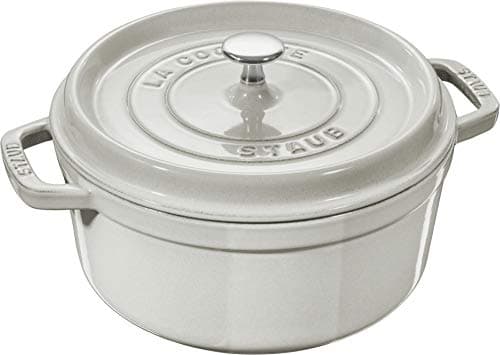
Staub is the younger French house: founded in 1974 by Francis Staub in Turckheim, Alsace, and owned since June 2008 by the German group Zwilling J. A. Henckels, though it has continued to operate as an independent brand. Two design decisions define it. The interior enamel is dark and matte rather than pale and glossy, which takes high-heat browning better and hides stains essentially forever. And the underside of the lid carries nubs that collect condensation and drip it back down onto the food — the self-basting design, and the reason Staub has a following among people who braise seriously.

If your cooking is mostly long, dark, savory braises — short ribs, coq au vin, shoulder cuts — Staub is the most purpose-built pot in this list, and the dark interior means it will still look new in a decade.

The honest cons. That dark interior cuts both ways: you cannot read fond color in it the way you can in a Le Creuset, which is a real loss when you are learning to judge a sear. It is heavier than the Le Creuset, which is already heavy. And it costs just as much. Our Le Creuset vs Staub comparison is the page to read if you have decided to spend French money and only need to pick which one.

Tramontina — the value alternative that reviewers keep picking

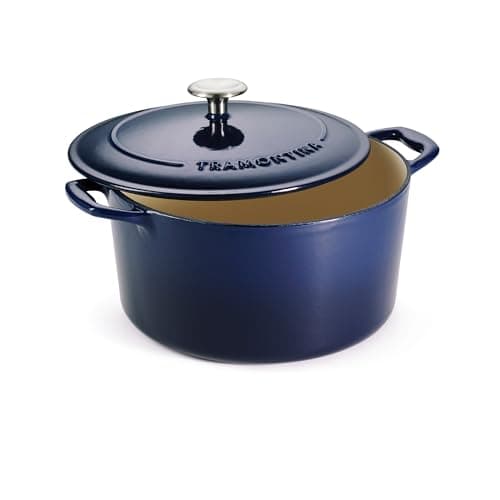
Tramontina is the Brazilian brand that has spent a decade as the budget-testing favorite in this category, and the appeal is straightforward: a large, well-made enameled pot with attractive colors at close to Lodge money. The capacity is the most generous of the value-priced pots here, which makes it the sensible pick if you batch-cook for four or five and freeze the leftovers.

The honest cons. The lid knob is typically rated lower than the 500°F Lodge and French pots — check the rating on the specific listing before you buy if high-heat bread is your plan, because this is exactly the spec that catches people out. The enamel is not as hard-wearing as the premium brands over years of use. Full assessment in is Tramontina worth it.

Cuisinart — the familiar middle

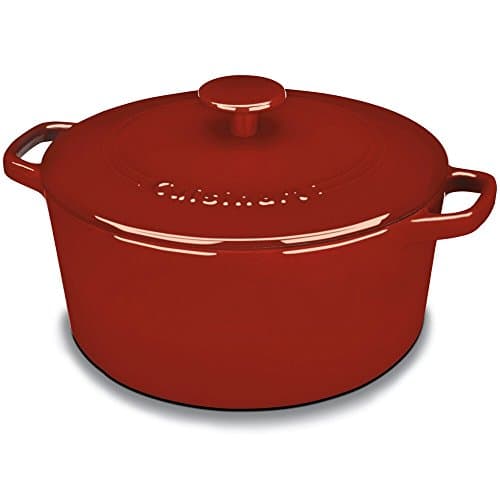
Cuisinart is the brand people buy because they already own a Cuisinart something-else and trust the name. The pot is fine. It is induction-ready, it is a sensible size for most households, it braises and simmers exactly as it should, and the brand is easy to deal with on returns.

The honest cons. It is the one pot here with no argument of its own. It typically prices above the Lodge without cooking any better, and its finish and hardware are middle-of-the-road. If you are optimizing value, the Lodge undercuts it; if you are optimizing quality, the French pots beat it. Buy it because you specifically prefer it, not because it wins on any axis.

Amazon Basics — the floor, and an honest one

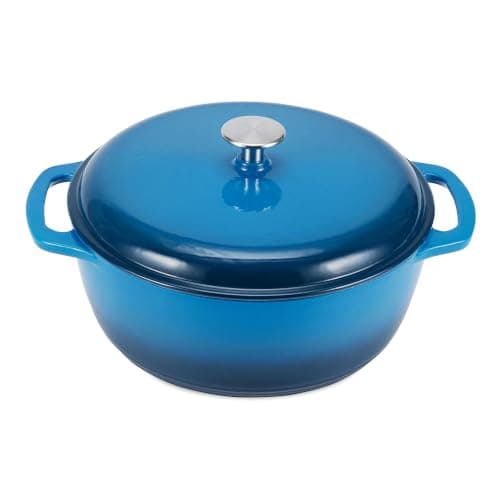
There is a real argument for the cheapest enameled pot that is not a gamble, and Amazon Basics is it. Full capacity, the same basic braising physics, and a price that makes the whole question of "will I actually use a dutch oven?" cheap to answer. As a way to find out whether this style of cooking is for you, it is a rational buy rather than a cheap one.

The honest cons. Enamel durability is the weak point and it is not close — this is the pot most likely to chip, craze or stain within a few years. There is no brand heritage, no meaningful warranty and no support to speak of. Treat it as a several-year pot, not a lifetime one. If you already know you will use it, the Lodge is only a little more and clearly better made.

What the brand badge actually buys you

Strip out the marketing and the differences between these six brands come down to four things, in roughly this order of real-world importance.

Enamel quality. This is the one that genuinely separates the camps. Vitreous enamel is powdered glass fused to the iron, and how many coats go on and how well they are applied decides whether the pot looks new in ten years or looks tired in three. The French houses win here on measurable process — Le Creuset's three-coat minimum on the Signature range is a real specification, not a slogan.

Temperature rating. The most underrated spec in the category, and the one that actually rules a pot in or out of a job. Lodge publishes 500°F; the French pots match it; several budget pots and knobs sit lower. If you bake bread, check this before anything else.

Hardware and ergonomics. Handle width, knob comfort, lid fit. This sounds like a luxury concern until you lift six quarts of boiling stew out of an oven with mitts on. The premium pots are meaningfully nicer to handle, and that is a safety point as much as a comfort one.

Warranty and resale. Only the French brands offer either in a form worth counting. If you keep cookware for decades or care about recovering value later, that gap is real money.

What the badge does not buy you

Heat retention is not a brand feature. All of these pots are thick cast iron, and thick cast iron holds heat — the differences between them are far smaller than the price gaps suggest, and smaller than the difference made by preheating properly. Anyone selling you a dutch oven on superior heat retention is selling you the material, which every brand here has.

Country of origin is a heritage and ethics question, not a performance one. French casting is genuinely impressive and worth valuing if you value it. It does not brown an onion faster.

And "professional" or "chef" branding means nothing in this category. There is no professional dutch oven. There is a heavy pot with a tight lid, and you already understand it.

So which brand should you buy?

Most people: Lodge. The 500°F rating, a sensible capacity, a trustworthy company and a price that keeps the pot on the stove rather than in a cupboard.

If you braise seriously and want it to last forever: Staub for dark, savory cooking; Le Creuset if you want to read your fond and prefer the lighter interior and the better resale. Both are heirlooms, and either is a defensible splurge once you know you cook this way.

If price is the binding constraint: Amazon Basics to find out whether you like it, Tramontina if you need the extra capacity — but check that knob rating first.

If you would rather compare individual pots than brands, our best dutch ovens roundup ranks them head to head, and the best dutch ovens for beginners is the page to start from if this is your first pot.
The short answer

Quick picks

#ProductBest forScorePrice
01
Lodge Lodge 6 qt Enameled Cast Iron Dutch Oven
Lodge 6 qt Enameled Cast Iron Dutch Oven

90% of the French pots' performance for a third of the money. The value pick, and our overall best buy.

The best-value dutch oven
8.8
$89.90Amazon
02
Le Creuset Le Creuset Signature Round Dutch Oven, 5.5 qt
Le Creuset Signature Round Dutch Oven, 5.5 qt

The reference enameled dutch oven. Superb, iconic, and priced like an heirloom — because it is one.

The heirloom splurge
8.2
$440.00Amazon
03
Staub Staub Round Cocotte, 5.5 qt
Staub Round Cocotte, 5.5 qt

The other French icon — a dark matte-enamel interior built for browning and self-basting.

Browning and braising
8.2
$339.95Amazon
04
Tramontina Tramontina Enameled Cast Iron Dutch Oven, 6.5 qt
Tramontina Enameled Cast Iron Dutch Oven, 6.5 qt

The long-time budget-reviewer darling. A big, capable enameled pot for not much money.

A large budget pot
7.8
$62.96Amazon
05
Cuisinart Cuisinart Chef's Classic Enameled Cast Iron Dutch Oven, 5 qt
Cuisinart Chef's Classic Enameled Cast Iron Dutch Oven, 5 qt

A mid-price enameled pot from a familiar kitchen brand — a safe, unremarkable middle option.

A mid-price middle ground
7.6
$72.99Amazon
06
Amazon Basics Amazon Basics Enameled Cast Iron Dutch Oven, 6 qt
Amazon Basics Enameled Cast Iron Dutch Oven, 6 qt

The cheapest enameled dutch oven worth owning. Plain, effective, and often the lowest price on the page.

The rock-bottom price
7.8
$41.99Amazon

#ad · Live prices from the Amazon Product API, as of Sep 3, 2026. Where we have no verified live price, we show none — we would rather leave a gap than print a number that has gone stale.

In detail

The picks, in full

01
Lodge Lodge 6 qt Enameled Cast Iron Dutch Oven

The best-value dutch oven

Lodge 6 qt Enameled Cast Iron Dutch Oven

6 qtEnameledOven safe to 500°FGreat value
8.8/10

90% of the French pots' performance for a third of the money. The value pick, and our overall best buy.

Heat retention
9
Enamel durability
7
Everyday usability
9
Oven & stovetop range
9
Value
10

Pros

  • Cooks braises, soups and bread indistinguishably from pots costing three times as much
  • A generous 6 qt — room for a big batch or a large boule
  • The most sensible first enameled dutch oven for almost everyone

Cons

  • Enamel and hardware are a step below Le Creuset/Staub in finish refinement
  • Not made in France, if that matters to you (it doesn't affect the food)

Don't buy this if…

you specifically want the heirloom object, the lifetime warranty, or the resale value of a French pot. On pure cooking, this is where the smart money goes.

$89.90View on Amazon

Price as of Sep 3, 2026. Prices change — Amazon's is the one that counts.

#ad · we may earn a commission from this link to Lodge 6 qt Enameled Cast Iron Dutch Oven

02
Le Creuset Le Creuset Signature Round Dutch Oven, 5.5 qt

The heirloom splurge

Le Creuset Signature Round Dutch Oven, 5.5 qt

5.5 qtEnameledLifetime warrantyMade in France
8.2/10

The reference enameled dutch oven. Superb, iconic, and priced like an heirloom — because it is one.

Heat retention
9
Enamel durability
9
Everyday usability
9
Oven & stovetop range
9
Value
5

Pros

  • The 5.5 qt round is the most useful single size — soups, a whole chicken, a big batch of stew, a boule of bread
  • Larger, ergonomic knobs and wider handles than most rivals; oven-safe knob rated to 500°F
  • Sand-colored interior enamel makes it easy to judge fond and browning

Cons

  • The price is a genuine luxury — three to five times a Lodge that cooks nearly the same
  • Pale interior enamel stains over time (cosmetic, not functional)

Don't buy this if…

you are buying purely on cooking performance. A Lodge enameled dutch oven produces near-identical results for a fraction of the price. Buy the Le Creuset for the warranty, the resale value, and because you want it — those are legitimate reasons, just not performance ones.

$440.00View on Amazon

Price as of Sep 3, 2026. Prices change — Amazon's is the one that counts.

#ad · we may earn a commission from this link to Le Creuset Signature Round Dutch Oven, 5.5 qt

03
Staub Staub Round Cocotte, 5.5 qt

Browning and braising

Staub Round Cocotte, 5.5 qt

5.5 qtMatte black enamelSelf-basting lidMade in France
8.2/10

The other French icon — a dark matte-enamel interior built for browning and self-basting.

Heat retention
10
Enamel durability
9
Everyday usability
8
Oven & stovetop range
9
Value
5

Pros

  • Dark matte-enamel interior takes high-heat browning better than pale enamel and hides stains
  • Spiked/self-basting lid drips condensed moisture back onto the food during long braises
  • Heavier build and a tight lid make it excellent for low, slow cooking

Cons

  • The dark interior makes it harder to read fond color than Le Creuset's pale enamel
  • Every bit as expensive as Le Creuset, and heavier

Don't buy this if…

you bake a lot of bright, light dishes where you want to see the fond, or you want the lightest pot you can get. The dark interior and heft are the trade for its browning and basting strengths.

$339.95View on Amazon

$367.898% off

Price as of Sep 3, 2026. Prices change — Amazon's is the one that counts.

#ad · we may earn a commission from this link to Staub Round Cocotte, 5.5 qt

04
Tramontina Tramontina Enameled Cast Iron Dutch Oven, 6.5 qt

A large budget pot

Tramontina Enameled Cast Iron Dutch Oven, 6.5 qt

6.5 qtEnameledOven safe to 450°FBudget pick
7.8/10

The long-time budget-reviewer darling. A big, capable enameled pot for not much money.

Heat retention
8
Enamel durability
7
Everyday usability
8
Oven & stovetop range
7
Value
9

Pros

  • Generous 6.5 qt capacity for big-batch cooking
  • Long a value-review favorite for approaching French-pot results at a Lodge-like price
  • Attractive porcelain-enamel colors

Cons

  • Knob is typically rated to 450°F — lower than the 500°F French pots, worth noting for high-heat bread
  • Enamel finish is not as hard-wearing as the premium brands over years of use

Don't buy this if…

you routinely preheat empty above 450°F for bread (the knob temperature rating is the limit). For most braising and everyday cooking it is a strong value.

$62.96View on Amazon

$79.9521% off

Price as of Sep 3, 2026. Prices change — Amazon's is the one that counts.

#ad · we may earn a commission from this link to Tramontina Enameled Cast Iron Dutch Oven, 6.5 qt

05
Cuisinart Cuisinart Chef's Classic Enameled Cast Iron Dutch Oven, 5 qt

A mid-price middle ground

Cuisinart Chef's Classic Enameled Cast Iron Dutch Oven, 5 qt

5 qtEnameledInduction readyOven safe
7.6/10

A mid-price enameled pot from a familiar kitchen brand — a safe, unremarkable middle option.

Heat retention
8
Enamel durability
7
Everyday usability
8
Oven & stovetop range
8
Value
7

Pros

  • 5 qt suits most households and it is induction-compatible
  • A recognizable brand with easy availability and returns
  • Cooks braises and soups perfectly well

Cons

  • Priced above the Lodge enameled without cooking any better
  • Finish and hardware are middle-of-the-road

Don't buy this if…

you're optimizing value — the Lodge enameled undercuts it and is at least as good. Buy this only if you specifically prefer the Cuisinart look or already trust the brand.

$72.99View on Amazon

$129.9544% off

Price as of Sep 3, 2026. Prices change — Amazon's is the one that counts.

#ad · we may earn a commission from this link to Cuisinart Chef's Classic Enameled Cast Iron Dutch Oven, 5 qt

06
Amazon Basics Amazon Basics Enameled Cast Iron Dutch Oven, 6 qt

The rock-bottom price

Amazon Basics Enameled Cast Iron Dutch Oven, 6 qt

6 qtEnameledOven safeCheapest pick
7.8/10

The cheapest enameled dutch oven worth owning. Plain, effective, and often the lowest price on the page.

Heat retention
8
Enamel durability
6
Everyday usability
8
Oven & stovetop range
8
Value
9

Pros

  • Consistently among the least expensive enameled dutch ovens that isn't a gamble
  • Full 6 qt capacity and the same basic braising performance as pricier pots
  • A fine way to try dutch-oven cooking before committing real money

Cons

  • No brand heritage or long warranty; enamel durability is the weak point over years
  • Colors and finish are utilitarian

Don't buy this if…

you want a pot to keep for decades. For that, the Lodge enameled is only a little more and clearly better made. This is the pick when price is the only axis.

$41.99View on Amazon

$44.095% off

Price as of Sep 3, 2026. Prices change — Amazon's is the one that counts.

#ad · we may earn a commission from this link to Amazon Basics Enameled Cast Iron Dutch Oven, 6 qt

How to choose a dutch oven brand

Pick the camp first, then the pot

Decide whether you are buying a working tool, an heirloom or a cheap experiment. That single decision eliminates four of the six brands immediately and is far more useful than comparing spec sheets across camps. Almost every bad dutch-oven purchase we see is someone buying from the wrong camp — usually an heirloom bought before the buyer knew whether they would use it.

Check the oven temperature rating before you buy for bread

Bread often goes into a very hot oven and the pot is frequently preheated empty, so the rating decides whether a pot is in or out for that job. Lodge states its enameled cookware is usable on the stovetop and in the oven up to 500°F. Budget pots vary, and the lid knob is sometimes rated below the pot itself, so read the specific listing rather than assuming the brand.

Enamel color is not just cosmetic

A pale interior lets you judge browning and fond, which matters while you are still learning to sear. A dark matte interior browns well at high heat and hides stains permanently. This is a genuine functional fork between Le Creuset and Staub, not a styling choice, and it is worth deciding deliberately rather than by color preference.

Handle the pot before you commit, if you can

Weight is the single most common reason a dutch oven stops getting used. A six-quart pot full of stew is heavy before you add mitts and a hot oven to the equation. If you are between capacities, take the smaller one — see what size dutch oven do you need for the full breakdown.

Do not pay for a warranty you will not use

A lifetime warranty is a real benefit of the French brands, but it covers manufacturing defects, not the chip you put in the rim by knocking it against the sink. Enamel is glass on every pot in this list. The care routine is the same regardless of badge: warm it with something in it, do not heat it empty at high heat on the stovetop, avoid sudden temperature swings, and use wooden or silicone tools if you want to keep the interior pristine. Our enameled cast iron care guide is the short version.

Ignore the sets

Several of these brands will sell you the dutch oven bundled with pieces you did not ask for. Buy the single pot. A dutch oven earns its place by being used several times a week, and a bundle spreads your money across pieces that sit in a cupboard while you find that out.

How we picked

We do not run a testing lab

We researched published manufacturer specifications, materials and thermal properties, and aggregated owner reviews, then scored each pan against a published rubric. The scores are judgments from documented research — they are notmeasurements we took, because we do not have a lab and we are not going to pretend we do. Where a number came from a manufacturer's spec sheet or someone else's lab, we name it in Sources.

Questions

Frequently asked

What is the best dutch oven brand overall?
Lodge, for most buyers. It publishes a 500°F oven rating, offers generous capacity and costs a fraction of the French pots while producing effectively the same braise. Le Creuset and Staub are better made and better to handle, but the premium buys refinement, warranty and resale value rather than better cooking.
Is Le Creuset or Staub better?
They are close, and the real fork is the interior enamel. Le Creuset's pale interior makes it easier to judge browning and fond; Staub's dark matte interior browns well at high heat, hides stains and adds the self-basting lid nubs. See Le Creuset vs Staub for the full comparison.
Are cheap dutch oven brands any good?
For cooking, yes — thick cast iron with a tight lid braises well regardless of badge. Where budget brands give ground is enamel durability over years, hardware quality, temperature ratings and warranty support. Amazon Basics is a rational way to find out whether you will use a dutch oven; Lodge is the better keeper for a little more.
Does the brand affect how a dutch oven cooks?
Far less than the price gaps suggest. Heat retention comes from thick cast iron, which every brand here uses. Brand mostly decides enamel quality, oven temperature rating, handle comfort and warranty. Preheating properly makes more difference to your results than choosing between these six.
Is Lodge enameled cast iron made in the USA?
Lodge has cast bare iron in South Pittsburg, Tennessee since 1896, but its enameled line is separate and newer — introduced in 2005 to compete with the European makers. Buyers often assume the enameled pots share the Tennessee foundry with the skillets. It does not affect the cooking, but it is worth knowing if origin matters to you.
Which dutch oven brands hold their value?
Only Le Creuset and Staub have a meaningful secondhand market, and Le Creuset in good condition holds value best. Lodge, Tramontina, Cuisinart and Amazon Basics are working pots with essentially no resale value — which is fine, as long as you are not telling yourself the purchase is an investment.

Keep reading

Receipts

Sources

We do not run a testing lab, and we do not pretend to. Where a measured number came from a manufacturer's spec sheet or someone else's lab, we name them and link them. Where we could not verify something, we say so on the page rather than quietly leaving it out. Read our full method.