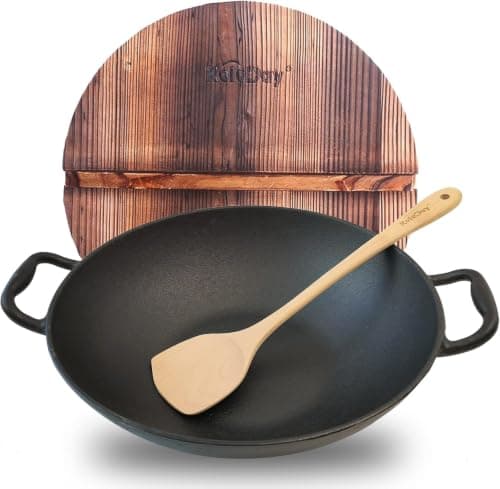
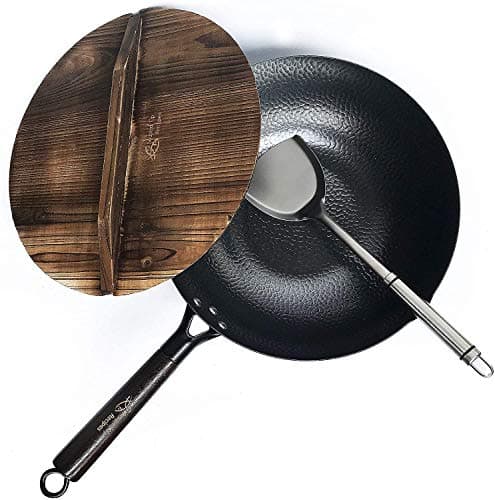
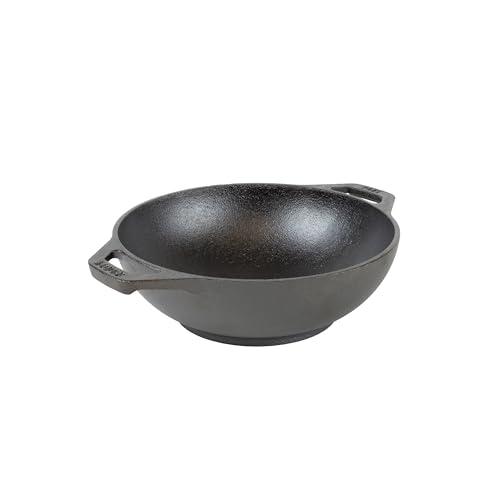
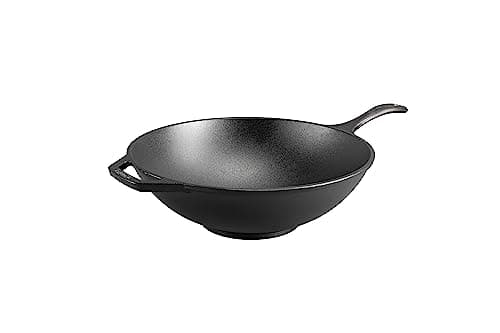
The best wok for an induction cooktop is the Lodge Chef Collection 12.5-inch cast iron wok, best for an induction cook who wants the walls of the wok to actually be hot. The budget pick is the Lodge 6.25-inch mini wok, which is a single-serving pan and says so. The reason this page does not rank the same way as our gas-stove page is that induction heats only the ferromagnetic metal in close flat contact with the hob — so on induction a wok’s walls are heated by the pan, not by the stove.
What induction does to a wok, in one paragraph
A gas flame licks up the outside of a round-bottomed wok and heats the walls directly. That is the whole design: a screaming-hot base for searing and a cooler slope to push cooked food up onto. An induction hob cannot do that. It induces currents in the metal it is magnetically coupled to, which is the flat disc of base sitting on the glass, and nothing else. Everything above that disc is heated only by conduction through the pan itself.
That matters because both iron and plain carbon steel are poor sideways conductors. In a 2 mm carbon steel wok there is very little metal to carry heat up the slope, so you get an intensely hot ring and cold walls — which is a frying pan with awkward sides. In a thick cast iron wok there is a great deal of metal, it carries heat outward, and the walls get usefully warm. On gas this thickness is a liability, because it makes the wok slow and heavy. On induction it is the whole point.
Flat base, and no wok rings
A round-bottomed wok on induction is not a compromise, it is a non-starter: with only a small tangent of metal near the glass there is almost nothing for the hob to couple to, and most induction hobs will simply refuse to detect the pan. A wok ring makes it worse, because it lifts the metal further from the coil. Every pick on this page is flat-bottomed for that reason.
The flat base also has to be big enough. Induction coils have a minimum detection diameter, commonly in the four-to-five-inch range, and a small base on a big hob also means the heat enters the pan over a narrow circle. This is why the 6.25-inch mini wok is the budget pick and not the value pick — it will work, and it will only ever cook one portion. Our woks for glass-top and electric stoves page covers the related but different problem of a radiant smoothtop, and why induction cooktops buzz explains the noise a big iron pan makes on one.
Why the carbon steel pick is third and not first
This is the opposite of what we say on gas. The Souped Up Recipes 12.5-inch is a good flat-bottomed carbon steel wok, it comes with a lid and a spatula, it weighs a fraction of the cast iron picks, and it heats in a minute. If you want a wok you can lift and toss one-handed, buy it.
But on induction it exposes the weakness described above: the base gets fiercely hot and the walls stay comparatively cool, so the classic stir-fry technique of parking seared food up the side does not work the way it does over a flame. It is third here on that basis, not on quality — on a gas stove it ranks higher, and cast iron wok versus carbon steel wok is the full material argument.
The honest limit of induction stir-frying
No wok on a domestic induction hob will reproduce a restaurant wok burner, which can put out an order of magnitude more heat up the outside of the pan. What you can do very well on induction is sear in batches: get the base genuinely hot, cook small amounts fast, take them out, repeat. The thick cast iron picks are better at this than thin steel precisely because they hold temperature when cold vegetables land in them.
If stir-frying is central to how you cook and you have the choice, our guide to using a wok explains the technique that gets closest, and are cast iron woks good answers the obvious objection to the material head-on.
What about the rest of your induction cookware?
Bare cast iron and plain carbon steel are both strongly ferromagnetic, so every pan and pot on this site works on induction — unlike many stainless pans, which need a magnetic base layer bonded on. The practical cautions are about the glass, not the magnetism: lift, never slide, and expect a hum from a heavy pan. The best cast iron for induction ranks skillets and pots for the same hob, and cast iron on glass and induction cooktops has the handling rules.
How the prices on this page work
Every figure comes from the live Amazon listing at the date stamped under the comparison table, read through this site’s price layer rather than written into a file. A pick with no verified live offer shows no number and the button still works.