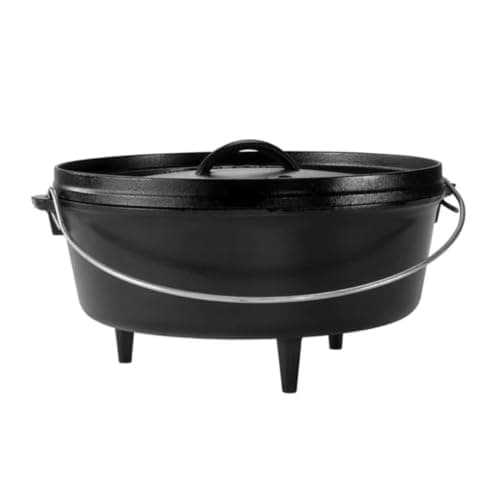
The best dutch oven for camping is the Lodge 6 qt camp dutch oven, best for anyone cooking in a fire ring rather than on a camp stove — it is the only pot on this page with legs to stand over coals and a flanged lid to carry them. The budget pick is the Amazon Basics enameled 6 qt, which is fine for car camping on a stove or grate and should never go near direct coals. Everything else here is a kitchen pot that happens to travel well.
A camp oven and a kitchen pot are not the same object
Both are thick-walled covered pots, and that is where the similarity ends. A camp dutch oven has three stubby legs so it can sit above a bed of coals with air underneath, and its lid is flat with a raised rim so a shovelful of coals stays put on top. Those two details turn the pot into an oven: heat from below for the base, heat from above for a crust, and a rough temperature you control by counting briquettes.
A kitchen dutch oven has a flat base and a domed lid. Put it straight on coals and the base scorches while the top stays cool; put coals on the dome and they roll off. It will still make a superb stew over a camp stove or on a grate, which is why four of the five picks here are kitchen pots — just ranked for what they can actually do outdoors.
Enamel outdoors: the honest warning
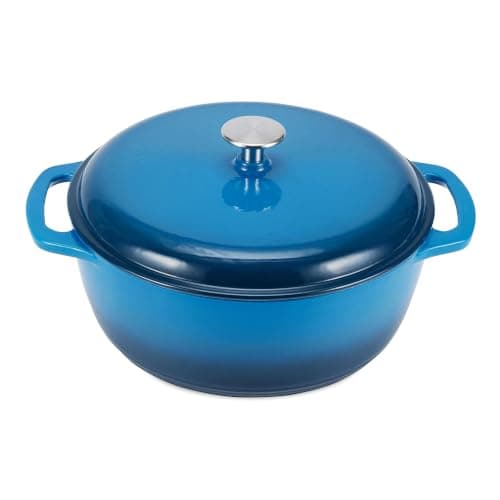
Enamel is powdered glass fused to iron, and glass chips when it is knocked and cracks when it is thermally shocked. A campsite is a place of knocks and thermal shocks. We still rank the Amazon Basics enameled pot, because for car camping on a stove it is cheap, needs no seasoning and cleans up with soap and water in a washing-up bowl — and if it chips, it cost very little.
What we would not do is take an expensive enameled pot to a fire. Our enameled or bare cast iron for camping page takes that decision apart properly, and chipped enamel cast iron explains what happens when it goes wrong.
The packable options
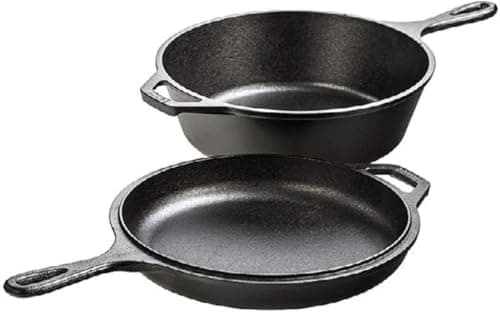
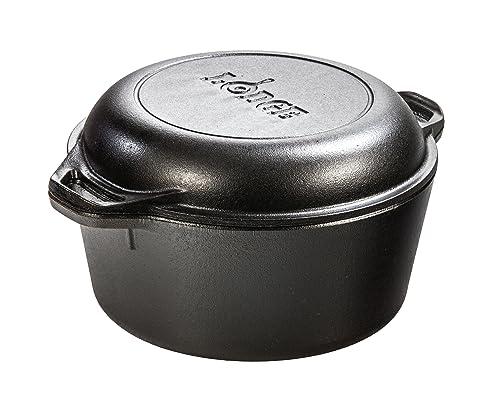
If weight and space matter, the Lodge combo cooker is the cleverest thing on this page: a 3.2 qt deep pan with a 10.25-inch skillet as its lid, which means one object does breakfast and dinner. The Double Dutch is the same idea at 5 quarts. Both are bare, seasoned iron, so they take direct flame and abuse without a glass coating to worry about, and both have flat bases, so they belong on a grate or a stove rather than buried in coals.
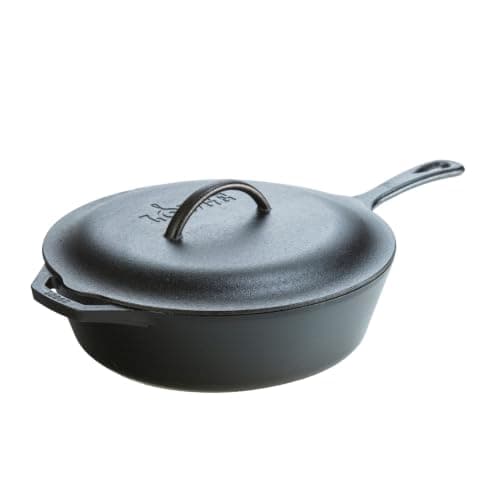
The 5 qt covered deep skillet is the one to take if frying is the point — deep sides, a lid, and enough oil depth for chicken. See the best cast iron for deep frying and the best bare cast iron pots for how these three compare away from a campsite.
What size camp oven to buy
Six quarts is the standard and the right default: it feeds four to six, most camp dutch oven recipes assume it, and the 12-inch footprint matches the briquette counts people quote. Go smaller only if you are cooking for two, and bear in mind that a smaller pot also means fewer coals and a twitchier temperature. Our what size dutch oven page has the full sizing argument, and the best small dutch ovens covers the two-person end.
Cooking in it, and getting it home again
The skill is heat management, not cooking: coals under for simmering and frying, coals on the lid as well for baking, and a rotation every ten minutes or so to even out hot spots. Our guide to camp cooking with cast iron covers the briquette arithmetic and the lid-lifter question, and the best cast iron for camping is the full kit list if you want a skillet and a griddle alongside the pot.
One practical point people learn the hard way: a seasoned pot that goes home damp comes out rusty. Dry it over the dying fire, wipe a thin film of oil inside, and store it with the lid ajar. Our pages on keeping cast iron from rusting and storing cast iron cover it.
How the prices on this page work
Every number comes from the live Amazon listing at the date stamped under the comparison table, through this site’s price layer. Nothing is typed in from memory, and a pick with no verified live offer carries no number at all.