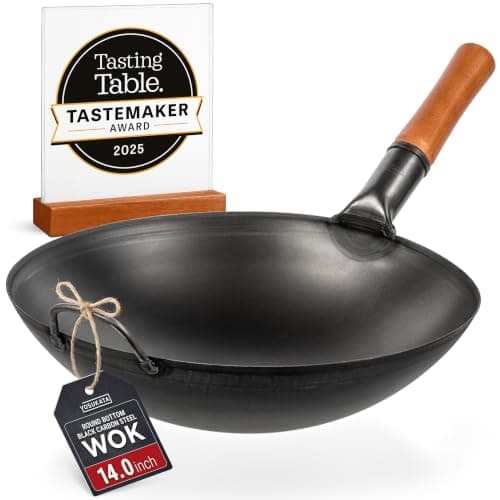
Buy carbon steel if you have a gas burner or you want to move food by moving the pan — a thin, light wok is what the technique was built around, and the pre-seasoned Yosukata 14-inch is the one to get. Buy cast iron if your element is slow and your real problem is the pan going cold the moment food lands in it. The two materials are not better and worse; they fail in opposite directions, and your stove decides which failure you can live with.
Both are bare, seasonable metal and both are induction-compatible. Wikipedia's wok article notes that cast iron was once the more common material and that cooks remain genuinely divided. The useful way to settle it is not brand loyalty but three published, checkable facts.
Fact one: carbon steel is thin, and that is the point
Carbon steel is rolled sheet, not a casting, so a wok can be thin without being fragile. Wikipedia describes it as relatively inexpensive, relatively light, and quick to conduct heat because of its low specific heat capacity — which in plain terms means it heats fast and cools fast. That is why a carbon steel wok can be shaken, tilted and tossed one-handed, and why it answers the moment you move it off the flame. The weakness is the flip side: take it off the heat and it surrenders its temperature immediately, so a big load of cold vegetables can stall it.
Fact two: cast iron woks come in two very different thicknesses
This is the fact that resolves most of the online argument. Wikipedia reports two distinct kinds: Chinese-made cast iron woks at around 3 mm, weighing only a little more than a carbon steel wok of the same size, and Western-made cast iron woks at around 9 mm, which are very heavy. Because of that thickness the Western pans take much longer to reach cooking temperature, and their weight makes stir-frying and bao techniques difficult. The thin Chinese woks are light but relatively fragile and can shatter if dropped or mishandled.
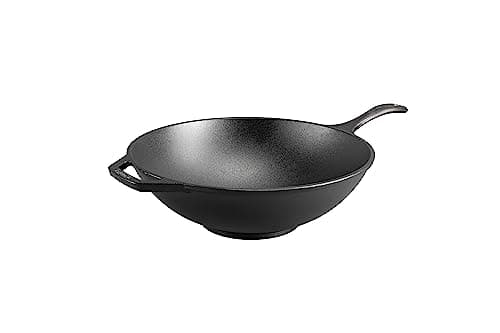
So “cast iron wok” on a US product page almost always means the heavy kind. Lodge's 12.5-inch Chef Collection wok is published at 9.72 lb. That is a pan you stir in, not one you flick.
Fact three: iron holds a more stable seasoning
Wikipedia's comparison credits cast iron woks with forming a more stable carbonized layer of seasoning, making them less prone to sticking, and with beating carbon steel on heat retention and uniform heat distribution — while responding slowly to heat adjustments and cooling slowly, so food has to come out of the pan the moment it is done or it keeps cooking. Carbon steel woks, by the same source, tend to be more difficult to season in the first place. If you have been told “carbon steel is easier”, that is true of weight and handling, not of the break-in.
So which one?
Match the material to the heat source, because that is the variable you cannot change:
- Strong gas burner: carbon steel, round bottom. Thin steel over a flame is the original design and nothing else gets close for searing and tossing.
- Coil electric or glass-ceramic: flat bottom, either material. Steel if you want to lift and move the pan on glass; iron if your element is slow and you cook by stirring. Our flat-bottom wok roundup for glass-top and electric stoves ranks only the pans that fit.
- Induction: flat bottom, and plan to stir rather than toss — lifting the pan breaks the magnetic coupling and heating stops.
- Campfire or grill: cast iron, every time. It does not care, and Lodge publishes its woks as campfire-safe.
| Property | Carbon steel wok | Cast iron wok |
|---|
| Published typical thickness | Rolled sheet; 14-gauge or thicker on better pans | ~3 mm (Chinese-made) or ~9 mm (Western-made) |
| Heats up | Fast — low specific heat capacity | Slowly, especially the 9 mm pans |
| Heat retention | Lower; cools quickly off the flame | Higher; also slow to cool, so food must come out |
| Seasoning | Tends to be harder to season | Forms a more stable carbonized layer |
| Tossing and bao technique | Yes — light enough to shake one-handed | Difficult; weight rules it out on Western pans |
| Best heat source | Strong gas flame | Weak or slow elements, grill, campfire |
Every figure above comes from Wikipedia's wok article or the maker's own published spec, not from measurements we took — we do not run a test lab, and our methodology page says so in those words.
What we would actually buy
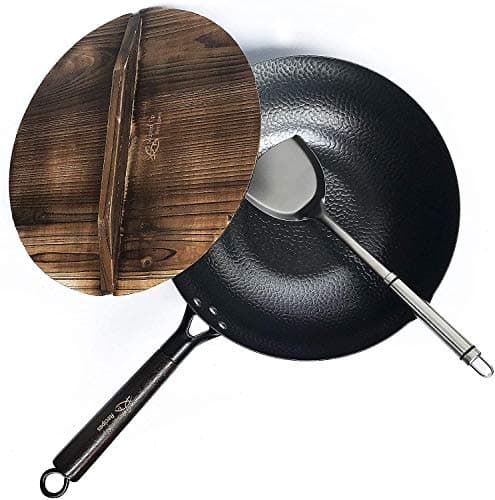
Three woks cover the whole decision, and they are ranked below in that order: the pre-seasoned Yosukata 14-inch round-bottom carbon steel for a gas burner, the Lodge Chef Collection 12.5-inch cast iron for a slow element or an outdoor fire, and the flat-bottom Souped Up Recipes 12.5-inch carbon steel as the compromise that works on anything and still lifts. For the broader fields, see the best carbon steel woks and the best cast iron woks.
Questions people ask once the metal is settled
Does a heavier wok cook better?
It cooks differently. Mass buys temperature stability and costs you responsiveness and agility. A thin pan lets you drop the heat by lifting the pan; a thick one does not, which is why cast-iron wok cooking is a stir-and-remove discipline rather than a toss-and-flick one.
Is a hand-hammered wok worth it over a spun one?
Hammered dimples help push cooked food up the sloping sides and out of the heat, and the best woks are still hand-made from heavy-gauge steel. The pan to avoid is the machine-stamped single-ply wok — those are the ones that deform and develop hot spots. The Yosukata vs Craft Wok comparisonis exactly this question between two specific pans. The same forming-and-finish argument runs through carbon steel skillets too — see De Buyer vs Matfer Bourgeat.
What about nonstick, clad or aluminum woks?
Nonstick coatings top out around 500°F, below what hard stir-frying wants, and they cannot carry seasoning. Clad stainless woks can cost five to ten times a traditional wok, heat more slowly, and are not used in most professional kitchens. Aluminum is mostly used for lids, and copper — excellent in a saucepan — is the wrong material here entirely, for the reasons in cast iron vs copper cookware. The two materials on this page are the two serious options.
Will either rust?
Both will, quickly, if you put them away wet. Dry on the burner and wipe a thin film of oil in while warm. Our rust-prevention guide and carbon steel cooking guide cover both metals; the routine is identical.
Can one wok replace a skillet?
Partly. A wok steams, deep-fries, boils and stir-fries better than a skillet, but its sloped walls leave a smaller flat area for steaks and eggs, and it pools oil in a deep well. If you own one pan, own a skillet — see the skillet roundup— and add a wok second.