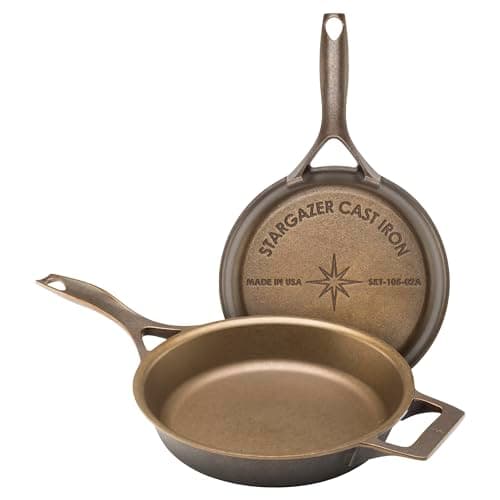
Buy the Stargazer 10.5-inch. It is the alternative that fixes both of the things people actually dislike about a Lodge — the pebbly as-cast interior and the weight — without leaving American iron or sliding into pure collectible territory. But read the next paragraph first, because on this site the honest answer is often “keep the Lodge”, and we are not going to pretend otherwise just because the alternatives pay us more.
Lodge is the default recommendation across this entire site, and it earns that: two foundries in South Pittsburg, Tennessee, casting since 1896, pans that arrive seasoned and are published as compatible with any stovetop including induction, the oven, a grill or a campfire, at a price that makes the whole question low-stakes. Nothing below cooks a steak better than a hot Lodge. What the pans below do is remove specific irritations — and three of them cost several times what you are replacing.
First: which complaint are you actually solving?
There are only four real reasons to look past a Lodge, and matching the reason to the pan is the entire job of this page:
- “It is too heavy.” Legitimate, and the hardest to fix cheaply. Modern cast iron is poured thicker than pre-war iron, so you are paying for a thinner casting. Field and Stargazer are the answers; so, for a lot less money, is Lodge's own Blacklock line, which Lodge engineers to be lighter than its traditional iron — an alternative to a Lodge that is still a Lodge, covered in our Blacklock review.
- “The surface is rough.” Also legitimate, and the one that shrinks with time. A mainstream pan is sand cast; boutique pans have the interior machined away. But seasoning fills and levels the texture, so a Lodge cooked on for a few months gets most of the way there by itself.
- “The handle is short and scalding.”Cheap to fix with a silicone holder, or designed out by Victoria's long curved handle and Finex's coiled spring handle.
- “I want a nicer object.” Completely valid, and worth saying out loud rather than dressing up as performance. Finex and Field are beautiful; a Lodge is a tool.
One reason that is noton the list: sticking. That is a preheat-and-seasoning problem and it follows you to a $200 pan — see cast iron skillet problems and how to fix them before you spend anything.
1. Stargazer 10.5-inch — the alternative for most people
Stargazer publishes exactly the numbers you want to compare: 5.2 lb, an 8.1-inch cooking surface, 2.0 inches deep, with the interior CNC machined across its entire surface, cast and finished in the United States. In use that means food releases earlier in the pan's life, the handle runs cooler than a stubby cast one, and the pan is light enough to move one-handed when it is full.
Honest cons: it costs several times a Lodge, it has no helper handle, and the machined surface is a head start rather than a permanent advantage. If your Lodge has a well-built seasoning already, the day-to-day difference is smaller than the price gap suggests. Our Lodge vs Stargazer head-to-head is the detailed version, and is Stargazer worth it takes the price question head on.
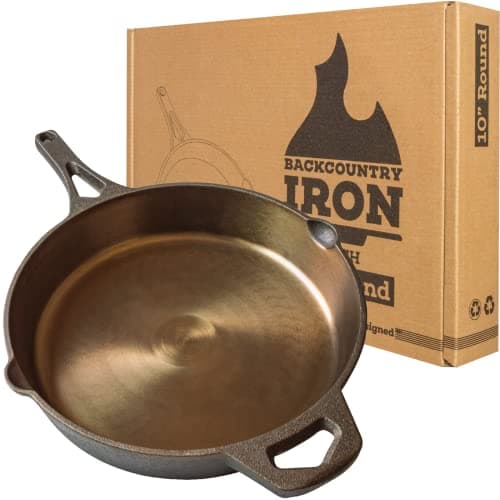
2. Backcountry Iron Wasatch — the cheapest milled surface
If the only thing you want is a machined interior and boutique prices are out, this is the pan. Backcountry Iron publishes a milled cooking surface, a deep heat ring, and weights of 7 lb for the 10-inch and 9 lb for the 12-inch. It ships seasoned in the company's own oil blend, so it cooks on arrival.
Honest cons: at a published 7 lb it is heavierthan the 10.25-inch Lodge you are replacing, which is the opposite of what most people expect from an upgrade, and Backcountry does not publish where the pans are cast — so if provenance is part of why you are leaving Lodge, this does not deliver it. Full comparison in Backcountry Iron vs Lodge.
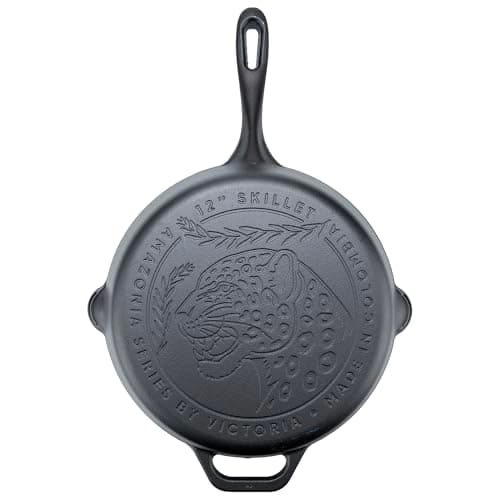
3. Victoria 12-inch — the handle fix, at the bottom of the market
Victoria has been family-owned since 1939 and manufactures in Colombia, seasoning its pans with flaxseed oil. The reason it is on this list is the handle: long and curved, it gives real leverage and keeps your hand further from the heat than a standard Lodge handle does, and the pan has pour spouts on both sides.
Honest cons: the old argument for Victoria was that it cost the same as a Lodge and offered more; that price parity is gone, so it is now a looks-and-handle buy rather than a value one. It is not American-cast, and it is not lighter. See Lodge vs Victoria and our Victoria review.
4. Field Company No. 6 — the weight fix, taken seriously
Field publishes 3 lb total weight for the No. 6, with an 8⅜-inch top diameter, a 7-inch cooking surface, a polished cooking surface, thinner sidewalls and a balanced handle, made in the USA. That is a genuinely different object from a modern mainstream pan — Field's whole pitch is casting thinner and polishing the interior, in the vintage Griswold tradition. If weight is the reason your cast iron lives in a cupboard, this is the most effective answer on the page.
Honest cons:the No. 6 is a small pan — a 7-inch cooking surface is a two-egg, one-chop pan, not a family skillet — and the bigger Fields cost accordingly. A thinner casting also stores less heat, so it recovers less well when you crowd it. See our Field review, Lodge vs Field and is Field Company worth it.
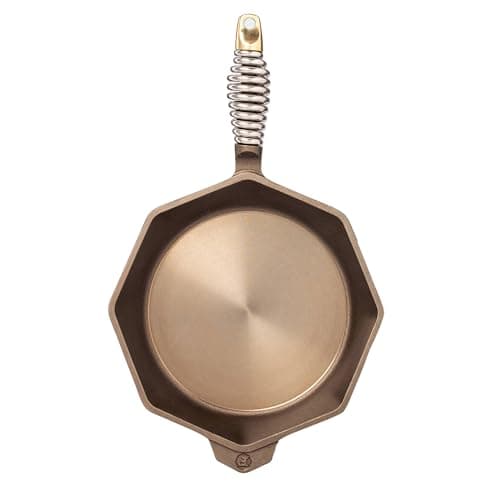
5. Finex 10-inch — the one you buy because you want it
Octagonal, eight pour spouts, and a coiled stainless steel spring handle that cools quickly: Finex makes the most distinctive American cast iron there is, in Oregon. The octagon is genuinely useful for pouring off fat from any angle, and the handle is the best-feeling one in this whole group.
Honest cons:it is a luxury and it does not pretend otherwise — this is the most expensive route out of a Lodge, the spring handle is a cleaning chore, and the faceted shape means a slightly smaller usable flat area than a round pan of the same diameter. See our Finex review and is Finex worth it.
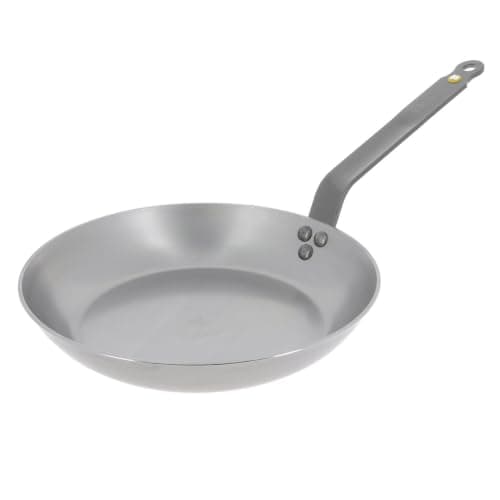
6. de Buyer Mineral B — leaving cast iron entirely
Plenty of people searching for a Lodge alternative do not want different cast iron; they want the same cooking without the mass. Carbon steel is the answer: rolled sheet instead of a casting, so it is thinner, lighter and far more responsive, and it seasons by the same polymerized-oil mechanism. de Buyer's Mineral B publishes a 3 mm base, 1,930 g for the 26 cm pan, French manufacture, induction compatibility and oven safety.
Honest cons: it ships coated in beeswax that has to be stripped before first use, it stores less heat than cast iron so it recovers more slowly under a crowded pan, and it is just as fussy about being dried. It also looks nothing like heirloom iron. Our best carbon steel skillets roundup and cast iron vs carbon steel cover the switch properly, and de Buyer vs Matfer Bourgeat settles the brand question inside carbon steel.
When the Lodge is still the right answer
Three cases, and they cover a lot of readers. If you cook outdoors — grill, campfire, camp stove — buy the cheap pan you will not wince about, which is a Lodge; see best cast iron for camping. If you want American iron at the lowest possible price, Lodge is the only mainstream foundry still casting at scale in the United States, as the list of American manufacturers makes clear, and best American-made cast iron sorts the rest. And if your real complaint is that food sticks, fix the preheat before you fix the pan.
There is also a middle path people miss: stay with Lodge but move up its own range. The Blacklock line is lighter and triple seasoned (though explicitly not machined), and the Chef Collection is smoother and a little lighter than the classic pans. Both cost a fraction of boutique money. If you want the whole field rather than the alternatives, that is the best cast iron skillets, and the best cast iron skillet brands ranks the makers themselves.
What we have not done:weighed these pans, measured surface roughness, or run release tests. Every figure on this page is the manufacturer's own published number, and where a maker publishes nothing — Victoria's and Finex's weights, Backcountry's country of casting — the table says so rather than guessing. That standard is set out on our methodology page.
How to choose a Lodge alternative
Name the complaint first, then shop
Weight, surface, handle or looks. Pans that fix weight (Field, Stargazer) are not the same pans that fix the handle (Victoria, Finex), and the cheapest machined pan fixes the surface while making the weight worse. Buying without naming the complaint is how people end up with a $200 pan that annoys them in exactly the same way.
Compare cooking surfaces, not rim diameters
A “10-inch” pan from one maker and a “10.5-inch” from another can have very similar flat areas, because sidewall flare differs. Field publishes a 7-inch cooking surface on an 8⅜-inch pan; Stargazer publishes 8.1 inches on a 10.5-inch pan. Those are the numbers that decide how much food fits.
Check whether the weight actually goes down
Boutique does not automatically mean light. The cheapest milled pan here is published at 7 lb — heavier than a 10.25-inch Lodge. If weight is your complaint, published weight is the only spec that matters, and our lightweight roundup ranks the field on exactly that.
Decide whether provenance is part of the point
If “made in the USA” is among your reasons, three of the pans here qualify and publish it, one publishes manufacture in Colombia, one publishes France, and one publishes nothing. There is no wrong answer; there is only knowing which you bought.
Budget for the accessories you were going to buy anyway
A silicone handle holder makes almost any short-handled pan tolerable, and a chainmail pad makes cleanup trivial on any bare-iron surface, machined or not. Both are cheap — see the accessories guide and chainmail vs steel wool. Spending there first has talked plenty of people out of a boutique purchase.
And keep the Lodge
Whatever you buy, keep the cheap pan. It is the one that goes on the grill, into the campfire, and into the oven at 500°F without a second thought, and the one you hand to a houseguest. The boutique pan becomes the stovetop pan; the Lodge becomes everything else. If you are still deciding what to buy at all, start from how to choose a cast iron skillet.