Skip to content
Hearth & Patina

The Brands

Staub Review

The other French icon: a dark matte-enamel interior made for browning and a lid that bastes the food for you.

By Stephen V.Updated How we research
#ad

We earn a commission when you buy through our Amazon links, at no extra cost to you. It never affects our rankings, and we say so when the cheaper pan is the better buy. How this works.

Staub is the French dutch oven for cooks who care most about browning and long, slow braises. Its signature is a dark matte-black enamel interior that takes high heat and hides stains, plus a lid studded with spikes that drip condensed moisture back onto the food as it cooks. It is every bit as well made as Le Creuset and priced right alongside it. Choose Staub over Le Creuset for the browning and the self-basting; choose Le Creuset if you want to see the fond and prefer a lighter look.

Staub and Le Creusetare the two names that come up whenever anyone talks about a "forever" enameled dutch oven, and people tend to treat them as interchangeable luxury. They are not. The differences are small on a spec sheet and real at the stove.

The two features that define a Staub

The matte black interior.Where Le Creuset uses a pale, glossy enamel, Staub uses a dark, slightly textured matte enamel. It takes aggressive, high-heat browning better than pale enamel, it does not show the stains and discolouration that a light interior picks up over years, and it is why so many restaurant kitchens reach for Staub. The trade-off is that you cannot read fond colour as easily — the dark surface hides how brown the bottom of the pot is getting.

The self-basting lid. The underside of a Staub lid is covered in small spikes (Staub calls the effect self-basting). As steam rises during a braise, it condenses on the cool lid and drips back down off those points, raining moisture evenly over the food instead of running to the edges (the mechanism is well documented). On a three-hour braise it keeps the top of a roast from drying out. It is a genuinely clever bit of design, not just marketing.

Made in France, owned by Zwilling

Staub cocottes are cast in France, as they have been since Francis Staub designed the first one in Alsace in the 1970s. The brand was acquired by the German knife-maker Zwilling J.A. Henckels in 2008 but continues to operate independently and manufacture in France (the official brand page leans hard on the "Made in France" heritage). So you are getting the same French pedigree as Le Creuset, from a different house.

Staub vs Le Creuset, decided

This is the comparison everyone actually wants, so here it is without hedging. Both are superb, both cost about the same, both will outlive you. The choice comes down to how you cook and what you want to look at.

If you want…Buy…
Hard, high-heat browning and stain resistanceStaub (dark matte enamel)
To see fond and browning as it developsLe Creuset (pale enamel)
A lid that bastes long braises for youStaub (spiked lid)
The lightest pot and biggest, comfiest knobsLe Creuset
A brighter, more classic look on the stoveLe Creuset

The honest caveat:neither pot cooks "better" than the other, and both cook only marginally better — if at all — than a Lodge enameled dutch oven that costs a third as much. If your budget is the deciding factor, the French-icon debate is a luxury you can skip entirely. See the Lodge vs Le Creuset guide for that math.

The cocotte and the braiser

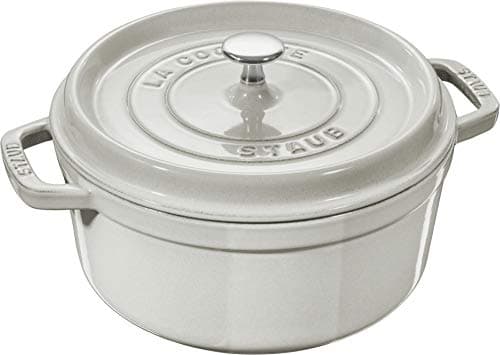
The 5.5-quart round cocotteis the flagship — the do-everything size for soups, stews, whole chickens and bread. Its dark interior and heavy, tight lid make it a specialist at low-and-slow cooking. If most of your cooking is braises, stews and short ribs, it is arguably the better buy than the equivalent Le Creuset.

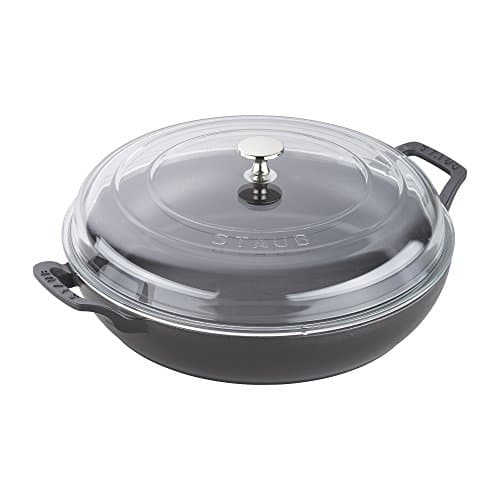
The 3.5-quart braisertakes a different tack from Le Creuset's: it comes with a glass lid, so you can watch a braise or a risotto without lifting anything. The trade is that a glass lid cannot take the extreme oven temperatures a solid cast-iron lid can. It is a lovely, wide, one-pan-meal vessel; just know the glass lid is the reason to choose it and also its one limitation. For deep stews and stock, the taller cocotte or a full dutch oven is the better shape.

Who Staub is for

Staub is for the cook who sears and browns aggressively, who does long braises and wants the lid working for them, and who would rather not watch a pale interior slowly stain over the years. It is where you are paying for the French logo in exactly the same way you are with Le Creuset — but at least the two signature features (the matte enamel and the spiked lid) give you something concrete for the money that a Lodge does not replicate. If none of that speaks to you, the value answer is still the Lodge.
The short answer

Quick picks

#ProductBest forScorePrice
01
Staub Round Cocotte, 5.5 qt

The other French icon — a dark matte-enamel interior built for browning and self-basting.

Browning and braising
8.2
$367.89Amazon
02
Staub Cast Iron Braiser, 3.5 qt

Staub's take on the wide braiser, with a glass lid and dark browning enamel.

A braiser you can watch
7.4
$199.95Amazon

#ad · Live prices from the Amazon Product API, as of Jul 17, 2026. Where we have no verified live price, we show none — we would rather leave a gap than print a number that has gone stale.

In detail

The picks, in full

01
Staub Staub Round Cocotte, 5.5 qt

Browning and braising

Staub Round Cocotte, 5.5 qt

5.5 qtMatte black enamelSelf-basting lidMade in France
8.2/10

The other French icon — a dark matte-enamel interior built for browning and self-basting.

Heat retention
10
Enamel durability
9
Everyday usability
8
Oven & stovetop range
9
Value
5

Pros

  • Dark matte-enamel interior takes high-heat browning better than pale enamel and hides stains
  • Spiked/self-basting lid drips condensed moisture back onto the food during long braises
  • Heavier build and a tight lid make it excellent for low, slow cooking

Cons

  • The dark interior makes it harder to read fond colour than Le Creuset's pale enamel
  • Every bit as expensive as Le Creuset, and heavier

Don't buy this if…

you bake a lot of bright, light dishes where you want to see the fond, or you want the lightest pot you can get. The dark interior and heft are the trade for its browning and basting strengths.

$367.89View on Amazon

Price as of Jul 17, 2026. Prices change — Amazon's is the one that counts.

#ad · we may earn a commission from this link to Staub Round Cocotte, 5.5 qt

02
Staub Staub Cast Iron Braiser, 3.5 qt

A braiser you can watch

Staub Cast Iron Braiser, 3.5 qt

3.5 qtGlass lidMatte enamelMade in France
7.4/10

Staub's take on the wide braiser, with a glass lid and dark browning enamel.

Heat retention
8
Enamel durability
8
Everyday usability
8
Oven & stovetop range
7
Value
6

Pros

  • Glass lid lets you watch a braise or risotto without lifting it
  • Dark matte enamel browns aggressively and hides stains
  • Wide, shallow shape for one-pan meals, stove to oven

Cons

  • Glass lid can't take the extreme oven temperatures a cast-iron lid can
  • Premium French price

Don't buy this if…

you want maximum oven temperature range — a solid cast-iron lid tolerates more heat than glass. Choose this if watching the pot without lifting the lid appeals.

$199.95View on Amazon

Price as of Jul 17, 2026. Prices change — Amazon's is the one that counts.

#ad · we may earn a commission from this link to Staub Cast Iron Braiser, 3.5 qt

How we picked

We do not run a testing lab

We researched published manufacturer specifications, materials and thermal properties, and aggregated owner reviews, then scored each pan against a published rubric. The scores are judgements from documented research — they are notmeasurements we took, because we do not have a lab and we are not going to pretend we do. Where a number came from a manufacturer's spec sheet or someone else's lab, we name it in Sources.

Questions

Frequently asked

What is the difference between Staub and Le Creuset?
Staub uses a dark matte enamel interior built for hard browning and a self-basting spiked lid; Le Creuset uses a pale interior that shows fond and is a touch lighter with bigger knobs. Both are French, similarly priced and superb. See the full split in the Le Creuset review.
What does the Staub self-basting lid actually do?
Spikes on the underside of the lid catch condensed steam and drip it back down onto the food, basting it evenly through a long braise (details). It helps keep the top of a roast from drying out over several hours.
Is Staub made in France?
Yes — Staub cast iron is manufactured in France. The brand has been owned by Zwilling J.A. Henckels since 2008 but still casts its cocottes in France (brand page).
Is the dark interior a downside?
Only if you like to watch fond develop. The dark matte enamel hides how brown the pot bottom is getting, so judging a deglaze takes a little more feel than with Le Creuset's pale interior. In return it browns harder and never looks stained.
Is Staub worth it over a Lodge enameled dutch oven?
For pure cooking, only marginally. The matte enamel and spiked lid are real features, but a Lodge enameled potbraises nearly the same for a third of the price. Buy Staub for those features, the French build and the looks — not for a better dinner.

Keep reading

Receipts

Sources

We do not run a testing lab, and we do not pretend to. Where a measured number came from a manufacturer's spec sheet or someone else's lab, we name them and link them. Where we could not verify something, we say so on the page rather than quietly leaving it out. Read our full method.