Skip to content
Hearth & Patina

Guides & Comparisons

Cast Iron Grill Pan vs Skillet

Ridges or a flat floor: that is the entire difference, and it decides how much of your food actually touches hot iron. Here is which pan wins each job, and why the skillet should still be the one you buy first.

By Stephen V.Updated How we research
#ad

We earn a commission when you buy through our Amazon links, at no extra cost to you. It never affects our rankings, and we say so when the cheaper pan is the better buy. How this works.

Top pick

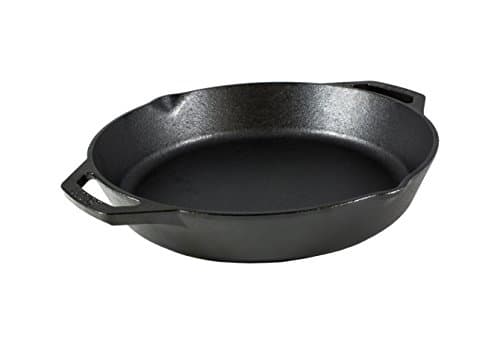
Lodge Lodge 10.25" Pre-Seasoned Cast Iron Skillet

Lodge 10.25" Pre-Seasoned Cast Iron Skillet

10.25 inPre-seasonedMade in USA5.66 lb
$24.42View on Amazon

Price as of November 2, 2026. Prices change — Amazon's is the one that counts.

#ad · we may earn a commission from this link to Lodge 10.25" Pre-Seasoned Cast Iron Skillet

Buy the skillet. A frying pan is flat-bottomed with low sides that flare outwards, and that flat floor is the feature: all of your steak's underside touches hot iron, not a third of it. It also holds fat, liquid and batter, so the same pan sears, fries, bakes and makes a pan sauce. Lodge publishes that the classic skillet is made in the USA and compatible with any stovetop including induction, the oven, the grill or a campfire. A grill pan does one thing better and several things worse.

Want the marks and the fat drainage — chops, sausages, zucchini, halloumi, chicken thighs with the skin up? Then the 10.5-inch square Lodge is the cheapest honest way to get them, and the Chef Collection 11-inch is the nicer one to live with.

Compare

Four pans, and what each cooking surface actually touches

VesselCooking surfaceFood contactFat behaviorPriceBuy
Lodge 10.25" Pre-Seasoned Cast Iron Skillet

Lodge

Flat round floorFull undersidePools in the pan$24.42Check Price on Amazon
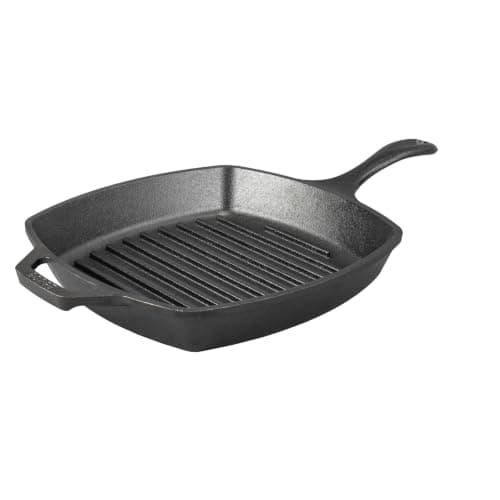
Lodge Square Cast Iron Grill Pan, 10.5"

Lodge

Raised ridges, 0.31 in apartRidge tops onlyDrains into channels$24.90Check Price on Amazon
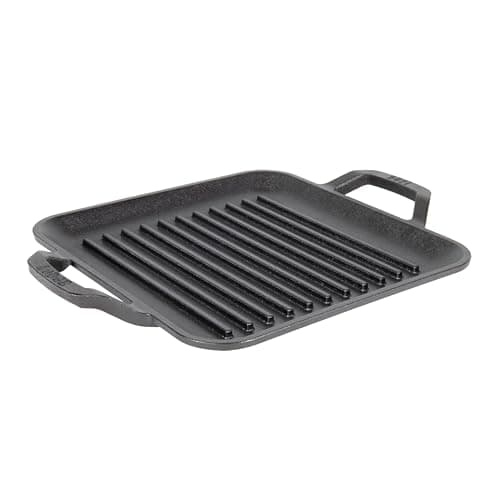
Lodge Chef Collection 11" Cast Iron Grill Pan

Lodge

Raised ridges, lighter castingRidge tops onlyDrains into channels$39.90Check Price on Amazon
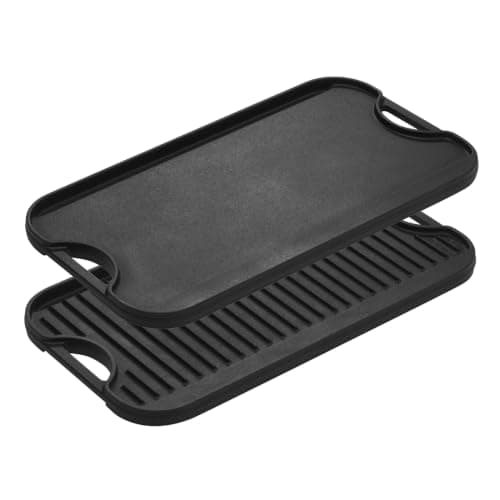
Lodge Pro-Grid Reversible Grill/Griddle, 20"

Lodge

Flat one side, ridged the otherEither, your choiceBoth, your choice$49.90Check Price on Amazon

#ad · Live prices from the Amazon Creators API, as of November 2, 2026. Where we have no verified live price we show none rather than a stale number — we may earn a commission.

Buy the skillet first, and buy the grill pan only once you know you want grill marks. Both pans are the same iron with the same stored heat; the difference is how much of your food touches it. A skillet offers a flat floor, so the entire underside of a steak is in contact with hot metal. A grill pan offers ridges — Lodge's square pan publishes raised grill ridges set 0.31 inches apart — so contact happens along the ridge tops and the rest of the food cooks in hot air above the channels. That single geometric fact explains every practical difference below.

Most people arrive here for one of two reasons. Either they want steakhouse grill marks indoors and are wondering whether the ridged pan is the better buy — it is not, not as a first pan. Or they already own a skillet, keep seeing grill pans on sale, and want to know whether it would actually earn cupboard space. Below we work through the five differences that matter, then call each job outright.

What each pan is, precisely

A skillet is a round pan with a flat floor, sloped or straight walls, a long handle and usually a short helper handle. A grill pan is the same casting idea with a ridged cooking surface: raised parallel bars with channels between them. It sits between a skillet and a griddle, which is a broad, usually flat cooking surface — and which, in commercial form, comes flat or grooved. Both pans are cast iron, both ship pre-seasoned from the major makers, both brown food by the same Maillard reaction, and both want the same care. Nothing here is about one being better metal.

A quick word on terms, because they get used loosely. A grill pan has ridges. A griddle is flat. A grill— the outdoor kind — cooks over live fire or coals, and no pan on a stovetop reproduces that. If the comparison you actually wanted was ridges versus a flat slab, that is grill pan vs griddle; if it was walls versus a flat slab, that is cast iron skillet vs griddle. This page is the third side of that triangle.

Difference 1: how much food touches hot iron

This is the whole comparison. On a flat skillet floor, a steak makes contact across its entire underside. On a ridged pan, contact is limited to the strips of metal under the ridge tops, and the food sitting over the channels is cooked by hot air instead. Air transfers heat far less efficiently than metal does, which is why the same steak develops a complete crust in a skillet and striped bars of crust in a grill pan.

Neither pan is hotter than the other. Both have the same thermal mass, so both hold their temperature when cold food lands. The crust difference is purely about contact area. If a wall-to-wall brown crust is what you are chasing — and on a steak, that crust is most of the flavor — the skillet wins and it is not close.

The flip side is that the channels are doing something useful: they are the reason a grill pan exists. Read on.

Difference 2: what happens to the fat

In a skillet, rendered fat pools around the food. That is often exactly what you want — it is how you baste a steak with butter, how bacon fat ends up in the cornbread, and how you build fond for a reduced pan sauce. It is also the reason a fatty chop can end up half shallow-fried rather than seared.

In a grill pan, the fat drains into the channels and sits below the food. Sausages, lamb chops, chicken thighs and bacon come out less greasy. So do marinated vegetables, which would otherwise stew in their own liquid. If you cook a lot of fatty cuts, that drainage is a genuine, repeatable improvement — the one thing a grill pan does that a skillet simply cannot.

Two honest caveats. Drained fat still smokes in the channels, so a grill pan is not a low-smoke pan; if smoke is your problem, see how to sear steak without smoke. And whatever drains into the channels is gone — you cannot build a pan sauce out of it.

Difference 3: grill marks, and what they are worth

Grill marks are real browning, just localized. They look like a restaurant plate and they taste like concentrated crust, which is why people want them. What they are not is live-fire flavor. Smoke flavor comes from fat dripping onto coals or a burner and vaporizing back onto the food; in a grill pan the fat drips into a channel in the same pan and nothing combusts. Any pan that claims to deliver charcoal flavor indoors is overselling.

So buy a grill pan for the marks and the drainage, not for a flavor it cannot produce. If what you want is the real thing, a skillet or a grate on an actual grill is the answer — see the best cast iron for the grill.

Difference 4: cleaning, and this one is lopsided

A flat skillet floor is the easiest surface in the kitchen to clean: hot water, a brush, dry it, wipe a film of oil. A ridged pan has channels that collect burnt fat and stuck protein, and the brush has to get down into each one. Every ridged pan is more work than every flat pan, every time. There is no technique that makes this not true — a stiff brush and cleaning while the pan is still warm are the two things that help most.

That maintenance gap is the single most common reason grill pans get bought and then abandoned. It is worth being honest with yourself about before you spend the money. Our how to clean cast iron guide covers both surfaces, and how to clean a cast iron griddle has the ridge-specific routine.

Difference 5: versatility and weight

A skillet does nearly everything in the category: searing, frying, a pan sauce, cornbread, a frittata, a skillet cookie, deep-dish pizza, roasting a chicken. A grill pan does ridged food. You cannot fry an egg properly on ridges, cannot bake a batter in them, cannot shallow-fry, and cannot make a sauce. It is a specialist tool and it should be bought as one.

Weight is worth checking too. Lodge publishes 7.33 lb and 17.06 inches of overall length for the 10.5-inch square grill pan, which is heavier and longer than a 10.25-inch round skillet — the square body and the long handle both add. The Chef Collection pan is the line Lodge positions as lighter with an improved handle, which is the upgrade most cooks actually feel; we are not quoting a figure for it, because Lodge does not publish a spec table for that pan and the retailer listings contradict each other.

Job by job: which pan wins

Steak — skillet. Full-contact crust, and the fat stays in the pan so you can baste with butter and aromatics. The grill pan gives you marks and less crust. Our method is in the best cast iron for steak and how to sear in cast iron.

Lamb chops, pork chops, sausages — grill pan. Fatty cuts are exactly where drainage pays. They would swim in a skillet.

Chicken thighs, skin on — grill pan, for the same reason, as long as you are not planning a pan sauce afterward.

Vegetables — grill pan. Zucchini, peppers, asparagus, eggplant, halloumi: the ridges keep them out of their own released water, so they char instead of stewing.

Smash burgers — neither, really.You need a flat surface and an open edge to scrape against, which is a griddle's job. See best cast iron for smash burgers.

Eggs — skillet, only. There is no ridged answer to a fried egg.

Bacon — either, and it depends what you want. Grill pan for leaner strips; skillet if you want to keep the rendered fat, which you usually do. A grill press improves both.

Cornbread, frittatas, skillet cookies, pizza — skillet, only. Batter and dough need a flat floor and walls.

Pan sauces — skillet, only. The fond and the fat you need are the two things a grill pan throws away.

Pancakes and tortillas — neither. That is a griddle. The shape argument is in cast iron skillet vs griddle.

Should you own both?

Eventually, and in this order. The skillet is the piece that covers the most ground, so it goes first — it is the pick on the best cast iron skillets for exactly that reason. The grill pan earns its place the moment chops, sausages or charred vegetables become a weekly habit, or the moment the weather closes your outdoor grill for four months.

If you want the ridged category ranked rather than the shape argument, that is the best cast iron grill pans. And if you want one piece of iron that does both, the two-burner reversible slab is flat on one face and ridged on the other — a real answer, at the cost of a pan that will not fit in most sinks.

The verdict

One pan: a 10 to 10.25-inch skillet. Flat floor, full contact, every job.

Two pans:that skillet plus a ridged grill pan, if you cook fatty cuts and vegetables often. Buy the cheap square Lodge unless the handle and the weight genuinely bother you — and if the price makes you suspicious, read why Lodge cast iron is so cheap before you assume it is the lesser pan.

Both surfaces, one piece: the reversible slab, if you have two burners in a line and a cupboard shelf to spare.

Whichever you buy, the thing that will actually improve your results is not the ridges — it is preheating properly and keeping the seasoning in order. Lodge has been casting iron in South Pittsburg, Tennessee since 1896, and a 1896-pattern pan still cooks badly if you put food in it cold. How to preheat cast iron is the page to read next.

The short answer

Quick picks

#ProductBest forScorePrice
01
Lodge Lodge 10.25" Pre-Seasoned Cast Iron Skillet
Lodge 10.25" Pre-Seasoned Cast Iron Skillet

The honest first cast-iron pan for almost everyone. Cheap, indestructible, made in the USA.

The default first skillet
8.4
$24.42Amazon
02
Lodge Lodge Square Cast Iron Grill Pan, 10.5"
Lodge Square Cast Iron Grill Pan, 10.5"

The cheap way to get grill marks and rendered fat drainage indoors, year-round.

Indoor grill marks on a budget
7.8
$24.90Amazon
03
Lodge Lodge Chef Collection 11" Cast Iron Grill Pan
Lodge Chef Collection 11" Cast Iron Grill Pan

A lighter, smoother grill pan with a more comfortable handle than the standard Lodge.

A nicer everyday grill pan
7.6
$39.90Amazon
04
Lodge Lodge Pro-Grid Reversible Grill/Griddle, 20"
Lodge Pro-Grid Reversible Grill/Griddle, 20"

One slab, two surfaces, two burners. Pancakes and bacon on the flat, grill marks on the ridged.

Feeding a crowd breakfast
8.0
$49.90Amazon

#ad · Live prices from the Amazon Product API, as of November 2, 2026. Where we have no verified live price, we show none — we would rather leave a gap than print a number that has gone stale.

In detail

The picks, in full

01
Lodge Lodge 10.25" Pre-Seasoned Cast Iron Skillet

The default first skillet

Lodge 10.25" Pre-Seasoned Cast Iron Skillet

10.25 inPre-seasonedMade in USA5.66 lb
8.4/10

The honest first cast-iron pan for almost everyone. Cheap, indestructible, made in the USA.

Heat retention
9
Cooking surface
7
Handling
7
Versatility
9
Value
10

Pros

  • The 10.25" is the size that fits four eggs, two steaks, or a batch of cornbread — the most useful single size
  • Pre-seasoned from the factory, so it works the day it arrives
  • Costs a fraction of a boutique pan and will outlive you with basic care

Cons

  • The cooking surface is pebbly, not machined smooth — food releases better once you build your own seasoning on top
  • The short helper handle is small; a leather or silicone sleeve on the main handle is a near-essential add

Don't buy this if…

…you specifically want a glass-smooth machined surface out of the box. That is what Stargazer, Smithey and Field sell, at five to eight times the price — for most cooks the Lodge gets there with a few months of use.

$24.42View on Amazon

Price as of November 2, 2026. Prices change — Amazon's is the one that counts.

#ad · we may earn a commission from this link to Lodge 10.25" Pre-Seasoned Cast Iron Skillet

02
Lodge Lodge Square Cast Iron Grill Pan, 10.5"

Indoor grill marks on a budget

Lodge Square Cast Iron Grill Pan, 10.5"

10.5 in squareTall ridgesPre-seasonedMade in USA
7.8/10

The cheap way to get grill marks and rendered fat drainage indoors, year-round.

Heat retention
9
Cooking surface
7
Handling
7
Versatility
7
Value
9

Pros

  • Tall ridges lift food out of rendered fat and lay down real grill marks
  • Square shape fits more chops or vegetables than a round pan
  • Cheapest honest route to indoor grilling

Cons

  • Ridges are a pain to scrub clean — a stiff brush is essential
  • It sears and marks, but it does not replicate live-fire flavor

Don't buy this if…

…you expect charcoal flavor indoors — no pan delivers that. Buy it for the marks, the fat drainage and searing in bad weather.

$24.90View on Amazon

Price as of November 2, 2026. Prices change — Amazon's is the one that counts.

#ad · we may earn a commission from this link to Lodge Square Cast Iron Grill Pan, 10.5"

03
Lodge Lodge Chef Collection 11" Cast Iron Grill Pan

A nicer everyday grill pan

Lodge Chef Collection 11" Cast Iron Grill Pan

11 inChef CollectionSmoother finishMade in USA
7.6/10

A lighter, smoother grill pan with a more comfortable handle than the standard Lodge.

Heat retention
8
Cooking surface
8
Handling
8
Versatility
7
Value
7

Pros

  • Lighter and smoother than the standard Lodge grill pan
  • Improved handle and a slightly refined casting
  • Big enough for several servings without straddling burners

Cons

  • Costs more than the standard square Lodge grill pan for modest gains
  • Ridged pans are always harder to clean than flat ones

Don't buy this if…

…you're on a tight budget — the standard Lodge square grill pan does the same job for less. Pick this for the better handle and lighter weight.

$39.90View on Amazon

Price as of November 2, 2026. Prices change — Amazon's is the one that counts.

#ad · we may earn a commission from this link to Lodge Chef Collection 11" Cast Iron Grill Pan

04
Lodge Lodge Pro-Grid Reversible Grill/Griddle, 20"

Feeding a crowd breakfast

Lodge Pro-Grid Reversible Grill/Griddle, 20"

20 x 10.5 inFlat + ridgedTwo burnersMade in USA
8.0/10

One slab, two surfaces, two burners. Pancakes and bacon on the flat, grill marks on the ridged.

Heat retention
9
Cooking surface
8
Handling
5
Versatility
9
Value
9

Pros

  • Spans two burners for a genuinely big flat cooking surface
  • Reversible: smooth griddle for pancakes and smash burgers, ridges for grill marks
  • Enormous thermal mass keeps temperature steady when you load it with cold food

Cons

  • Big, heavy and awkward to store and to wash in a standard sink
  • Straddling two burners means the middle can run cooler than the ends

Don't buy this if…

…you have a small kitchen or a single-burner setup. This is a batch-cooking tool for weekend breakfasts and burger nights, not an everyday pan.

$49.90View on Amazon

Price as of November 2, 2026. Prices change — Amazon's is the one that counts.

#ad · we may earn a commission from this link to Lodge Pro-Grid Reversible Grill/Griddle, 20"

How to choose between them

Count how many of your regular meals are fatty cuts

This is the deciding question, and it is the only one. If chops, sausages, skin-on chicken or charred vegetables show up most weeks, a grill pan will earn its keep through drainage alone. If your regular rotation is steak, eggs, bacon and something baked, the skillet already covers all of it and a grill pan will sit in the cupboard.

Match the pan to the burner, not the counter

A grill pan concentrates its heat in the ridges, and cast iron moves heat sideways slowly. A square pan overhanging a small burner will have hot ridges in the middle and lukewarm ones at the corners, and it never fully catches up. Measure your largest burner before you buy a square pan, and preheat for longer than feels reasonable — three to five minutes over medium is not excessive.

Decide whether you will actually scrub the channels

Be honest. A ridged pan needs a stiff brush worked along every channel, ideally while the pan is still warm. If that sounds like something you will skip, buy a second skillet instead — a pan you maintain beats a pan you avoid.

Square or round

Square fits more straight-sided food: four chops, a row of sausages, a tray's worth of zucchini planks. Round fits your burner better and is easier to store. Lodge's square pan publishes a 10 by 8.12-inch flat bottom inside a 10.5-inch body, so the usable ridged area is meaningfully smaller than the outside dimension suggests — worth knowing before you assume a 10.5-inch pan holds four chops.

Do not buy ridges for the marks alone

If you want grill marks occasionally and nothing else, a grill press on a hot skillet gets you most of the way for a fraction of the money and none of the cleaning. The press is also the better buy for bacon and paninis.

Both pans take the same care

There is no separate grill-pan seasoning routine. Dry it, oil it lightly, keep it out of standing water, and do not let it sit wet in the sink. Ridges have more nooks for water to hide in, which is the one care difference worth knowing. How to season cast iron applies to both.
How we picked

We do not run a testing lab

We researched published manufacturer specifications, materials and thermal properties, and aggregated owner reviews, then scored each pan against a published rubric. The scores are judgments from documented research — they are notmeasurements we took, because we do not have a lab and we are not going to pretend we do. Where a number came from a manufacturer's spec sheet or someone else's lab, we name it in Sources.

Questions

Frequently asked

Is a cast iron grill pan better than a skillet?
No, not as a general-purpose pan. A skillet's flat floor puts the whole underside of your food against hot iron, so it browns harder and more evenly, and it holds fat, liquid and batter so it also fries, bakes and makes sauces. A grill pan is better at exactly two things: grill marks, and draining fat away from fatty cuts and wet vegetables. Buy the skillet first.
Can I use a grill pan as a skillet?
Only for things that do not need full contact or a flat surface. Chops, sausages and vegetables are fine. Eggs, pancakes, cornbread, anything with batter, anything that needs a pan sauce, and any shallow frying are all out — the channels mean food sits unevenly and fat drains away from where you need it.
Does a cast iron grill pan give real grilled flavor?
It gives real browning in stripes, which tastes like concentrated crust — but not live-fire flavor. Smoke flavor comes from fat dripping onto coals or a burner and vaporizing back onto the food. In a grill pan the fat drips into a channel in the same pan and nothing combusts. Buy one for the marks and the drainage, not for a flavor no pan can produce indoors.
Which cooks a steak better, a grill pan or a skillet?
A skillet, clearly. Both pans hold the same thermal mass, so neither is hotter — but the skillet's flat floor browns the entire underside, while the grill pan browns only the strips under the ridge tops. The skillet also keeps the rendered fat and butter in the pan so you can baste. The grill pan's advantage is cosmetic.
Are cast iron grill pans hard to clean?
Harder than any flat pan, yes. Burnt fat and stuck protein collect in the channels between the ridges and a brush has to be worked along each one. Cleaning while the pan is still warm and using a stiff brush are the two things that help most. This is the most common reason grill pans end up unused, so weigh it before buying.
What size cast iron grill pan should I buy?
Buy the one that matches your largest burner, not the biggest one you can find. Lodge's 10.5-inch square pan publishes a 10 by 8.12-inch flat bottom, so its usable ridged area is smaller than the outside measurement implies. A pan that overhangs a small burner will have cool corners that never catch up, because cast iron spreads heat sideways slowly.

Keep reading

Receipts

Sources

We do not run a testing lab, and we do not pretend to. Where a measured number came from a manufacturer's spec sheet or someone else's lab, we name them and link them. Where we could not verify something, we say so on the page rather than quietly leaving it out. Read our full method.