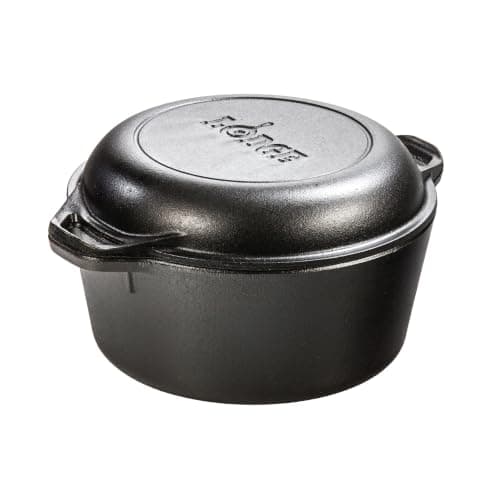
The best cast iron pot for most people is the Lodge Double Dutch Oven, because its lid is a full skillet and you therefore get two pans for one price. Everything on this page is bareiron — seasoned, not enameled. If you want a glass-coated pot you can throw tomatoes and soap at, you want the enameled page instead, and if you are buying a pot specifically to bake sourdough, that is its own page. This one is for the cook who actively wants iron.
Bare iron and enamel are two different purchases
Both are cast iron pots. The difference is what is on the inside. Vitreous enamel is glass fused to the iron: inert, so acid does not touch it, dishwasher-tolerant in principle, and it never needs seasoning — but it chips, it cannot be rebuilt once chipped, and it will never develop a slick surface. Bare iron is the opposite trade. Seasoning is polymerized oil, so the surface improves with every use and can always be stripped and rebuilt from scratch, but you have to dry the pot and keep it oiled, and a long tomato braise will eat into the layer and taste faintly metallic.
That is the whole decision, and it is a decision about you, not about quality. We argue it out properly in bare vs enameled dutch oven and enameled vs bare cast iron. Everything below assumes you have landed on bare.
The thing that separates these pots is the lid
All four pots here are thick, seasoned Lodge iron with similar walls and similar thermal mass. Capacity varies by a couple of quarts. What genuinely changes how you cook is the lid, and it is the spec nobody compares:
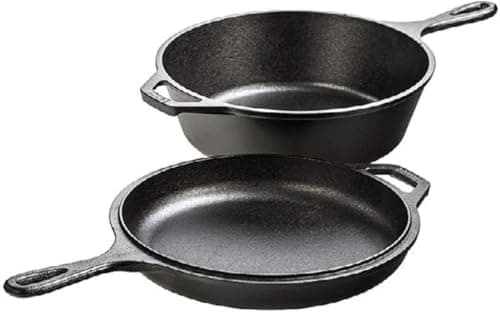
- A lid that is a skillet(Double Dutch, Combo Cooker). Two vessels, one purchase, one shelf. Lodge publishes the Combo Cooker as exactly this — a deep pan and a shallow pan that doubles as its lid.
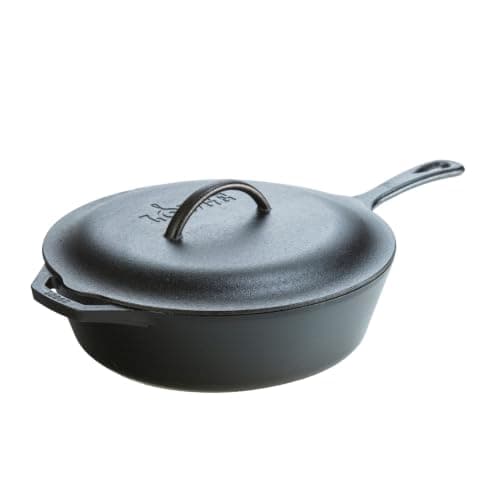
- A plain domed lid(Deep Skillet). Does one job, does it with less weight than a skillet-lid and a tighter seal — which is what you want over hot oil.
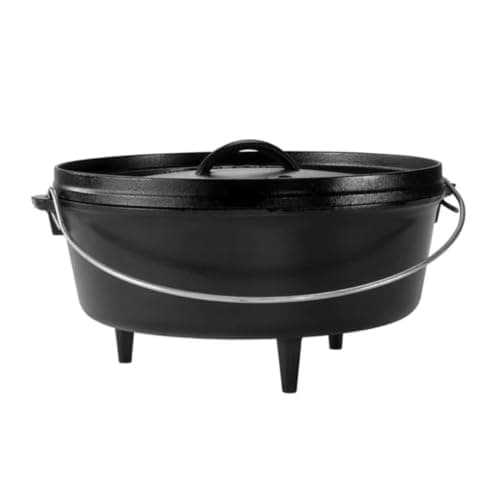
- A flat, flanged lid (Camp Dutch Oven). The flange is a wall that holds a bed of coals on top of the pot, which is the entire mechanism that turns a campfire into an oven. On a flat home stovetop the same flange and the three legs are just in the way.
Capacity: 3 quarts is more pot than it sounds
Bare iron pots run smaller than enameled ones, and that is fine, because bare iron is mostly used for searing, frying, bread and one-pot dinners rather than for a stockpot's worth of soup. A 3.2-quart combo cooker takes a standard boule. A 5-quart pot braises four generous portions of short ribs. A 6-quart camp oven feeds a group. If you genuinely need eight quarts for stock, you want a large enameled pot— nobody makes a bare-iron pot that big that one person can lift when it is full.
Our what size dutch oven page has the full sizing argument, and 5 quart vs 7 quart is the comparison most buyers are actually stuck on.
What bare iron is genuinely better at
Three things, and they are the reasons to choose this page over the enameled one. First, searing: there is no glass layer between the food and the iron, so you can run the pot blisteringly hot without worrying about thermal shock to an enamel coating. Second, frying: bare iron takes a hard preheat, and cast iron's slow conduction is an advantage once it is up to temperature, because the oil barely drops when the food goes in — see how to deep fry in cast iron. Third, bread: a bare pot can be preheated empty to 500°F indefinitely with no enamel to craze, which is why the shallow combo cooker is such a good loaf vessel. If your loaves are scorching underneath, that has a fix and it is not the pot.
The honest cons
Bare iron pots are heavy, every one of them needs drying and a wipe of oil, and none of them is the right tool for a two-hour tomato braise. They are also, every one, unlovely compared to a coloured French pot — if the pot is going on the table, enamel wins on looks and we are not going to pretend otherwise. And a bare pot you neglect will rust, which is annoying rather than fatal: rust comes off, and a rusty pan is not dangerous.
One more: a bare pot is oven-safe to any temperature your oven reaches, with no knob or gasket to worry about — the full answer on cast iron in the oven. That is a genuine advantage over most enameled pots, whose makers publish a ceiling.
How to choose between these four
In order, because the first question settles most of it:
- Will this pot ever go over a fire?If yes, buy the camp oven and stop reading — legs and a flanged lid are not optional for coal cooking, and no flat-based pot substitutes. See how to camp cook with cast iron.
- Is this mostly a bread pot? Then shallow beats deep. Lowering a proofed boule into a tall pot is how people burn their forearms; the combo cooker lets you set the loaf on the flat pan and drop the dome over it. Combo cooker vs dutch oven covers this properly.
- Is this mostly a frying pot? Then the deep skillet. Tall straight sides hold a safe depth of oil, the plain lid actually contains splatter, and there is no skillet lid to find a home for.
- None of the above — it is the household pot? Double Dutch Oven. The skillet lid makes it the most useful object per dollar in this whole category.
What you do not need to compare
Finish and brand, on this page. All four pots are sand-cast with the ordinary pebbly as-cast interior, all four are Lodge, and none of them is machined. Nobody makes a milled bare-iron pot at a sane price, and it would not help: the texture fills in with seasoning within a few months of real use, and a pot spends most of its life holding liquid, where surface slickness barely matters. Save the smooth-finish argument for skillets, where it does matter — smooth vs rough cast iron.
Also do not compare on oven ceilings. These are bare iron with iron lids; there is no stated limit to exceed. And if you are buying this as a present rather than for yourself, the presentation problem is real and the dutch oven gift guide is the better starting point.