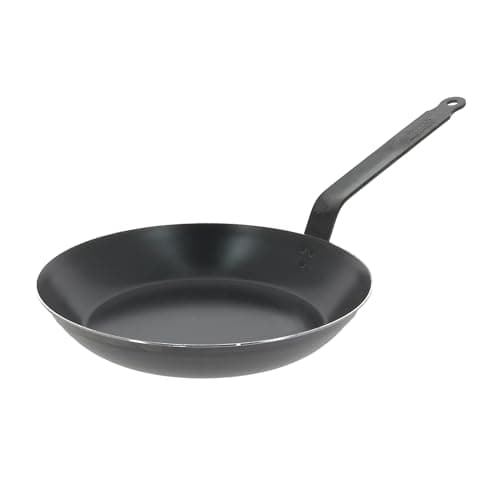
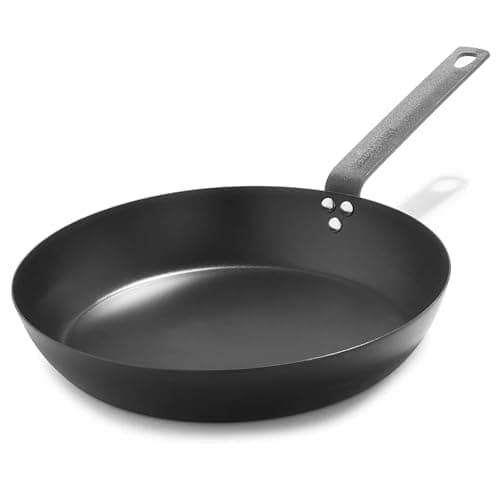
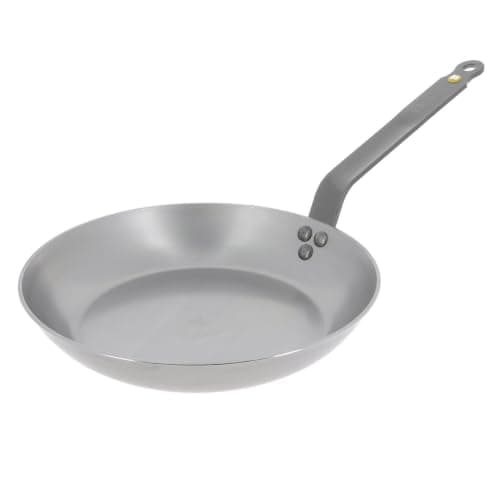
The best carbon steel pan under $100 is the De Buyer Mineral B 10.25-inch, best for a cook who wants one pan for eggs and steak both. The budget pick is the Merten & Storck 12-inch, best for anyone finding out whether they like carbon steel before spending French money. Three of the five carbon steel fry pans in our registry carried a live price under $100 when this page was last priced — which makes this the cheapest route into cookware a professional kitchen would actually use.
Why carbon steel is cheap for what it is
Carbon steel is steel whose main alloying constituent is carbon, with no minimum specified content of chromium or nickel. That is the whole cost story. There is no chromium to pay for, no aluminum core to bond, no non-stick coating to apply and inspect, and no cladding step. A carbon steel fry pan is a stamped disc of steel with a handle riveted to it. The reason restaurant kitchens buy them by the dozen is that they are cheap, nearly indestructible, and can be re-seasoned instead of replaced.
The flip side of having no chromium is that these pans rust, and they arrive sticky. The release comes from the polymerized-oil seasoning layer you build over the first few weeks, exactly as with bare cast iron. Nobody should buy a pan in this band expecting non-stick behavior on day one.
The two pans that are not in the band
We carry five carbon steel fry pans and three of them are under $100. The induction-specific Mauviel M'Steel sits above the ceiling, so it is named here rather than ranked: if you cook on induction and want a carbon steel pan designed for it, that is the one to look at and it will cost more than this page covers. Every pan here works on induction in the practical sense — steel is ferromagnetic — but a thin pan on a powerful induction hob is easier to warp than a thick one.
The Matfer Bourgeatis the other one, and it used to be on this page. Matfer discontinued the 11 5/8-inch pan we had been pricing; the nearest size it still sells is the 12 5/8-inch, and that one lands above $100. It is the pan to buy if you are cooking on a line or for a crowd every day — it is just no longer a sub-$100 pan, so it is named here rather than ranked.
Thick or thin, which is the real decision
The three picks split cleanly. The Mineral B is the thick pan: more thermal mass, so it holds a sear when cold protein hits it, and heavier to hold out at arm's length. The De Buyer Blue is the thin one: it heats in seconds, responds the instant you turn the burner down, and is light enough to tilt an omelette out of. The Merten & Storck sits in between and is the largest at 12 inches.
If you are buying one pan, buy the thicker one — a thick pan does eggs adequately and steak superbly, while a thin pan does eggs superbly and steak adequately. If you are buying a second pan to sit next to a cast iron skillet, buy the thin one, because you already own the mass. Our best carbon steel pans for eggs page ranks the same field on the thin-and-light axis specifically.
What you give up against cast iron at this price
Honestly: a little mass and a lot of weight. For the price of the Mineral B you could buy three Lodge skillets, and the Lodge holds heat better. A one-piece 12 5/8-inch Matfer is still appreciably lighter than a 12-inch cast iron pan, has sloped sides you can toss food in, and heats far faster. That is the trade: carbon steel is the responsive, manageable version of bare iron, and it costs more per inch. Our cast iron vs carbon steel comparison lays out where each one wins.
How the band is checked
Every number here comes from the live Amazon listing at the date stamped under the comparison table. If a pick drifts above the $100 line it comes off the page rather than staying on with a stale price, and where there is no verified live price we show none. That is also why the band is three pans and not five — we are not going to round a pan down to fit a headline.