Use chainmail for baked-on food on a seasoned pan, a stiff brush for everyday washing-up, and a plastic scraper for the stuck patch in the corner. Keep steel wool for one job only: stripping rust or a ruined seasoning off a pan you are about to re-season from scratch. Steel wool on a pan you want to keep seasoned does exactly what it looks like it does — it takes the seasoning off.
The reason this matters more on cast iron than on any other cookware is what the non-stick surface actually is. Seasoning is not a coating sitting on the metal; it is oil that has polymerized into a hard, bonded layer chemically attached to the iron. It is tough, and it is also thin — built up over many cooks in films you can barely see. A tool that abrades metal will happily abrade that.
What each tool is for
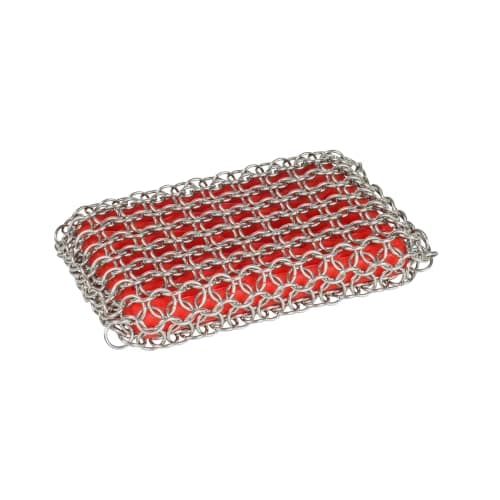
Chainmail.A mat of small interlocking metal rings with a core you grip. Lodge's version is published as 304 stainless steel chainmail with a silicone core, dishwasher safe, and described by Lodge as removing “stubborn food easily, without removing seasoning”. That last part is the maker's claim rather than a measurement of ours, but the mechanism is sound: the rings are hard enough to shear off carbonized food residue, yet they present rounded surfaces and they flex, so they scrape rather than sand. The 300-series stainless also matters practically — it will not rust in a damp pan the way plain steel wool does.
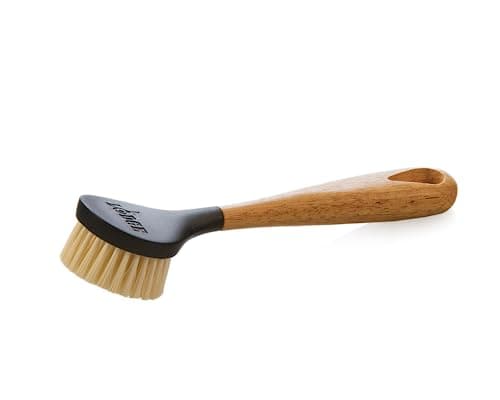
A stiff-bristle brush. The everyday tool, and the one most people should reach for nine times out of ten. Lodge's own scrub brush gets food off a warm pan under running water without touching the seasoning at all, and it gets into the corner where the wall meets the base. It is also the only one of these that is pleasant to use on a pan that is still hot.
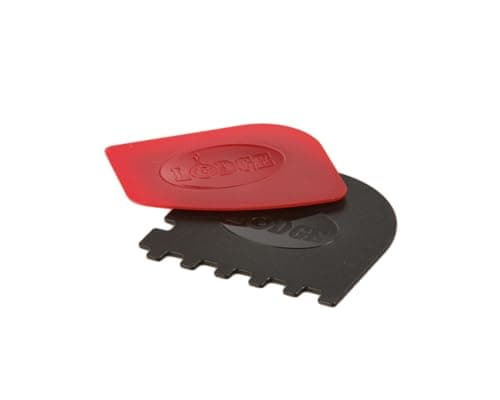
A plastic pan scraper.A hard polycarbonate wedge with different radii on its corners. For one baked-on patch — a fried-on bit of egg, caramelised sugar from a cobbler — a scraper is faster and gentler than anything abrasive, because it attacks only the lump and never touches the rest of the surface.
Steel wool. Fine strands of carbon steel designed to abrade metal. It will take food off, and it will take seasoning off at the same time, because it cannot tell the difference. It also sheds steel fibres that rust in place if they stay in the pan.
| Tool | Use it for | Effect on seasoning | Material |
|---|
| Chainmail scrubber | Baked-on, carbonized food on a seasoned pan | Designed not to remove it (maker's claim) | 304 stainless rings, silicone core (Lodge, published) |
| Stiff-bristle brush | Everyday washing, hot or warm pan | None | Plastic bristles, wooden or plastic handle |
| Plastic pan scraper | One stubborn stuck patch | None | Hard plastic |
| Steel wool | Stripping rust or ruined seasoning before re-seasoning | Removes it — that is the job | Carbon steel strands (rust if left in the pan) |
When steel wool is the right tool
We are not anti-steel-wool; we are anti-steel-wool-on-Tuesday. If a pan has rust, or a flaking, patchy, sticky seasoning that has gone past rescue, then the correct move is to take it all back to bare gray metal and start again — and steel wool is exactly right for that. It is the standard first step in removing rust from cast iron and in stripping a seasoning, and it is the reason a flea-market pan can be brought back at all. After that, rinse the pan, dry it immediately, and re-season it in the same session — bare iron starts rusting within minutes of being wet.
If the seasoning is flaking in patches but the pan is otherwise fine, read why seasoning flakes before you reach for anything abrasive; sometimes the answer is one more round of seasoning, not a strip. And for a badly neglected pan, the heavier options are in how to restore cast iron, the lye bath and electrolysis, all of which strip more thoroughly and more gently than scrubbing.
The everyday routine, in order
- Clean the pan while it is still warm, not cold and not screaming hot. Warm food comes off; cold food has set.
- Hot water and a brush first. Soap is fine — modern detergent does not strip polymerized seasoning, and we take that apart in can you use soap on cast iron.
- Still a stuck patch? Scraper on the patch only.
- Still carbonized residue across the surface? Chainmail, with water, in circles.
- Dry it completely over low heat on the burner — not on a towel — then wipe a trace of oil in while it is warm. This is Lodge's own hand wash, dry thoroughly, light oil routine, and skipping the drying step is how pans rust in cupboards.
The full version of that routine is in how to clean cast iron, and the heavier-duty version for a genuinely burnt pan is in how to clean burnt cast iron.
None of this belongs on enamel
Chainmail and steel wool are both for bare iron. Enamel is glass fused to the iron, and dragging metal across glass scratches it — which is both ugly and the start of a chip. For an enameled pot use a soft sponge, a plastic scraper and, for stains, a non-abrasive cleanser, as Lodge's enamel care guidance sets out. Our enameled cast iron care and removing stains from enameled cast iron pages cover that side properly.
And metal utensils? Different question, different answer: a metal spatula on a well-built seasoning is fine on bare iron and not fine on enamel. We go through it in can you use metal utensils on cast iron. The short version: the seasoning you are worried about is harder than you think, and the enamel you are not worried about is more fragile than you think.
What to actually buy
One brush, one scraper, and chainmail if you cook messily
That is the whole kit. The brush does the daily work, the scraper handles the single stuck patch, and chainmail is the heavy option for the baked-on film that builds up after searing and frying. If you mostly cook eggs and pancakes, you may never need the chainmail.
Check the chainmail's alloy and core
You want stainless rings, not plain steel — Lodge publishes 304 stainless with a silicone core, and the silicone is what makes it gripable rather than a handful of cold metal. A bare chainmail square with no core works, but it is miserable to hold and harder to rinse out.
Dishwasher-safe matters more than it sounds
A scrubber that has lived in a pan full of grease needs cleaning itself. Lodge lists its chainmail as dishwasher safe, which is the easy answer; otherwise rinse it, shake it dry and leave it somewhere airy rather than in the bottom of the sink. (The pan itself, of course, never goes in the dishwasher — see is cast iron dishwasher safe.)
Buy coarse steel wool only when you have a project
If you are restoring a rusty pan, buy steel wool then and keep it with your restoration kit, not by the sink. The temptation to use the nearest abrasive on a merely dirty pan is how seasonings die.
Skip the gadgets
You do not need a dedicated cast iron soap, a special cleaning salt, or a scrubbing glove. A brush, a scraper and hot water handle almost everything, and the rest is technique — our accessories roundup is honest about which add-ons earn their place and which do not.
Then stop worrying
Seasoning is rebuildable. If you take some off, you put some back — one round of seasoning fixes most of what people panic about, which is the single biggest difference between cast iron and a coated pan.