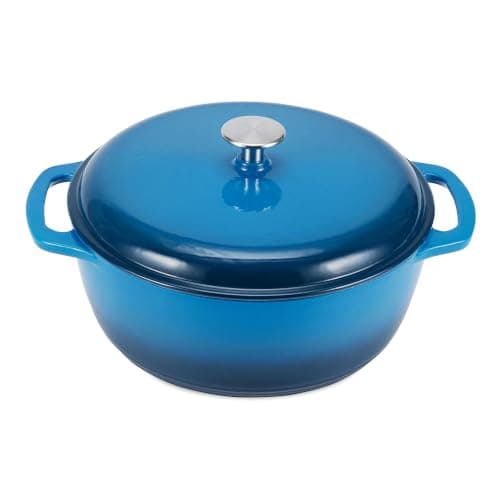
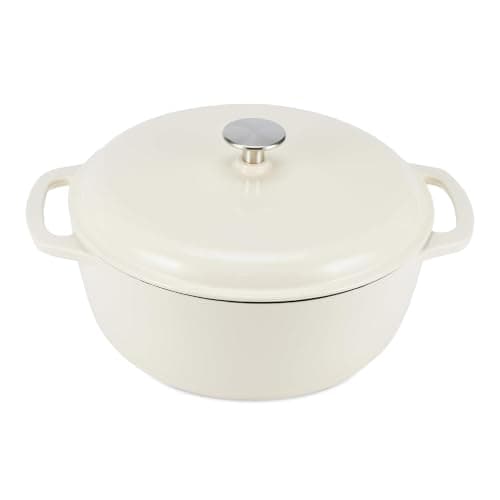
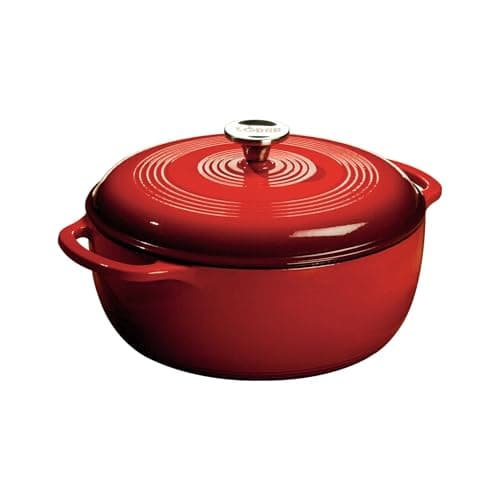
Buy one enameled dutch oven of about six quarts and cook in it for a month before you buy anything else. That is the whole beginner answer. For most people that pot is the Lodge enameled 6-quart: it braises, bakes bread, and makes soup indistinguishably from a pot costing three to five times as much, and it cleans up with soap and water. You do not need a French heirloom to learn on, and buying one first is the most common and most expensive beginner mistake in this category.
A dutch oven is simply a thick-walled pot with a heavy lid, and that thickness is the whole trick. The mass holds a steady low temperature for hours, which is what turns a cheap, tough cut of meat into the best meal of your week. The same mass and the same tight lid trap steam around a loaf of bread, which is why the pot doubles as a bakery-grade oven. Nothing about using one is difficult. The hard part is only the buying, because the marketing in this category is aimed squarely at people who do not yet know what they need.
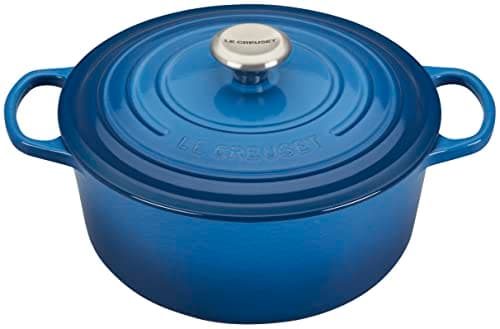
The picks below are ranked for a first-time buyer specifically, not for the best pot in the world. The value Lodge leads because it is the one we would hand a beginner our own money for. The Le Creuset is ranked last here despite being a superb pot, because it is the wrong first purchase for almost everyone — see the honest note on it below.
Start with enameled, not bare iron
This is the first fork, and for a beginner it is not close. An enameled pot is cast iron coated in vitreous enamel — powdered glass fused to the metal. Because the cooking surface is glass, it needs no seasoning, it cannot rust, and it does not care that your tomato and wine braise simmers for three hours. You wash it with soap and water like any other pot. That is a genuinely forgiving tool to learn on.
Bare cast iron is cheaper and it is the better high-heat bread pot, but it asks you to build and protect a seasoning layer, to dry it promptly so it does not rust, and to keep long acidic braises out of it. Those are easy habits once you have them, and they are two extra things to think about on the night you are also cooking your first braise. Learn the cooking first; add a bare pot later if you want one. If you want the full argument, our bare vs enameled dutch oven guide lays out both sides.
Six quarts is the beginner size
Between about five and six quarts is the sweet spot, and a 6-quart is the safest single guess. It is big enough for a family stew, a whole chicken, a double batch of chili you freeze half of, or a large boule of bread. It is not so heavy that it lives in a cupboard, which is the failure mode of the giant pots — a pot you dread lifting is a pot you do not cook in.
Go smaller only if you genuinely cook for one or two: a 4-quart-ish pot is lighter, easier to store, and still bakes a single loaf, which is why the 4.3-quart Amazon Basics is on this list. Go bigger only if you routinely batch-cook for a crowd. Round is the right shape to start with — it sits evenly on a burner and suits bread — and oval is a niche shape for long roasts. If you want that decision spelled out, see what size dutch oven do you need and round vs oval.
Why the French pot is not the beginner pick
Le Creuset and Staub make wonderful objects, and we say so plainly in our is Le Creuset worth it review. But understand what the premium actually buys: a harder and prettier enamel, larger and more comfortable handles, a lifetime warranty, a wide color range, and real resale value. Those are legitimate reasons to spend the money. They are not cooking reasons. The braise that comes out of a $90 Lodge and the braise that comes out of a $420 Le Creuset are, for practical purposes, the same braise.
For a beginner the calculus is even simpler: you do not yet know whether you will use this pot twice a week or twice a year. Find that out on a pot that does not make you nervous. If you turn into someone who braises every Sunday, you will know exactly which heirloom you want and you will have earned it. If you do not, you have not spent four hundred dollars finding out. That is why the Le Creuset sits last on this list rather than off it — it is the right pot for the person who already knows, and we would rather rank it honestly than pretend it is a starter buy.
The bread-first beginner
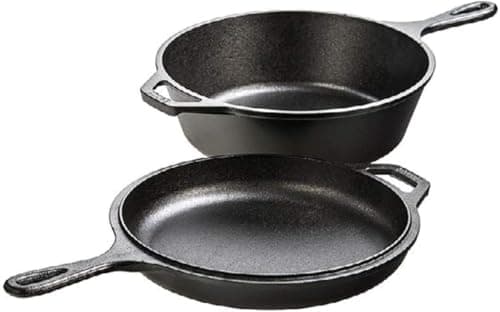
If your reason for wanting a dutch oven is sourdough — and for a lot of people it is — the combo cooker deserves a serious look as a first purchase. It is bare iron rather than enameled, so it carries the seasoning caveats above, but its shallow bottom pan makes loading and scoring a wet dough far easier than dropping it into a deep, screaming-hot pot. Preheat, drop the loaf on the shallow pan, cover with the skillet lid, and the trapped steam gives you the oven spring and crust that make a home loaf look like a bakery loaf. It is also two skillets when it is not baking. Our best dutch ovens for sourdough roundup goes deeper if bread is the whole point for you.
Who each pick is actually for
The ranking above is a buying order, not a quality order, and the pots are genuinely different bets. The Lodge enameled 6-quartis the default: the right size, a trusted brand, a 500°F rating that clears any bread recipe, and a price that does not make you precious about using it. If we could only put one pot in a beginner's kitchen, it is this one. The Amazon Basics 6-quartexists for the reader whose real question is "what is the least I can spend to find out if I like this?" — it is the same capacity and the same basic braising performance, and what you give up is enamel durability over years and any brand support. As a five-year pot it is a gamble; as a first pot it is a rational one.
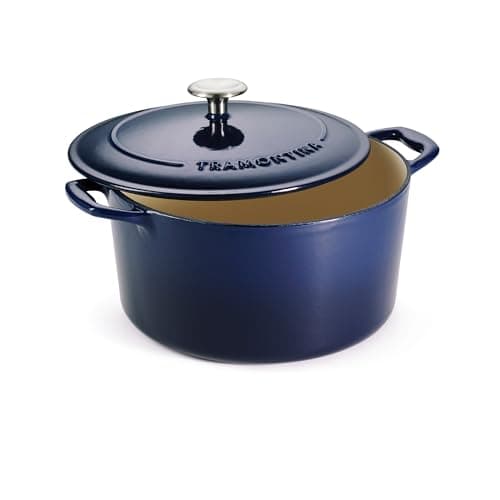
The 4.3-quart Amazon Basics is the pick when the six-quart is simply too much pot — one or two people, a small kitchen, a shelf that will not take a heavy pot, or anyone who wants a single-loaf bread vessel without the heft. The trade is that it fills up faster than you expect the first time you make a stew for guests. The combo cooker is the bread specialist described above, and the only bare-iron pick here; it is on the list because a meaningful share of first-time dutch-oven buyers are really first-time sourdough bakers, and for them it is both cheaper and easier to load than a deep pot. The Tramontina 6.5-quartis the step up in capacity for a beginner who is already cooking for four or five, with the caveat that its knob temperature rating is lower than the Lodge's — check the listing if you plan to bake bread in it.
Three mistakes that cost beginners money
Buying the heirloom first. Covered above, and it is the expensive one. The pot you are slightly afraid to scratch is the pot you leave in the cupboard.
Buying too big. An 8-quart pot sounds like value until you try to lift it full of stew out of a hot oven with two hands and oven mitts. Weight is the single most common reason a dutch oven stops getting used. If you are between two sizes, take the smaller one.
Buying accessories you do not need. A dutch oven needs nothing. Not a trivet, not a special cleaner, not a set of silicone tools. Wooden or silicone utensils are a nice-to-have for the enamel and you probably already own some. Spend the money on the pot, or keep it.
Your first month with it
Cook three things and you will understand the pot better than any article can teach you. Start with a braise — brown the meat hard in batches so you build real browned fond rather than steaming it gray, deglaze, then add liquid partway up the food and let it go low and slow for a few hours. Then make a soup, which shows you how steadily the pot holds a simmer without scorching the bottom. Then bake a loaf of no-knead bread, lid on, to see the steam trick work. After those three you will know whether this is a pot you reach for weekly or one you use at Christmas — and that, not a spec sheet, is what tells you whether to upgrade later.
How to buy your first dutch oven
The four specs that actually matter
Almost everything on a product listing is noise. What matters is: capacity (five to six quarts for most households), enameled or bare (enameled for a beginner), the oven temperature rating, and whether you can comfortably lift it full. Everything else — color, country of origin, the shape of the handles — is preference, not performance. Do not let a listing talk you into a fifth criterion.
Check the temperature rating before you buy for bread
This is the one spec buyers routinely miss. Bread often goes into a very hot oven, sometimes preheated empty, so the pot's rating decides whether it is in or out for that job. Lodge states its enameled cookware is usable on the stovetop and in the oven up to 500°F, which covers essentially any bread recipe. Budget pots vary and some are rated lower, and the lid knob is sometimes rated below the pot itself, so read the specific listing for the pot you are buying rather than assuming. If you never bake bread, this matters much less.
Buy for the food you actually cook
A dutch oven earns its place through braising: you brown the meat hard to build the Maillard fond, deglaze it, add liquid partway up the food, then cover and let low heat do the work for hours. If that sounds like how you want to cook, buy the six-quart. If you mostly want a bread pot, the combo cooker or a smaller pot is a better fit. If you mostly want a soup pot, almost any of these will do and you should buy on price. Our how to braise in a dutch oven guide walks the whole method.
Enamel is tough, not invincible
The one genuine care rule for a beginner: enamel is glass, so it chips if you knock it hard against a sink or drop a heavy lid on the rim, and it dislikes sudden temperature swings and being heated empty at high heat. Warm it with something in it, use wooden or silicone tools if you want to be careful with the interior, and do not plunge a hot pot into cold water. That is the entire routine. See how to care for enameled cast iron for the full, short version.
Do not buy the set
Some brands will sell you the dutch oven bundled with pieces you did not ask for. Buy the single pot. A dutch oven is a tool you will use several times a week if it suits you, and a bundle spreads your money across pieces that will sit in a cupboard while you figure that out. One pot, used often, beats three pieces used rarely — the same logic we apply to skillets in the best cast iron skillet for beginners guide.