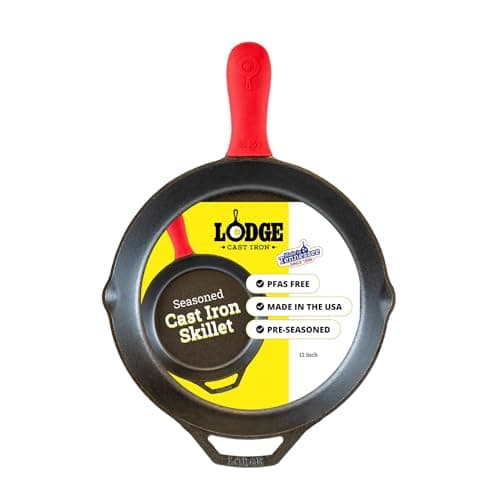
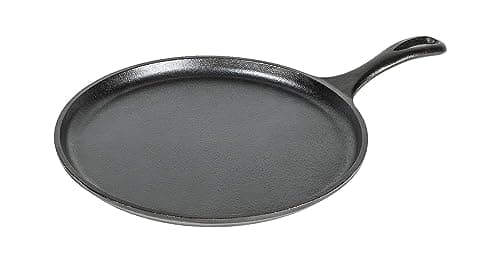
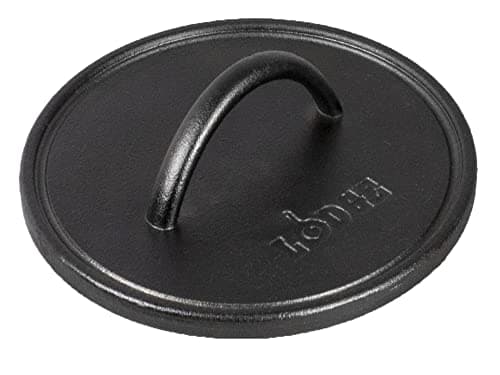
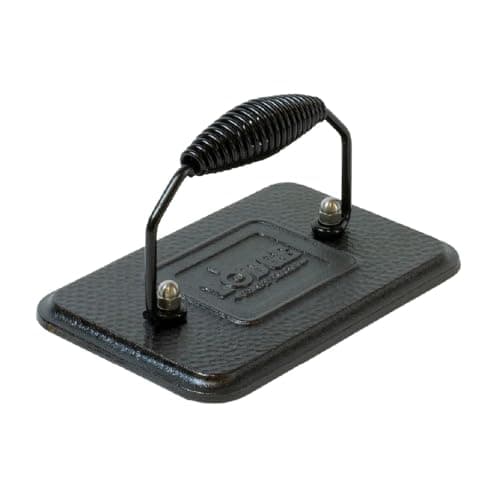
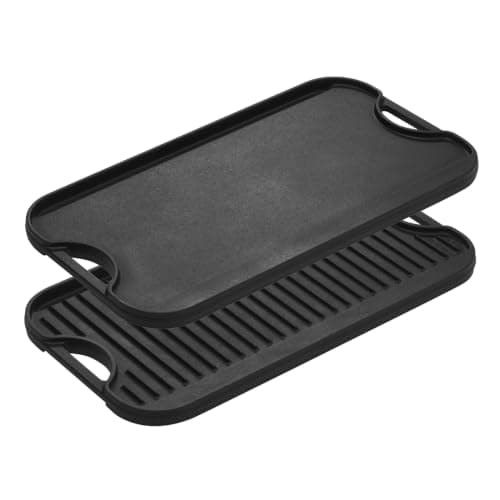
Buy the 20-inch Lodge Pro-Grid reversible griddle if smash burgers are genuinely a thing you do — flat, unwalled, two burners wide, four patties at a time. Buy the 12-inch Lodge skillet instead if you want one pan that does this well and everything else too. Then add a 6.75-inch round press, because the press is what makes it a smash burger rather than a thin hamburger, and a spatula pressed by hand does not reach the same pressure.
The technique is simple enough to be unforgiving: a loose ball of beef goes onto a very hot surface and is pressed flat immediately, so that the maximum amount of meat is in contact with the maximum amount of hot iron for the shortest possible time. All of the flavor comes from the Maillard reaction in that contact patch. Nothing else about the burger matters as much, which is why the equipment question is really one question: what surface holds the most heat and lets the beef spread flat?
What to look for before you look at the picks
1. Stored heat, not peak temperature
Every surface here gets hot. The one that matters is what happens in the two seconds after four refrigerator-cold balls of beef land on it. A thin surface drops fifty or more degrees and spends the next minute climbing back, during which your beef is steaming in its own juices rather than browning. Iron's advantage is thermal mass — it has stored enough energy to shrug that off. More iron under the patty is better, full stop, and this is the one job on the whole site where the heaviest option is the correct one.
2. No walls
This is the argument for a griddle over a skillet, and it is a real one. A skillet's walls do three bad things to a smash burger: they stop you spreading the patty at the edge of the pan, they stop the spatula getting under at a shallow angle (which is how you keep the crust attached to the beef instead of leaving it on the iron), and they trap steam over the meat. A flat plate removes all three problems at once.
3. Working area per burner
Two patties need roughly as much flat space as a 10.5-inch round griddle gives you. Four need something that spans two burners. Decide how many you cook at a time before you decide the shape, because a 20-inch plate on one burner has cold ends and a 10.5-inch round cooking in relays goes cold between batches.
4. A press, and the right size of press
A smashed patty ends up somewhere around five to six inches across. A 6.75-inch press covers that completely in one motion, which is why both presses ranked here are that size. A press smaller than the finished patty gives you a thin middle and thick edges; a press much larger is unwieldy and heats slowly. Pressing with a spatula and your weight on top is possible, and it is also how spatulas get bent and patties get uneven. The dedicated press is a cheap part of this setup and the most noticeable upgrade.
5. Bare iron, not enamel
This job runs the surface hotter and drier than almost anything else you will do, and enameled cast iron is the one material you should keep away from it. Enamel does not like prolonged empty high heat, and a smash burger surface is preheated empty and hard. Bare, seasoned iron is the right material and every pick here is bare.
Griddle or skillet: the honest answer
If you are buying specifically for this, buy the griddle. The flat plate is better at the job in every respect that matters and the Pro-Grid costs less than a good skillet.
If you are buying one pan for a kitchen, buy the 12-inch skillet and accept two burgers at a time. It holds more heat than anything else here, and unlike a griddle it also roasts a chicken, bakes a cornbread and makes a pan sauce. Our full skillet rankings explain why that pan is the default recommendation across this whole site.
If your constraint is one burner and a small budget, the 10.5-inch round griddle is the best few dollars in this category: a flat plate, no walls, one element, and it doubles as the tortilla and pancake surface. The griddle rankings cover the rest of that shape, and grill pan vs griddle covers the ridges question properly.
The method, in four lines
Preheat the surface dry and hard, longer than feels necessary — iron takes its time, and preheating properlyis most of the result. Use loose balls of beef, not pre-formed pucks; the beef should be barely handled. Press once, firmly, and leave it alone until the edges are lacy and brown. Scrape — rather than lift — with a stiff, thin spatula so the crust comes with the patty.
The full recipe, with timings and the cheese-and-onion variations, is on our smash burger page. This page is the equipment half of it.
Why this gets smoky, and what to do about it
A smash burger is cooked above the smoke point of beef fat, indoors, with the fat spread thin. It will smoke. That is not a fault in your pan and it is not a sign of bad seasoning. Run the extractor from before you start, open a window, and if a smoke alarm has ended one of these sessions before, read how to sear without setting off the smoke alarm — the oil-choice and ventilation logic there applies exactly.
It will also leave a mess of carbonised fat on the surface. That cleans up with heat, water and a scraper, not with a long soak; see how to clean burnt cast iron. If you bought the big reversible griddle, note that it spans two burners, which means neither burner is directly under a large part of it — so cleaning heat has to be moved around.
What we are not claiming
We have not run a timed temperature-recovery comparison between these surfaces, because we do not have a lab and are not going to invent one. The reasoning above is drawn from the published mass and dimensions of each piece and from the documented thermal behavior of cast iron, and our methodology page states plainly that our scores are judgments from documented research rather than measurements. Every price is live from the Amazon API, stamped with its as-of date.