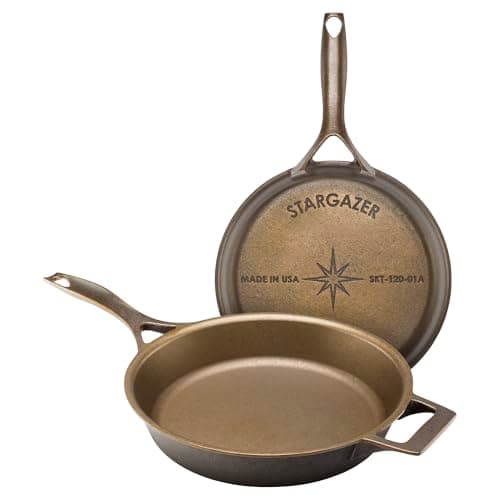
The Stargazer 12-inch skillet is the boutique cast-iron pan we recommend most, because its upgrades are the kind you feel at the stove rather than read on a box. It arrives machined glass-smooth, so it releases food from day one; it is cast lighter than a same- size Lodge; and it has the best handle in cast iron — long, angled and shaped to run cooler. It costs several times what a Lodge does, and unlike much premium iron, most cooks will feel where the money went. If you have decided to spend beyond a Lodge, this is where we would spend it. This review is about the pan itself; our broader Stargazer brand review covers the company.
A lot of expensive skillets are a Lodge with a nicer badge and a heavier price. The Stargazer is not that. It changes three specific things a standard pan makes you live with, and it changes them where it counts: the surface, the handle and the weight. Here is how each plays out in real cooking, and where the pan still loses to a Lodge.
The machined surface
Stargazer CNC-machines and hand-finishes the entire cooking face, so the pan is smooth to the touch straight out of the box (the maker's how-it's-made page walks the process). In practice that means good release early — eggs and fish let go cleanly in the first weeks, rather than after the months of built-up seasoning a pebbly Lodge needs. It does not sear harder than a Lodge; a crust is the Maillard reaction firing on hot, dry iron, and both pans are the same metal. What the smooth surface changes is how food releases and how the pan feels under a spatula, and it changes those from the first cook. See smooth vs rough cast iron for why the gap narrows over time.
The handle — the part people underestimate
Pick the pan up and the handle is what sells it. Where a Lodge has a short, stubby handle that runs hot and gives little leverage, the Stargazer's is long, angled and flared at the end, so it stays cooler on the stovetop and gives real control lifting a heavy, loaded 12-inch pan. For a tool you reach for every day, that is a bigger quality-of-life win than the surface, and it is the thing owners mention first. You will still want a handle holder for oven work, but on the stovetop the handle alone is a genuine upgrade.
The weight, and the 10.5 vs 12 choice
Stargazer casts thinner, more even walls than Lodge, so a 12-inch Stargazer is lighter than a 12-inch Lodge — easier to lift, tilt and toss. The trade is marginally less thermal mass, so a heavy Lodge holds a touch more heat for a screaming, back-to-back sear; for most cooking the lighter, more manageable pan is the better daily tool. On size: the 12-inchreviewed here is the family pan — room to sear six thighs or a big batch without crowding. If you cook for one or two, Stargazer's 10.5-inch is the more everyday size and lighter still; our 10 vs 12-inch guide makes the call. Either size is the same machined pan with the same handle.
What you give up versus a Lodge
Mostly money, and a little thermal mass. Value is the one score where a Stargazer loses to a Lodge and always will — you can buy several Lodges for one Stargazer, and a well- seasoned Lodge gets nearly as slick after a few months of cooking. So the Stargazer is not a better cook; it is a nicer, lighter, better-handled pan you enjoy using more. That is a real thing to buy, but it is a preference, not a performance gap. Our Lodge vs Stargazer head-to-head lays the two side by side, and is Stargazer worth it answers the money question directly.
Buying it, and caring for it
Stargazer sells through its own site and a first-party Amazon store, so the buy button here goes to a real listing rather than a random reseller. Care is identical to any bare cast iron: cook on the factory seasoning, wash and dry it, wipe a thin coat of oil, and let it build over time — the smooth surface only gets better. It is not a fragile object; it is a lifetime pan that happens to arrive already slick. The verdict: if a Lodge is the pan everyone should start with, the Stargazer 12-inch is the upgrade most worth making when you are ready.