Skip to content
Hearth & Patina

Guides & Comparisons

The Best Cast Iron for Deep Frying

Cast iron is the home fryer's secret weapon: its thermal mass holds the oil temperature steady when cold food hits it, which is the whole difference between crisp and greasy.

By Stephen V.Updated How we research
#ad

We earn a commission when you buy through our Amazon links, at no extra cost to you. It never affects our rankings, and we say so when the cheaper pan is the better buy. How this works.

For deep frying, buy the Lodge covered deep skillet: its tall sides hold a safe depth of oil, the lid tames splatter, and cast iron's thermal mass keeps the oil temperature from crashing when the food goes in. That temperature stability is the entire secret to crisp, non-greasy frying — and it is exactly what a thin, light pan cannot give you.

Good deep frying is really a temperature problem. When you drop cold, wet food into hot oil, the oil temperature plunges; if it drops too far, the food sits and soaks up grease instead of crisping. A heavy cast iron vessel stores a large reservoir of heat and hands it back to the oil, so the temperature recovers fast and stays put — which is why cast iron has been the home fryer of choice for a century, long before countertop deep fryers existed. Any deep, heavy iron pot beats a thin one for this.

We ranked these five by how well each suits real home frying, from a dedicated deep skillet to the dutch ovens that double as fryers. All are cast iron; the choice is about depth, cleanup, and what else you want the pot to do. A quick safety note runs through everything below: never fill a pan more than a third to halfway with oil, and keep a thermometer in it.

How the picks break down

PieceWhat it isBest for
Lodge covered deep skillet5 qt deep skillet + lidThe dedicated fryer
Lodge double dutch ovenBare 5 qt pot + skillet lidFrying plus bread and searing
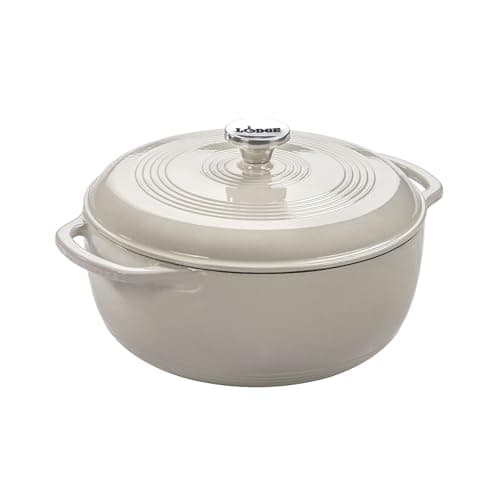
Lodge enameled dutch ovenEnameled 6 qt potEasy cleanup, no seasoning worry
Lodge 12-inch skilletStandard skilletShallow frying in less oil
Lodge combo cooker3.2 qt deep panSmall-batch frying

The dedicated fryer: Lodge covered deep skillet

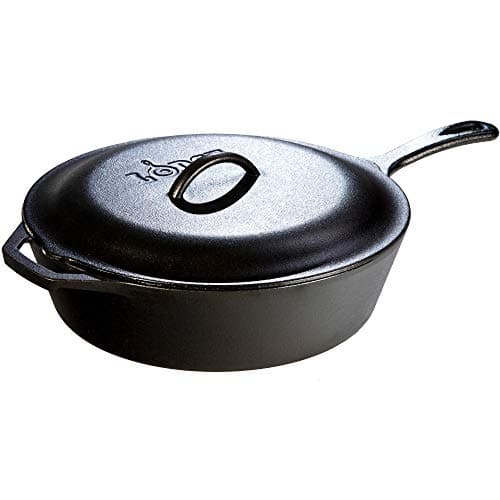
The Lodge 5-quart covered deep skillet is the piece built for this job. Its tall, straight sides hold enough oil to submerge food for true deep frying without the dangerous shallow splatter of a regular skillet, and the included lid contains spatter and stores the pan between uses. Like all cast iron it holds oil temperature superbly, and it is a genuine do-everything pan the rest of the time — braising, sauteing, simmering. It is heavy, and heavier still with oil in it, so moving it is a careful two-hand job; that is the price of the depth and the stability. For most home cooks who fry with any regularity, this is the pick.

Fry, bake, and sear: Lodge double dutch oven

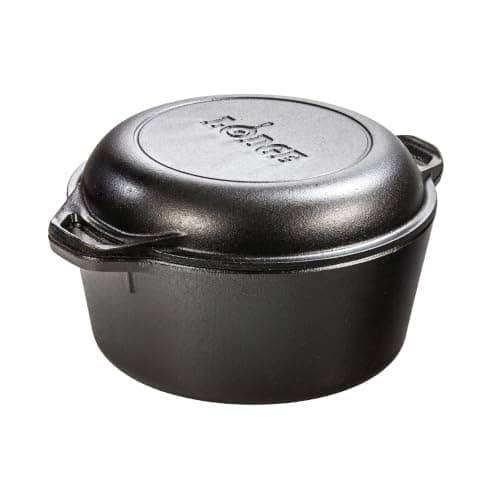
A bare dutch oven is the traditional deep fryer, and the Lodge double dutch oven is a clever one: a 5-quart bare pot whose lid is a full skillet, so it deep-fries, bakes bread, and sears, all in one purchase. The tall pot holds a safe volume of oil with high sides to contain bubbling, and bare iron shrugs off frying heat. The trade versus the deep skillet is that a round pot is a little less handy to lower food into and lift it out than a wider, shallower deep skillet — but you gain a superb bread and braising vessel.

Easiest cleanup: Lodge enameled dutch oven

If the mess is what puts you off frying, an enameled dutch oven is the answer: the glass interior wipes clean of oil with soap and water and needs no re-seasoning after a greasy session, unlike bare iron. It fries just as well — enamel over cast iron has the same heat retention. The one caution is thermal shock: heat the oil gradually and never add cold liquid to screaming-hot enamel. For a fry pot you want to clean and forget, this is the friendliest.

Shallow frying: Lodge 12-inch skillet

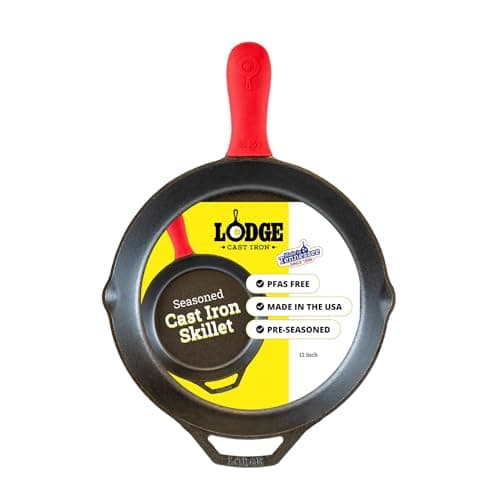
Not everything needs a deep pot. For shallow frying — a half-inch of oil for fried chicken cutlets, schnitzel, or crisping potatoes — a standard 12-inch skillet is the right, lighter, less oil-hungry tool, and its wide surface fries several pieces at once. It cannot deep-submerge food, so it is not for doughnuts or a proper fry, but for the everyday pan-frying most people actually do, the skillet you already own is the honest answer.

Small-batch frying: Lodge combo cooker

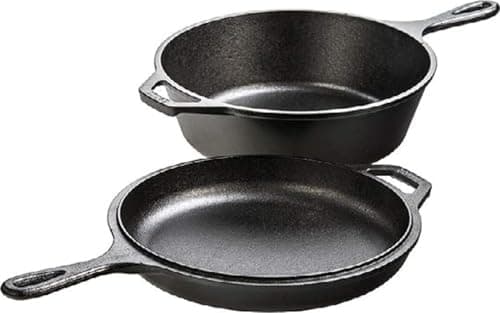
The combo cooker's deep 3.2-quart pan is a tidy small-batch fryer — enough depth for a modest amount of oil to fry a snack's worth of food without heating a big pot, and it doubles as two skillets and a sourdough vessel besides. It is the pick for a small kitchen or occasional frying, where a full 5-quart fryer is more oil and more pan than you want. For a family-size fry, step up to the deep skillet or a dutch oven.

The short answer

Quick picks

#ProductBest forScorePrice
01
Lodge Lodge 5 qt Cast Iron Covered Deep Skillet
Lodge 5 qt Cast Iron Covered Deep Skillet

The dedicated frying pan: tall sides hold a safe depth of oil, a lid tames splatter, and cast iron holds the oil temperature steady when the food goes in.

Deep and shallow frying
8.0
$69.90Amazon
02
Lodge Lodge Cast Iron Double Dutch Oven, 5 qt
Lodge Cast Iron Double Dutch Oven, 5 qt

Two tools in one: a 5 qt bare dutch oven whose lid is a 10.25" skillet. Brilliant for bread and camping.

Bare-iron versatility
8.8
$59.90Amazon
03
Lodge Lodge 6 qt Enameled Cast Iron Dutch Oven
Lodge 6 qt Enameled Cast Iron Dutch Oven

90% of the French pots' performance for a third of the money. The value pick, and our overall best buy.

The best-value dutch oven
8.8
$89.90Amazon
04
Lodge Lodge Seasoned Cast Iron Skillet, 12"
Lodge Seasoned Cast Iron Skillet, 12"

The big-batch workhorse. More searing room, more weight, same near-unkillable Lodge value.

Cooking for a family
8.4
$34.90Amazon
05
Lodge Lodge Cast Iron Combo Cooker, 3.2 qt
Lodge Cast Iron Combo Cooker, 3.2 qt

The cheapest great sourdough vessel there is — a deep skillet and a shallow one that lock together.

Sourdough on a budget
8.8
$59.90Amazon

#ad · Live prices from the Amazon Product API, as of Jul 29, 2026. Where we have no verified live price, we show none — we would rather leave a gap than print a number that has gone stale.

In detail

The picks, in full

01
Lodge Lodge 5 qt Cast Iron Covered Deep Skillet

Deep and shallow frying

Lodge 5 qt Cast Iron Covered Deep Skillet

5 qtDeep sides + lidPre-seasonedMade in USA
8.0/10

The dedicated frying pan: tall sides hold a safe depth of oil, a lid tames splatter, and cast iron holds the oil temperature steady when the food goes in.

Heat retention
9
Frying depth
9
Versatility
8
Handling
6
Value
8

Pros

  • Tall, straight sides hold enough oil to fry safely without the shallow splatter of a regular skillet, and the lid contains spatter and stores the pan
  • Cast iron's thermal mass keeps the oil temperature from crashing when cold food hits it, which is the whole secret to crisp, non-greasy frying
  • A true family-size 5-quart pan that also braises, sautes, and simmers, made in the USA and pre-seasoned

Cons

  • Heavy, especially once loaded with oil — moving hot oil is a two-hand, full-attention job
  • Bare iron, so long deep-frying is fine but acidic simmers are better left to enamel, and it needs drying and re-oiling after a wash
  • More pan than someone who only ever shallow-fries needs

Don't buy this if…

you only shallow-fry the occasional egg or chop — a plain 10.25" or 12" skillet is enough. Buy the deep skillet if you fry chicken, doughnuts, or fries often and want the depth and the lid.

$69.90View on Amazon

Price as of Jul 29, 2026. Prices change — Amazon's is the one that counts.

#ad · we may earn a commission from this link to Lodge 5 qt Cast Iron Covered Deep Skillet

02
Lodge Lodge Cast Iron Double Dutch Oven, 5 qt

Bare-iron versatility

Lodge Cast Iron Double Dutch Oven, 5 qt

5 qtLid = 10.25" skilletPre-seasonedMade in USA
8.8/10

Two tools in one: a 5 qt bare dutch oven whose lid is a 10.25" skillet. Brilliant for bread and camping.

Heat retention
9
Enamel durability
8
Everyday usability
8
Oven & stovetop range
9
Value
10

Pros

  • The lid is a full skillet, so you get two pans in one purchase
  • Bare cast iron takes and holds seasoning, so it becomes naturally nonstick — unlike enamel
  • A superb, cheap sourdough vessel: preheat, drop the dough in, cover with the skillet lid

Cons

  • Bare interior needs seasoning and care — no dishwasher, dry it promptly
  • No pouring lip and heavy, like all bare cast iron

Don't buy this if…

you want a hands-off, soap-and-water pot for acidic tomato braises. Enamel is the better tool there. This shines for bread, searing and everyday bare-iron cooking.

$59.90View on Amazon

Price as of Jul 29, 2026. Prices change — Amazon's is the one that counts.

#ad · we may earn a commission from this link to Lodge Cast Iron Double Dutch Oven, 5 qt

03
Lodge Lodge 6 qt Enameled Cast Iron Dutch Oven

The best-value dutch oven

Lodge 6 qt Enameled Cast Iron Dutch Oven

6 qtEnameledOven safe to 500°FGreat value
8.8/10

90% of the French pots' performance for a third of the money. The value pick, and our overall best buy.

Heat retention
9
Enamel durability
7
Everyday usability
9
Oven & stovetop range
9
Value
10

Pros

  • Cooks braises, soups and bread indistinguishably from pots costing three times as much
  • A generous 6 qt — room for a big batch or a large boule
  • The most sensible first enameled dutch oven for almost everyone

Cons

  • Enamel and hardware are a step below Le Creuset/Staub in finish refinement
  • Not made in France, if that matters to you (it doesn't affect the food)

Don't buy this if…

you specifically want the heirloom object, the lifetime warranty, or the resale value of a French pot. On pure cooking, this is where the smart money goes.

$89.90View on Amazon

Price as of Jul 29, 2026. Prices change — Amazon's is the one that counts.

#ad · we may earn a commission from this link to Lodge 6 qt Enameled Cast Iron Dutch Oven

04
Lodge Lodge Seasoned Cast Iron Skillet, 12"

Cooking for a family

Lodge Seasoned Cast Iron Skillet, 12"

12 inPre-seasonedMade in USA~8 lb
8.4/10

The big-batch workhorse. More searing room, more weight, same near-unkillable Lodge value.

Heat retention
10
Cooking surface
7
Handling
6
Versatility
9
Value
10

Pros

  • The extra diameter is the difference between searing two chicken thighs and searing six without crowding
  • Deep enough sidewalls for shallow-frying and pan sauces
  • Includes a silicone handle holder in the box

Cons

  • At roughly 8 lb full, it is genuinely heavy — one-handed tossing is out for most people
  • Overkill for one or two servings; a bare 8" or 10.25" is the everyday pan

Don't buy this if…

you mostly cook for one or two. A 12" pan that lives in the cupboard because it is too heavy to bother with is worse than a 10.25" you reach for daily.

$34.90View on Amazon

Price as of Jul 29, 2026. Prices change — Amazon's is the one that counts.

#ad · we may earn a commission from this link to Lodge Seasoned Cast Iron Skillet, 12"

05
Lodge Lodge Cast Iron Combo Cooker, 3.2 qt

Sourdough on a budget

Lodge Cast Iron Combo Cooker, 3.2 qt

3.2 qt deep pan10.25" skillet lidPre-seasonedMade in USA
8.8/10

The cheapest great sourdough vessel there is — a deep skillet and a shallow one that lock together.

Heat retention
9
Enamel durability
8
Everyday usability
9
Oven & stovetop range
8
Value
10

Pros

  • The shallow pan on the bottom makes loading and scoring a boule far easier than a tall dutch oven
  • Preheats fast and traps steam for a great oven-spring crust
  • Doubles as two separate skillets for everyday cooking

Cons

  • 3.2 qt is sized for a single standard loaf, not a big double batch
  • Bare iron — season it and keep it dry

Don't buy this if…

you bake large or high-hydration loaves that need tall walls. A round dutch oven gives more headroom; the combo cooker wins on ease of loading and price.

$59.90View on Amazon

Price as of Jul 29, 2026. Prices change — Amazon's is the one that counts.

#ad · we may earn a commission from this link to Lodge Cast Iron Combo Cooker, 3.2 qt

How to choose cast iron for frying

Depth and oil volume

For true deep frying you want a pot deep enough to hold oil that submerges the food while still leaving plenty of headroom — the oil should never come more than a third to halfway up the pot, because it bubbles up violently when food goes in. A 5-quart deep skillet or dutch oven is the sweet spot for a family. For shallow frying, a wide skillet with a half-inch of oil is enough and wastes less.

Bare or enameled

Both fry equally well thanks to identical heat retention. Bare iron is traditional, cheap, and indestructible, but it needs drying and re-oiling after a greasy wash. Enameled is far easier to clean and needs no re-seasoning, at a higher price and with a caution against thermal shock. Choose bare for cost and versatility, enamel for easy cleanup — see enameled vs bare.

Use a thermometer and the right oil

The whole point of cast iron is holding temperature, so measure it: a clip-on thermometer takes the guesswork out, with most frying done between about 325 and 375°F. Use a neutral oil with a high smoke point— peanut, canola, vegetable, or refined oils — not butter or olive oil, which burn. Cast iron's job is to keep that oil steady; yours is to set the right number.

Fry safely

Never overfill the pot, dry food before it goes in (water makes oil erupt), lower food away from you, and do not crowd the pot — too much cold food at once crashes the temperature and the mass can only recover so fast. Keep a lid nearby to smother a flare-up, and never move a pot of hot oil until it has cooled. The deep skillet's lid helps on all counts.

Cleaning up after frying

Let the oil cool completely, strain and store or discard it, then wipe out the pan. Bare iron gets a hot-water scrub, a thorough dry, and a thin coat of oil; frying actually builds seasoning nicely. Enamel wipes clean with soap and water. Our cleaning guide covers the details for a bare pan.
How we picked

We do not run a testing lab

We researched published manufacturer specifications, materials and thermal properties, and aggregated owner reviews, then scored each pan against a published rubric. The scores are judgments from documented research — they are notmeasurements we took, because we do not have a lab and we are not going to pretend we do. Where a number came from a manufacturer's spec sheet or someone else's lab, we name it in Sources.

Questions

Frequently asked

Is cast iron good for deep frying?
It is excellent. Cast iron's thermal mass holds the oil temperature steady when cold food is added, which keeps food crisp instead of greasy — the key to good frying. It also takes high heat and costs far less than a dedicated deep fryer.
What is the best cast iron pan for deep frying?
A deep, heavy vessel: a covered deep skillet or a bare dutch oven, both with tall sides to hold oil safely. The Lodge covered deep skillet is the dedicated pick; a bare dutch oven doubles as a fryer, bread pot, and searing pan.
Can you deep fry in an enameled dutch oven?
Yes — enamel over cast iron fries just as well and cleans up far more easily than bare iron. The only caution is thermal shock: heat the oil gradually and avoid adding cold liquid to a screaming-hot enameled pot. See enameled cast iron care.
How much oil should I put in a cast iron pot for frying?
Never more than a third to halfway up the pot — the oil bubbles up sharply when food goes in and you need headroom to stay safe. Enough to submerge the food for deep frying, or about a half-inch for shallow frying in a skillet.
What oil is best for frying in cast iron?
A neutral oil with a high smoke point— peanut, canola, vegetable, or another refined oil. Avoid butter and olive oil, which burn at frying temperatures. Keep a thermometer in the oil and fry between about 325 and 375°F.

Keep reading

Receipts

Sources

We do not run a testing lab, and we do not pretend to. Where a measured number came from a manufacturer's spec sheet or someone else's lab, we name them and link them. Where we could not verify something, we say so on the page rather than quietly leaving it out. Read our full method.