Buy the Lodge Chef Collection 12.5-inch. For most home kitchens it is the honest best cast iron wok you can currently get: a flat, stable base that works on any stovetop, enough thermal mass to keep searing when your burner can't, a thinner and smoother casting than standard Lodge iron, and made in the USA. But read the next paragraph before you buy anything, because for a lot of cooks the right answer is not cast iron at all.
A cast iron wok is a genuinely different tool from the thin steel wok a restaurant line cook flips over a roaring jet burner. The whole point of stir-frying is very hot oil and constant motion, and a professional does it in a light carbon steel wok precisely because it heats in seconds, responds the instant the flame changes, and is light enough to toss one-handed. Cast iron does none of those things well. What it does do is hold an enormous amount of heat, and that is the one thing a weak home burner cannot supply on its own. Drop a wok of cold vegetables onto a modest electric coil in a thin steel wok and the temperature crashes and the food steams; the mass of a cast iron wok shrugs that off and keeps browning. That single trade-off decides whether cast iron is right for you, and we come back to it throughout this guide.
We rank by how well a wok earns its price for a normal home cook on a normal stove, not by which looks most traditional. If, after reading, you decide agility matters more than mass, our cast iron vs carbon steel guide makes the case for the lighter metal in full — buying the wrong material is a more expensive mistake than buying the wrong brand.
One honest note on the shortlist. This page used to rank five cast iron woks, including a 14-inch Lodge and a rounded-interior Bayou Classic. Those listings no longer come back from Amazon at all, and we would rather rank woks you can actually buy than pad the list with dead links. The cast iron wok category on Amazon has genuinely thinned out, and one consequence is worth stating plainly: you can no longer buy a rounded-bottom cast iron wok from a name brand there. Everything below is flat-bottomed. If a traditional bowl shape is what you came for, that now means carbon steel, where round-bottom 14-inch woks are still the standard.
How the picks break down
A quick map of who each wok is for. Prices are live, so we do not quote them here; the buy buttons above show today's number and the date we checked it.
| Wok | Shape & size | Best for |
|---|
| Lodge Chef Collection 12.5-inch | Flat base, lighter cast | The default: any stovetop, made in USA, lighter than standard iron |
| Classic Cuisine 14-inch | Flat base, 14 in | The cheapest full-size wok, if you can handle the weight |
| Lodge 9-inch mini | Small, dual loop | Single servings and hot serving at the table |
The honest question: cast iron or carbon steel?
Match the wok to your stove. If you have a powerful gas range, a wok burner, or an outdoor propane ring, a light carbon steel wok is the better tool — it gets ripping hot, it responds instantly, and you can toss it with a flick of the wrist to build the smoky wok heithat defines great stir-fry. If you cook on an ordinary electric, glass, or induction cooktop that can't deliver that kind of heat, cast iron's thermal mass is a real advantage: it stores heat and hands it back to the food, so a modest burner keeps searing instead of stalling. Cast iron also wins for jobs that are not really stir-fry at all — deep-frying, where a stable oil temperature matters, and searing or one-pot braises where you want the pan to stay hot. Everything below assumes you have weighed this and decided iron is your material.
Why the Chef Collection 12.5-inch wins for most kitchens
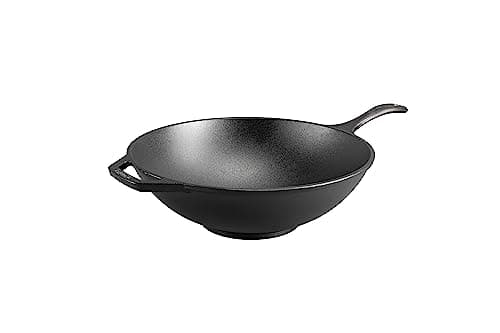
The Chef Collection wok is the one we'd hand a friend now. It has a flat base, which is the detail that matters most on a Western stove: it sits stable and makes full contact on electric, glass and induction cooktops, where a round-bottomed wok would wobble or need a ring. It comes pre-seasoned and ready to cook, and like every bare Lodge it is made in South Pittsburg, Tennessee. Its dual loop handles are the sensible choice for a pan this heavy — you lift a loaded cast iron wok with two hands and two mitts, not with a one-handed toss.
The honest knocks are the knocks against all cast iron. It is heavy, so the toss-and-flip motion that defines stir-fry is out; you push and turn the food with a spatula instead. It is slow to heat and slow to cool, so it responds sluggishly when you want to drop the temperature fast. And out of the box the surface is Lodge's usual pebbly cast finish, not glass-smooth — it releases food better once you build seasoning on it, exactly as a Lodge skillet does. None of that is a defect; it is the nature of the material, and it is why the very first section of this guide told you to make sure iron is what you actually want.
The honest caveat: a cast iron wok will not give you restaurant wok hei on a home stove, and neither will anything else in a normal kitchen — that takes a burner most homes do not have. What the Lodge gives you is a stable, heat-hoarding pan that browns well and lasts forever. Buy it for that, not for a video-perfect toss.
The one real trade against the discontinued 14-inch is capacity. At 12.5 inches this wok crowds sooner, and a crowded wok steams instead of sears — so cook a stir-fry for four in two batches rather than one. Lodge's Chef Collection is its lighter, smoother line, so the casting is thinner and the surface starts smoother than standard Lodge iron, which is a genuine everyday improvement on the wrist and on release.
The cheapest full-size wok: Classic Cuisine 14-inch
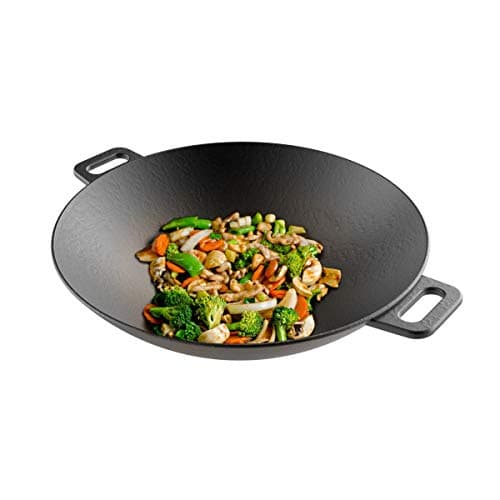
If what you want is the biggest cast iron cooking surface for the least money, this is it: a genuine 14-inch pan for less than most 12-inch cast iron woks cost. The base is flat, so it sits stable and makes full contact on electric, glass and induction cooktops, and the listing rates it for the stovetop, oven, induction, a grill or a campfire. It arrives pre-seasoned.
Two honest caveats, and they matter. It is heavyeven by the standards of cast iron woks — published weights for this model differ between retailers, which is why we are not printing a figure, but every source agrees it is a two-hands, two-mitts pan. And it is a value house-brand product rather than one from a cast iron or wok specialist, so there is no long record of how the casting and finish hold up. Buy it as the cheap way to a big iron wok, not as an heirloom. If you want the lighter, smoother pan with a foundry behind it, that is the Chef Collection above.
The small specialist: Lodge 9-inch mini wok
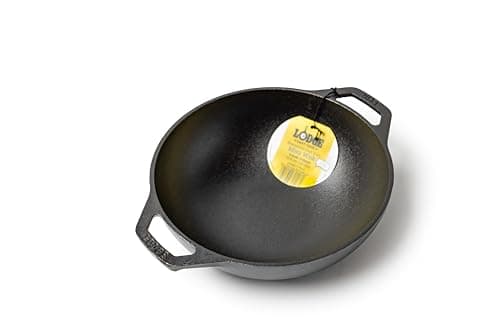
The 9-inch Lodge mini wok is not a family stir-fry pan, and buying it as one is the mistake to avoid — crowd nine inches with a stir-fry for four and it steams. What it is good at is a single portion of fried rice or a small stir-fry, and it is light enough to actually toss the way you cannot with a big iron wok. Its retained heat also makes it a genuinely nice sizzling serving dish, straight from the stove to the table. The dual loop handles sit close to the hot metal, so keep mitts to hand. Treat it as a charming specialist that complements a full-size wok, not as your only one.
How to choose a cast iron wok
Start with your stove — it decides almost everything
The single most important match is between the wok and your heat source. A powerful gas burner or a dedicated wok ring suits a light carbon steel wok that can exploit all that heat and be tossed. An ordinary electric, glass or induction cooktop is where cast iron earns its keep, because its thermal mass stores heat the burner cannot deliver in a rush and hands it back to cold food. Decide this first; the brand and size questions are downstream of it. If you are still torn between the two metals, read cast iron vs carbon steel before you spend.
Flat bottom versus rounded
Almost every cast iron wok sold for Western stoves has a flat base, and for good reason: it sits stable and makes full contact with a flat burner, which is what an electric or induction hob needs. A rounded interior like the Bayou Classic's is closer to a traditional wok and keeps food circulating better, but it wants a gas flame or a wok ring to sit securely and heat evenly. Buy flat for a flat stovetop; consider rounded only if you cook on gas and value the classic shape.
Size and weight
Fourteen inches is the standard family size and the one most people should buy; a 12.5-inch suits one or two people or a compact stove; a 9-inch mini is a single-serving specialist, not a main wok. Remember that cast iron is heavy and a full wok is heavier still, so the biggest pan is not automatically the best pan — pick the largest size you can comfortably lift with two hands, because the wok you actually use beats the one that stays in the cupboard. This is the same logic as choosing a skillet size.
Handles
Cast iron woks come with either two loop handles or a single long handle plus a small helper loop. For a heavy iron wok the loops are honestly the more practical choice, because you are not going to toss a loaded cast iron wok one-handed no matter what handle it has — you lift it with two mitts. A long handle looks like a carbon steel wok but tempts you into a toss the weight will not allow. Whichever you get, the metal runs hot, so keep mitts or a handle sleeve nearby.
Seasoning and care
A bare cast iron wok is cared for exactly like a skillet: it arrives pre-seasoned, it gets better as you cook fat in it, and it needs to be dried promptly and wiped with a thin film of oil so it does not rust. High-heat stir-frying actually builds seasoning quickly. The one rule specific to woks is to go easy on long, wet, acidic simmers in a bare pan, which can strip seasoning — for those, the lidded braising jobs, an enameled pot is the better tool. Our how to season cast iron and how to clean cast iron guides cover the whole routine.
When to skip cast iron entirely
Be honest with yourself about your burner. If you have serious gas heat and you want the tossed, smoky, restaurant-style stir-fry, a light carbon steel wok will make you happier than any cast iron pan here, and it costs about the same. Cast iron is the right buy when your stove is the limiting factor, when you want a pan that also deep-fries and sears beautifully, or when you simply want one heavy, near-indestructible wok that will outlast the kitchen. If a flat griddle or grill pan is more your style of cooking, see the best cast iron griddles instead.