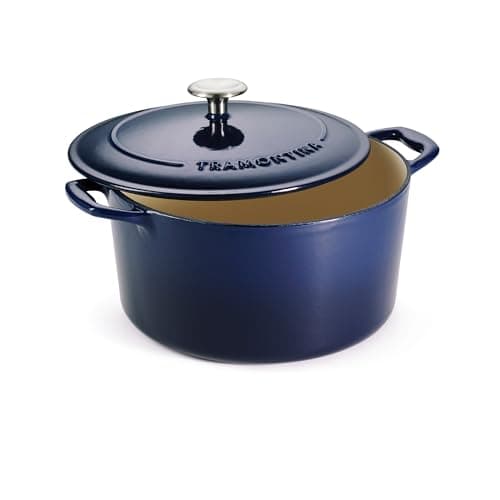
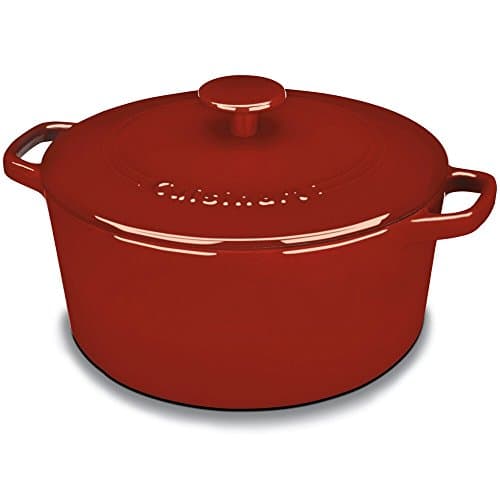
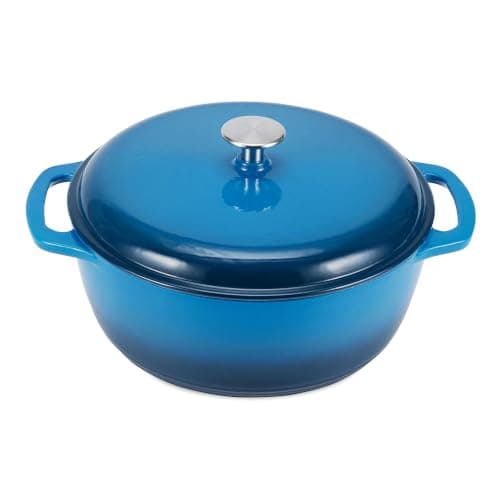
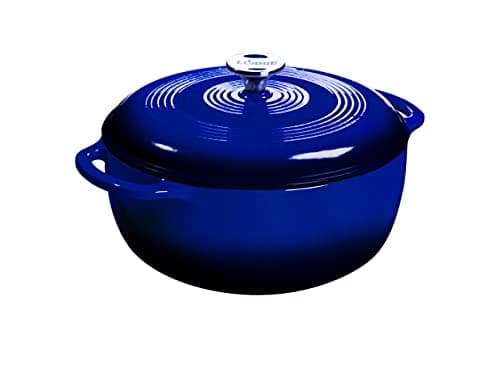
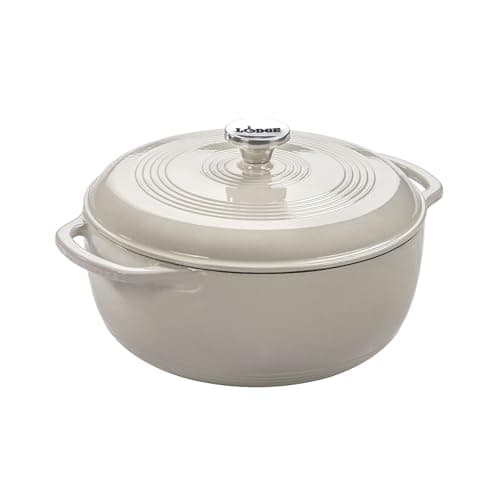
If you want the cooking of a Le Creuset without the price, buy the Lodge6-quart enameled dutch oven. It is a heavy enameled cast iron pot that braises short ribs, simmers soup and bakes a boule of bread indistinguishably from a pot costing three or four times as much — because the cooking is physics, not a badge. The French pot buys a harder enamel, nicer hardware, a lifetime warranty and real resale value; it does not buy a better dinner. If those heirloom qualities matter to you, spend up. If you just want the braise, one of these pots is the smart place to put your money.
A dutch oven works by simple means: a heavy body of cast iron holds a low, even heat through its thermal mass, and a tight lid traps moisture so a tough cut turns tender over hours. Coat that iron in vitreous enamel and you get a pot that needs no seasoning, shrugs off an acidic tomato braise, and cleans up with soap and water. Every pot on this page does exactly that. What separates a Le Creusetfrom a Lodge is not the braise on the plate — it is the finish of the enamel, the size and comfort of the handles, the warranty, and whether the object is something you want to hand down. Our Lodge vs Le Creuset and is Le Creuset worth it guides take that apart in full.
What makes a real alternative, not just a cheaper pot
The pots that stand in for a Le Creuset are enameled cast iron of genuine weight, with a knob or handle rated for oven heat and an interior enamel that wears well. That is a different thing from a light, thin, cheaply-enameled pot that heats unevenly and chips early. Every pick here is heavy cast iron with a proper enamel coat; where a pot cuts a corner — a lower knob rating, a plainer interior, a shorter warranty — we say so on its card. The honest headline is that the cooking is close to identical across all of them, and the differences are in longevity, finish and the details you touch, not in the food.
The one spec worth checking: the knob and the oven rating
If you bake bread, the pot goes into a very hot oven, sometimes preheated empty, and the limiting part is usually the lid knob. Le Creuset and the Lodge enameled are rated to 500°F; some budget pots cap their knob at 450°F, which is fine for braising but tight for the hottest no-knead loaves. It is the single spec that quietly rules a pot in or out for high-heat bread, and the one most buyers never think to check — so we check it for you. Our best dutch ovens for sourdough page goes deeper for bread bakers specifically.
Where the French pot is still worth it
We are not here to talk you out of a Le Creuset. If you want an object as much as a tool — a pot with a harder, prettier enamel, a lifetime warranty, and resale value that is real if you ever move one on — that is a legitimate thing to buy, and none of these alternatives match it. What we will not do is pretend the cheaper pot cooks worse than it does. It does not. Buy the French pot for the heirloom; buy one of these for the dinner, and the food will not know the difference. Our are expensive dutch ovens worth it guide is the full version of that argument.
How to choose a Le Creuset alternative
Match the size to your household, not the biggest number
A 5-to-6-quart round pot is the sweet spot for most families — a stew, a chicken or a large boule. Go to 3 quarts for one or two people, and up only if you routinely batch-cook. A pot too big for your cooking is heavy and mostly empty. Our dutch oven size guide matches capacity to household.
Check the knob rating if you bake bread
For the hottest no-knead loaves you want a knob rated to 500°F; 450°F is fine for braising and most bread. It is the one spec that decides high-heat baking, so confirm it before you buy.
Expect a step down in finish, not in cooking
A budget enameled pot cooks like the French icon and looks a notch plainer up close — a slightly rougher enamel, simpler hardware, a shorter warranty. That is the honest trade, and for most kitchens it is a good one. If the finish and the warranty matter more than the savings, that is exactly when to buy the real Le Creuset.
Care is the same either way
Enamel is glass: no seasoning, no rust, but it dislikes thermal shock and empty high heat, and it can chip if you knock it. Treat any of these pots gently and it lasts for years — see how to care for enameled cast iron.