Buy the skillet first. A skillet has walls, and walls are what make a pan general-purpose — they hold liquid, contain a pan sauce, allow shallow and deep frying, and let the pan go from stovetop to oven with a cornbread batter in it. Buy a griddle second, once you know you cook flat food in batches: a griddle is a flat cooking surface for food cooked by direct contact, and with no walls in the way it gives you more usable area per burner and total access for a spatula. Both are the same metal with the same sear. The shape, not the material, is the entire question here.
People usually arrive at this comparison from one of two directions. Either they own a skillet, keep making pancakes four at a time, and suspect there is a better tool — there is. Or they are buying their first piece of cast iron and the griddle looks like it offers more cooking surface for the money — it does, and that is still usually the wrong first purchase. Below we work through the five differences that actually matter, then call each job outright.
What each one is, precisely
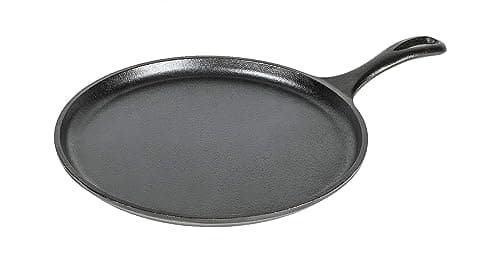
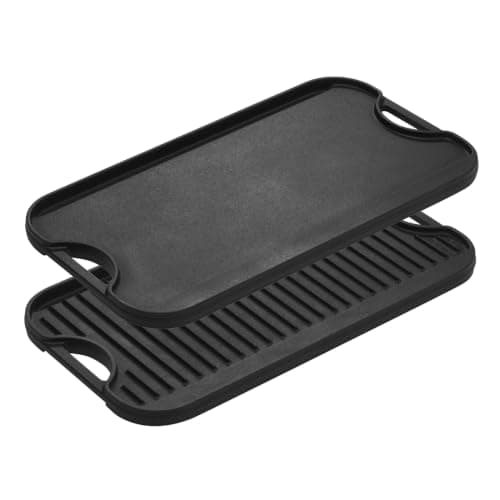
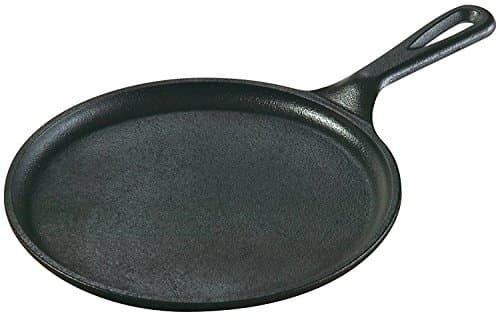
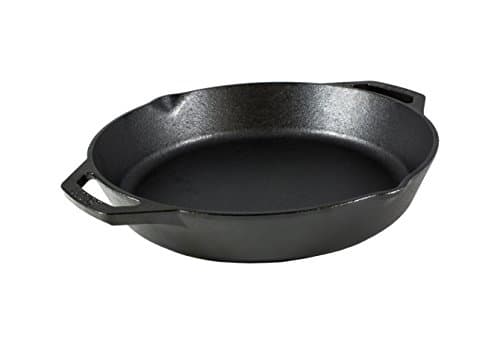
A skillet is a round pan with sloped or straight walls, a long handle and usually a short helper handle opposite it. A griddle is a flat slab of iron: no walls, sometimes no handle at all, sometimes a ridged “grill” face on the reverse. Both are cast iron, both come pre-seasoned from the major makers, both need the same care, and both brown food by the same mechanism — the Maillard reaction, driven by a hot, dry surface. Nothing in this comparison is about one being hotter or better metal than the other.
A note on terms, because the words get used loosely: a griddle is flat, a grill pan has raised ridges, and a comal is a thin flat round traditionally used for tortillas. If the ridges are what you are weighing up, that is a different comparison and we wrote it: grill pan vs griddle.
Difference 1: walls, and everything they let you do
This is the whole comparison in one paragraph. Walls mean the pan can hold something. That single capability is why a skillet is the default first piece of cast iron and a griddle never is.
With walls you can:
- Build a pan sauce. Deglaze the fond with wine or stock and reduce it. On a griddle the liquid simply runs off the edge onto your burner.
- Shallow or deep fry. Oil needs a vessel. See the best cast iron for deep frying for the depths that actually work.
- Bake.Cornbread, a skillet cookie, a frittata, an upside-down cake, a deep-dish pizza — all of them are batter or liquid held by walls.
- Braise a little.Not a dutch oven's job, but a skillet will take chicken thighs and half an inch of stock into the oven happily.
- Toss. Sloped walls let you flick food back on itself without a spatula.
What walls cost you is access. A spatula has to come in at an angle, the far edge of the pan is awkward to reach, and the walls trap a little steam around whatever is nearest them — which is why the outer pancakes in a crowded skillet brown less evenly than the middle one.
Difference 2: usable surface per burner
A 10.25-inch skillet does not give you 10.25 inches of cooking surface. Subtract the wall flare and the corner radius and the flat bottom is meaningfully smaller than the rim diameter. A 10.5-inch flat griddle, by contrast, is flat edge to edge: nearly all of it is cooking surface, and all of it is reachable.
That is the real reason pancakes and smash burgers go better on a griddle. You fit more per batch, and every item sits in the same conditions. Scale that up and the two-burner reversible is a different order of tool again — a published 20 by 10.5 inches of iron, which is enough to cook a family breakfast in one pass instead of four.
The trade comes with the burners. Straddling two burners means the middle of the slab sits over the gap between them, and because cast iron conducts heat slowly, that middle band runs cooler than the ends. You manage it by preheating longer than feels necessary and by rotating food through the hot zones. It is a real limitation and the big griddle is still worth it when you are feeding five people.
Difference 3: flipping and access
On a griddle a spatula arrives flat from any direction. Nothing is in the way, nothing has to be lifted over a wall, and you can slide finished food straight onto a plate. For anything that needs a confident flip — a quesadilla, a grilled cheese, a thin pancake, a smash burger you are scraping off the surface — that access is worth more than it sounds.
It cuts the other way for small or loose food. Diced onion, a handful of mushrooms, anything that wants to roll will roll off a griddle and onto the stove. Walls are a fence as much as a vessel.
Difference 4: weight, storage and the sink
A 10.25-inch skillet is awkward but manageable: one hand on the handle, one on the helper handle, and it fits in a standard sink. A 10.5-inch round griddle is a flat plate that stacks and stores more easily than a pan, but Lodge's round griddles are handle-less, so you lift them with a towel or a handle holder.
The 20-inch reversible is the one to think hard about before you buy. It is heavy, it will not fit in most sinks, it does not stack with anything, and it needs a cupboard shelf of its own. That is the honest cost of the surface area, and it is the reason this piece lives in a lot of garages and a lot of regret posts. If your kitchen is tight, read the best cast iron for a small kitchen before you commit.
Difference 5: heat sources
Both shapes work on gas, electric coil, smoothtop and induction, and both go in the oven, on a grill and over a fire — Lodge publishes exactly that compatibility for its classic skillet, and it has been casting iron in South Pittsburg, Tennessee since 1896.
Two caveats worth knowing. On induction, only the metal directly over the coil heats, so a two-burner griddle is a poor match for an induction hob — a single round griddle sized to the coil is much better. And on a glass smoothtop, dragging a heavy flat slab across the surface is how glass gets scratched: lift, never slide. We cover both in cast iron on glass and induction cooktops.
Job by job: which shape wins
Pancakes — griddle. Flat, roomy, no walls to fight. Our best cast iron for pancakes picks accordingly.
Smash burgers — griddle. You need to press and scrape, and the scraping needs an open edge. The skillet works for two patties; the griddle works for six. See best cast iron for smash burgers.
Tortillas, quesadillas, flatbreads — griddle.This is the comal's native job. Our comal picks cover it.
Grilled cheese and toasted sandwiches — griddle, and a grill press makes it better still.
Steak — skillet. You want the fat and juices to stay put so you can baste, and you want to finish with butter and aromatics in the pan. Both sear equally hard, thanks to thermal mass; only one of them keeps the butter. Best cast iron for steak has the full method.
Eggs — either, and it depends. Fried eggs with room to spread: griddle. Scrambled, an omelet, or anything that needs corralling: skillet. See best skillet for eggs.
Bacon — griddle for a crowd, skillet for a couple. A griddle holds more strips flat; a skillet keeps the rendered fat, which you want for the cornbread you are about to make. Our cast iron bacon method works on both.
Cornbread, skillet cookies, frittatas — skillet, only. Batter needs walls. There is no griddle answer to this.
Deep or shallow frying — skillet, only. Oil needs a vessel, and a shallow slab of hot oil on an open plate is a genuine hazard.
Stir-fry — neither, really. You want curved walls and the ability to toss, which is a wok. See the best cast iron woks.
So should you own both?
Eventually, yes, and in that order. The skillet is the piece that does the most jobs, so it goes first; the griddle is the piece that does a few jobs much better, so it earns its place the moment one of those jobs becomes a habit. Pancakes every Saturday, tortillas on a weeknight, burgers for five — any of those is reason enough.
If you want the whole griddle category ranked rather than the shape argument, that is the best cast iron griddles, and Lodge's flat range covers the sizes side by side. If you are weighing materials rather than shapes, carbon steel vs cast iron griddle is the right page. And if the comparison you actually wanted was pan versus pot, it is dutch oven vs cast iron skillet.
The verdict
One piece of cast iron: a 10 to 10.25-inch skillet. Nothing else in the category does as many jobs, and it is the pick on the best cast iron skillet for that reason.
Two pieces: that skillet plus a flat round griddle sized to your largest burner. Between them you cover batter, liquid, oil, and flat food in batches.
Two burners and a household to feed: add the reversible slab, and accept the storage problem as the price of cooking a whole breakfast at once.
Whatever you buy, the thing that will actually improve your results is not the shape — it is preheating properly and keeping the seasoning in good order. How to preheat cast iron and how to cook on a cast iron griddle are the two pages to read next.
How to choose between them
Write down the three things you cook most
If two of the three involve batter, liquid or oil, the skillet is your answer and the decision is over. If two of the three are flat food cooked in batches — pancakes, tortillas, burgers, sandwiches — the griddle earns the spot. Most people's list is mixed, which is exactly why the skillet goes first and the griddle second.
Measure your largest burner before buying a griddle
A griddle should match the burner, not the counter. Iron overhanging a small burner heats unevenly and never catches up, because cast iron moves heat sideways slowly. An 8-inch round over a small burner outperforms a 10.5-inch round that is only hot in the middle, and a two-burner slab is only worth owning if you genuinely have two usable burners in a line.
Check your sink and your cupboard
This is the practical check people skip. Will the piece fit in your sink to be washed? Is there a shelf it can live on? A 20-inch reversible griddle fails both tests in a lot of kitchens, and a tool that is annoying to clean and store is a tool you stop using.
On induction or glass, buy round and buy sized
Induction only heats the metal above the coil, so a single round griddle matched to the hob element is the right shape; a long two-burner slab is the wrong one. On glass, lift rather than slide, every time. Details in the best cast iron for induction and the best cast iron for glass-top stoves.
Do not buy reversible for the ridges alone
The ridged face is useful, but it is a compromise against a dedicated grill pan, and the ridges are harder to clean than any flat surface — see how to clean a cast iron griddle. Buy the reversible slab for the flat side and the size; treat the ridges as a bonus.
Season and store both the same way
There is no separate griddle care routine. Dry it, oil it lightly, keep it out of standing water. Because a griddle has no walls, it also has nowhere for water to pool, which makes it marginally more forgiving. How to season cast iron and how to store cast iron apply to both shapes equally.