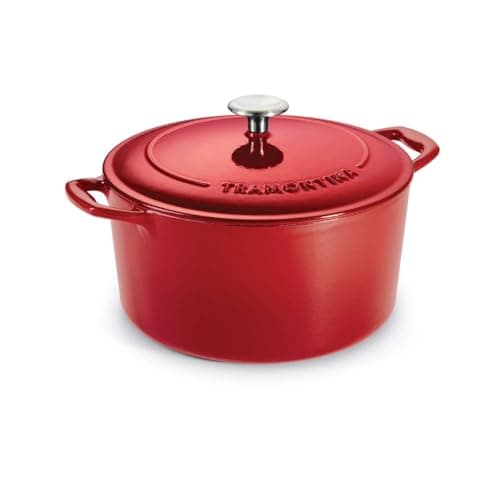
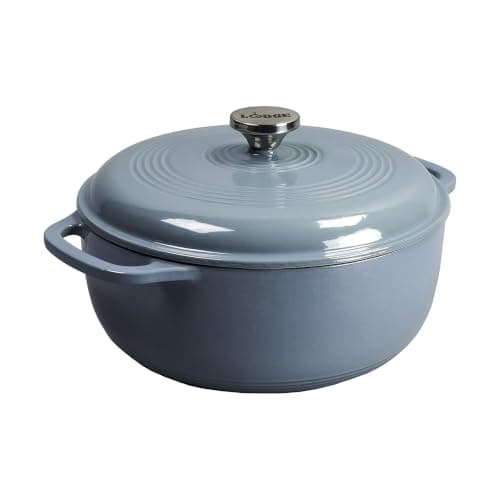
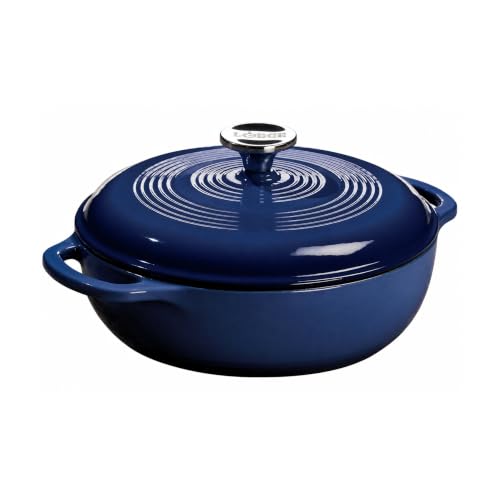
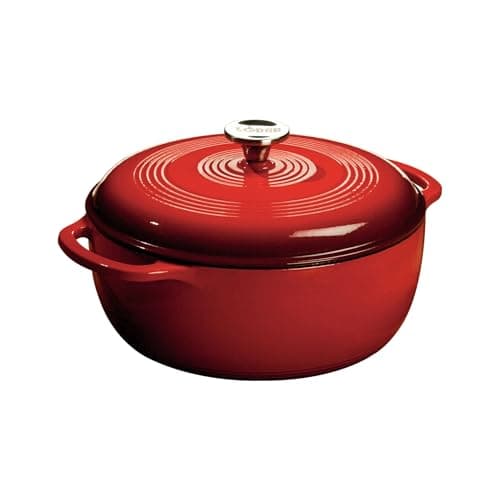
The best Staub alternative is the Lodge 6-quart enameled, best for a cook who wants the cooking result without the object — same glass interior, same heavy sealing lid, a published 500°F rating and a fraction of the money. The budget pick is the Tramontina 6.5-quart, best for someone who wants the most capacity for the least outlay. Staub is a genuinely excellent pot; this page is about what else does the same job.
What Staub is known for
Staub presents itself as a French maker of enameled cast iron cocottes, founded in Alsace and now part of the Zwilling group. Two features drive its reputation among cooks. The first is the dark matte interior enamel, which does not show staining and which many cooks find browns more readily than a pale glossy interior. The second is the lid: Staub lids are heavy and have raised points or ridges underneath, so condensation collects and drips back onto the food rather than running down the walls — the “self-basting” claim.
Both are real design choices and we are not going to pretend otherwise. What we will say is where they matter. The matte interior is a cosmetic and color-reading advantage: a dark pan makes it harder to judge how far your fond has gone, which is why a first potis usually better with a pale interior. And the self-basting lid is a refinement on a mechanism every dutch oven already has — the thick walls and tight-fitting lid that define the vessel already trap the moisture. A dimpled lid redistributes it slightly better. It does not create it.
Matching it on browning
The browning reaction that builds a braise's flavor depends on the pan surface being hot and dry, and on the pan having enough thermal mass not to be cooled below that point by cold meat. Both are functions of iron thickness, not of enamel color. A Lodge enameled pot and a Staub cocotte of the same capacity have comparably thick walls; the Lodge browns a chuck roast the same way. If you want the appearanceof the dark interior as well, that is a preference and there is no cheap pot that offers it — say so to yourself honestly before you substitute.
Matching it on capacity and shape
The Staub round cocotte we carry is 5.5 quarts and the oval is 7. Both are well-chosen sizes. If capacity is the thing you want, the Lodge 7.5-quart exceeds anything in the Staub line we stock, for far less. If you want the small-cocotte format — a 3-quart pot for rice, beans and a braise for two — the Lodge 3-quart enameled is the direct swap and it also publishes 500°F. Our best small dutch ovens page ranks that end properly.
If you want to stay French
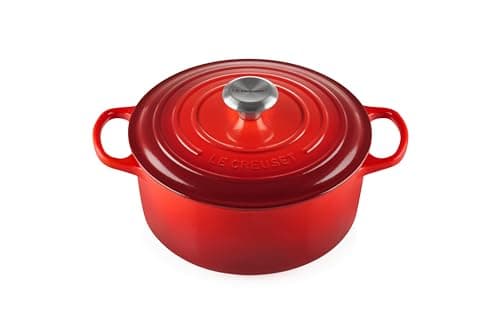
Plenty of people shopping for an alternative to Staub are not trying to spend less — they want the other French pot. In that case the Le Creuset 4.5-quart is the like-for-like: the same enameled cast iron construction, a pale interior rather than a dark one, a famously broad color range, and published care guidance that the enamel interior needs no seasoning and should be protected from thermal shock. Our Le Creuset vs Staub comparison is the page for that decision, and the best Le Creuset alternatives is the mirror image of this one.
What you give up
Three things, and they are worth naming. Warranty: the French brands carry lifetime limited warranties and the budget pots do not. Enamel hardness: the premium pots use a harder, more chip-resistant coating, and a chipped rim on a cheap pot is a more likely event. Resale: a used Staub or Le Creuset holds value and a used Lodge does not. None of those changes how dinner turns out, which is the point of this page — but if you are buying a pot to hand down, they are exactly the reasons to buy the original instead. Our is Staub worth it page makes that case rather than this one.
One caveat that applies to all of these
Every pot on this page is enameled, and enamel is glass fused to metal. Glass chips. Do not preheat an empty enameled pot over high heat, do not drop metal into it from a height, and do not plunge a hot one into cold water. That advice is identical for a Staub and for a forty-dollar pot; the difference is how forgiving the coating is, not whether the rule applies. Our enameled cast iron care guide has the full routine, and chipped enamel cast iron covers what to do when it happens anyway.