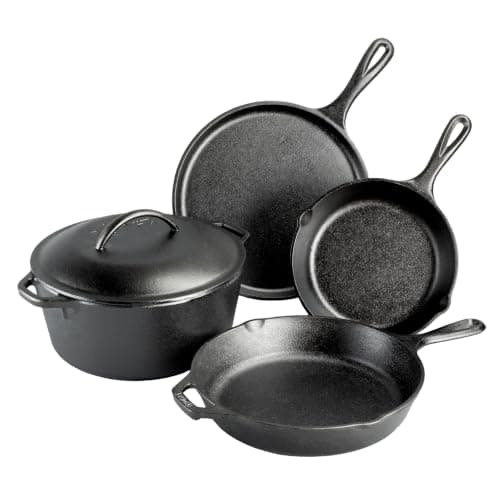
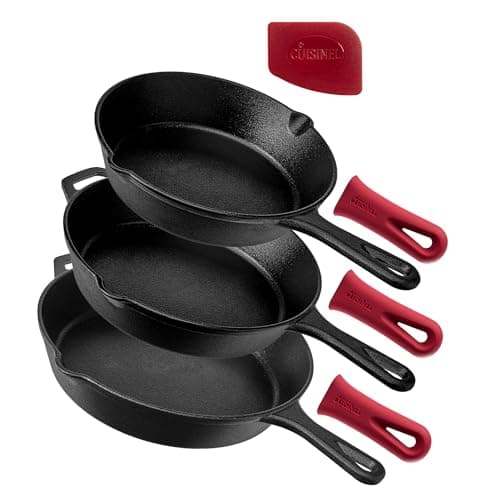
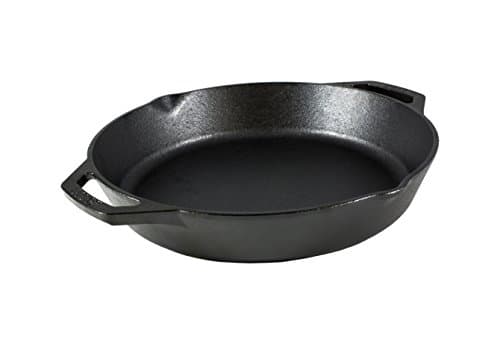
Buy individual pieces. Start with one 10.25-inch skillet, add a second size only when you have actually outgrown the first, and spend the difference on a dutch oven or care gear. Sets are right in exactly two situations: furnishing a kitchen from nothing, and giving someone a complete kitchen as a gift. In every other case a set spreads your money across pans you will not reach for, and cast iron is heavy enough that unused pans are a genuine storage cost, not a neutral one.
We rank the sets themselves in the best cast iron cookware sets, and some of them are good. This page is the question that comes first: whether to buy one at all.
The math sets rely on
A three-pan set at a headline price looks like three pans for less than two. The arithmetic is real. The problem is that it is the wrong arithmetic.
Cast iron sets are almost always assembled from the sizes that are cheapest to cast, not the sizes people use most. The typical skillet set is a 6-inch, an 8-inch and a 10-inch — and the 6-inch is a novelty for most households while the 10-inch is doing all the work. You have bought one pan you needed and two you did not, at a price slightly below buying the one.
That would be harmless if storage were free. It is not: cast iron does not nest well, it is heavy to move around a cabinet, and the pans you never use end up in front of the ones you do.
When a set genuinely wins
1. You are furnishing a kitchen from zero
A first apartment, a new household, a rental with nothing in it. Here a multi-piece set that includes a skillet, a griddle and a pot really is a head start, and the price per useful piece is genuinely lower. This is the strongest case for a set and it is a real one.
2. You are giving a complete kitchen as a gift
A boxed set presents better than loose pans and reads as a substantial gift. If the recipient owns nothing, the objection above does not apply — every piece is new capability. Our gift guide covers the occasion, and the first-skillet kit is the better option if they already own a pan.
The case that is not a real case
“I will grow into it.” People do not grow into cookware; they develop habits around the pans they reach for, and the pans they reach for are the ones that suit what they already cook. Buying ahead of your habits is how a cabinet fills up.
What to buy instead, for the same money
Take the price of a typical three-pan skillet set. For roughly that money you can have:
- One 10.25-inch skillet, plus a chainmail scrubber, a pan scraper and a silicone handle sleeve. One pan you will use daily and three items that remove every early frustration. This is our default recommendation and the reason the assembled kit page exists.
- Or one 10.25-inch skillet and a budget enameled dutch oven. Two genuinely different tools rather than three versions of one. This is the better buy if you cook soups and braises at all.
Either combination covers more actual cooking than a set of three skillets, and neither leaves you with a pan you resent storing.
The one set worth considering on its merits
Mixed sets — a skillet plus a griddle plus a dutch oven, rather than three skillets — escape most of the criticism above, because the pieces do different jobs. If you are set-shopping, that is the shape to look for. A set of three skillets in three sizes is buying one thing three times; a set with a pot and a flat surface in it is buying three things.
What about enameled sets?
Same logic, more money at stake. A matched enameled set looks superb and always contains a piece that will not be used, and at the premium tier that unused piece is expensive. Buy the pot you will cook in. We make that argument at the top of the market in premium cast iron gifts and are expensive dutch ovens worth it.
The honest summary
Cast iron is the category where buying one excellent thing is easiest, because the one excellent thing is inexpensive and the difference between a cheap pan and a costly one is smaller here than anywhere else in the kitchen. That is precisely why sets are unnecessary: you are not economizing by bundling, because the single pan was never the expensive problem.
Build the ladder deliberately instead — our size ladder guide is the order we would buy in.
If you are set-shopping anyway
Prefer mixed sets to same-item sets
A skillet plus a griddle plus a pot is three tools. Three skillets in three sizes is one tool bought three times. That single test filters most of the market.
Price the set against the pieces you would actually buy
Not against the sum of every piece in the box. If you would only ever buy two of the four items, the honest comparison is the set price against those two. Sets frequently lose that comparison.
Check the sizes, not the count
A “5-piece set” that counts two lids as pieces is a 3-pan set. This is common enough at the budget end to be worth reading the listing carefully.
Enameled sets bind you to one color for decades
Enameled cookware is displayed, and a set commits you to a single colorway across every piece. Buying individually lets you change your mind, which over a thirty-year life is worth something.
Storage is a real cost
Cast iron does not stack neatly and is heavy to shuffle. Before buying four pieces, decide where they live. A pan behind two other pans is functionally a pan you do not own.