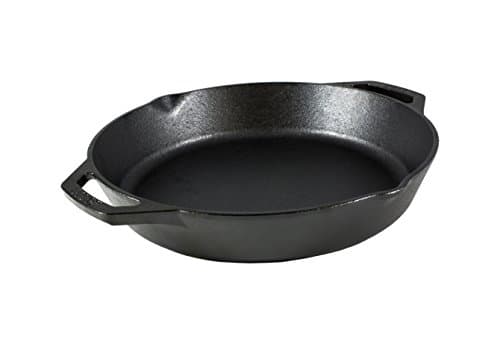
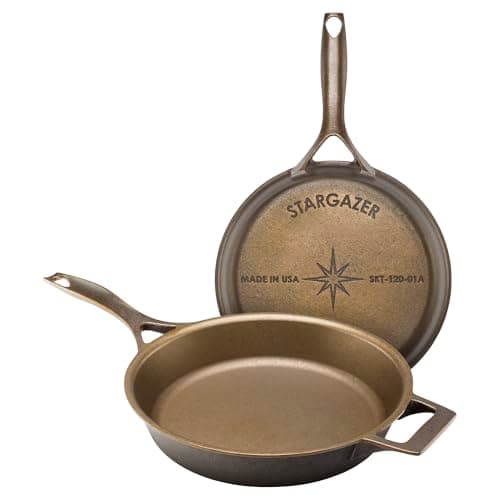
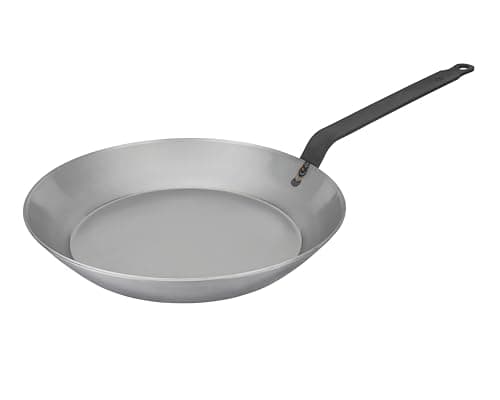
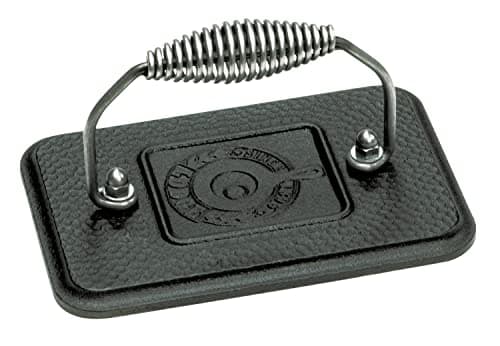
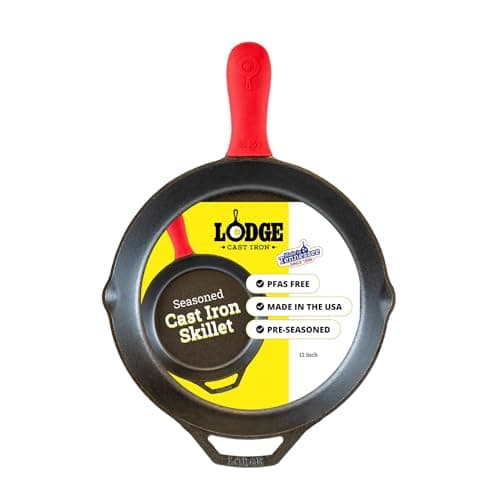
For steak, buy the heaviest flat cast-iron skillet you can comfortably lift — a 12-inch Lodge is the honest best pick, because a hard crust is really a question of thermal mass, and mass is exactly what a thick, cheap pan has. A smooth Stargazer sears just as hard with a nicer handle; a thick carbon-steel pan is a lighter alternative; and a grill press is the one accessory that measurably improves the crust. What you do not need is an expensive pan — the physics does not care what it cost.
A great sear is the Maillard reaction — the browning that happens fast and hard above roughly 300°F. The enemy of that crust is a pan whose surface temperature crashes the moment a cold, wet steak lands on it, because a cooler surface steams the meat instead of browning it. The fix is thermal mass: a thick, heavy pan stores so much heat that a cold steak barely dents its surface temperature, so the crust keeps forming. That is the entire reason cast iron sears better than a thin stainless or nonstick pan, and it is why, within cast iron, a heavier pan usually edges out a lighter one for this one job. Our cast iron steak method walks the technique start to finish.
Why heavier tends to win
Between two cast-iron pans, the heavier one holds temperature better under a cold steak, which is why we rank the 12-inch Lodge ahead of the 10.25 for a dedicated steak pan — more diameter also means you can sear two steaks without crowding, and crowding is the other great crust-killer. The boutique Stargazer matches the sear with a smoother surface and a cooler handle; it costs far more, and it does not sear harder, it just feels nicer doing it. A thick carbon steel pan is the lighter option, holding a little less heat but flipping more easily. And a cast-iron grill press pushes the whole surface of the steak into the pan, which genuinely improves contact and crust.
The other half of the crust is technique
The best pan in the world will not sear a wet, cold steak well, so half the job is done before the meat touches the iron. Pat the steak bone-dry — surface moisture steams instead of browning, and steam is the enemy of crust. Salt it ahead (even 40 minutes on a rack in the fridge dries and seasons the surface), and let it lose the deepest chill of the fridge so the center is not raw when the crust is done. Then get the pan genuinely hot: a drop of water should skitter and evaporate almost instantly. Our preheating guide covers how far to push it without scorching the seasoning.
Once the steak is down, leave it alone. Moving it too early tears the forming crust off the surface; let it release naturally, which it will when the crust is set. A knob of butter, a smashed garlic clove and a thyme sprig added in the last minute, spooned over the top, finish it. Rest the steak before slicing so the juices redistribute instead of running onto the board. None of this needs an expensive pan — it needs a hot, heavy, well-seasoned one and a little patience, which is exactly what every pick here delivers. The full method, step by step, is in our cast iron steak guide.
How to choose a steak pan
Weight and thickness first
For searing, mass is the spec that matters. A heavy 12-inch skillet holds its temperature under a cold steak better than a light pan, so the crust forms faster and darker. Buy the heaviest flat pan you can comfortably lift and maneuver — past that point, a pan too heavy to control is a burn risk, not an upgrade.
Flat, not ridged
A flat skillet gives full-contact browning across the whole steak; a ridged grill pan gives stripes and drains fat, which looks great but browns less of the surface. For maximum crust, sear on the flat pan; use a grill pan when you want the marks. See our best cast iron grill pans if marks are the goal.
Size to your burner and your servings
A 12-inch pan sears two steaks without crowding, but it needs a burner that can heat the whole base. On a small or weak burner, a 10.25-inch pan may actually sear more evenly. Match the pan to your stove, not just your appetite.
Add a grill press, skip the expensive pan
A grill press is a cheap upgrade that measurably improves crust by forcing even contact — better value for your sear than spending five times more on a boutique skillet. Put the money there, and toward good preheating, before you buy a fancier pan.