Cast iron woks are good at half of what a wok is for. They are excellent at deep frying, searing, braising and anything that benefits from a pan that refuses to cool down — and they are genuinely poor at the fast, responsive, constantly-moving cooking that defines stir-frying. If you have a domestic burner and you mostly want one pan for big-batch searing and frying, a cast iron wok is a good buy. If you want to learn to stir-fry properly, buy carbon steel instead and do not let anyone tell you the weight builds character.
What a wok is actually asking of the metal
A wok is a round-bottomed pan designed around a very high-output ring burner, and the technique it exists for involves shoving food up the sloped sides into cooler air, pulling it back into the hot centre, and changing the heat several times in a two-minute cook. That technique needs a pan that responds— thin metal that follows the flame up and down almost instantly.
Cast iron is the opposite material by design. It has to be cast thick to be strong, which gives it enormous thermal mass and poor thermal conductivity. Turn the flame down under a cast iron wok and nothing happens for a minute. That is a feature when you are frying and a defect when you are stir-frying, and that single trade explains every other answer on this page.
Carbon steel is rolled sheet rather than a casting, so it can be a fraction of the thickness for the same strength. A 14-inch carbon steel wok weighs a few pounds; a 14-inch cast iron wok is a two-handed object. Both season, both are bare metal, both rust if you leave them wet. The only meaningful difference is thickness, and therefore responsiveness. The dedicated comparison is cast iron wok vs carbon steel wok.
Where a cast iron wok is genuinely the better pan
Four cases, and they are not consolation prizes:
- Deep frying. The best thing a cast iron wok does. Drop a basket of cold food into oil in a thin pan and the temperature collapses; in cast iron it barely moves. The sloped sides also mean you get usable depth from less oil than a straight-sided pot.
- Searing in volume. A wok-shaped pan holds a lot of food, and browning needs the surface to stay hot when the food lands. Two pounds of beef in a cast iron wok browns; in a thin wok on a domestic burner it steams.
- Braising and steaming. Long, low, covered cooking is exactly what high thermal mass is for.
- A weak burner. This is the counter-intuitive one. On an underpowered domestic hob, a thin wok cannot stay hot under a load no matter how good your technique. A heavy wok arrives at temperature slowly and then stays there, which can beat a better pan on a bad burner.
Where it is the wrong pan
- Actual stir-frying.The tossing motion — lifting the pan and throwing the contents — is not optional technique, it is how the food cooks evenly in a pan with one hot spot. You cannot toss eight pounds of iron, so you stir instead, and stirring in a wok is just cooking in a bowl-shaped skillet.
- Anything delicate or fast. Prawns and greens go from right to overdone in seconds, and the pan will not let you back off.
- A small kitchen. A full-size cast iron wok is heavy to lift, awkward to wash and hard to store. See best cast iron for a small kitchen.
- Chasing “wok hei”. The smoky restaurant character comes from a burner putting out several times what a domestic hob manages, plus tossing. No pan material delivers it at home. Anyone selling you a pan on that promise is overselling.
Your cooktop decides more than the metal does
Gas. The best case for a thin carbon steel wok, because you get both responsiveness and visible flame control. A round-bottomed wok needs a ring to sit in; a flat-bottomed one does not.
Induction. Iron is ferrous so cast iron woks work, and Lodge publishes its iron as compatible with any stovetop including induction. But induction heats only where the pan meets the coil, so a wok's sloped sides are heated by conduction from the base alone. A round-bottomed wok on induction barely works at all; a flat-bottomed one works, in a smaller circle than you want. Here cast iron's thermal mass genuinely helps, by spreading that small hot disc.
Glass-ceramic or smooth-top electric.Workable with a flat-bottomed wok, with the usual rule: lift, never slide. The weight is a real liability on glass — best woks for glass top stoves is the page for this, and the handling rules cover the rest.
The four woks we cover, on their published specs
Specs as listed by the makers on the live listings — three cast iron and one carbon steel, because on this question the honest answer for a lot of readers is the other material. The ranked picks and live prices are below the table.
| Wok | Size | Material | Bottom | Suits |
|---|
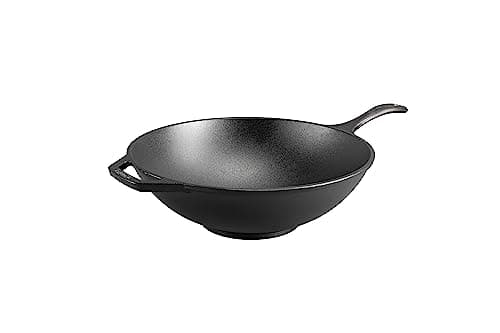
| Lodge Chef Collection | 12.5 in | Cast iron, smoother finish, made in USA | Flat | Any hob, including induction and glass |
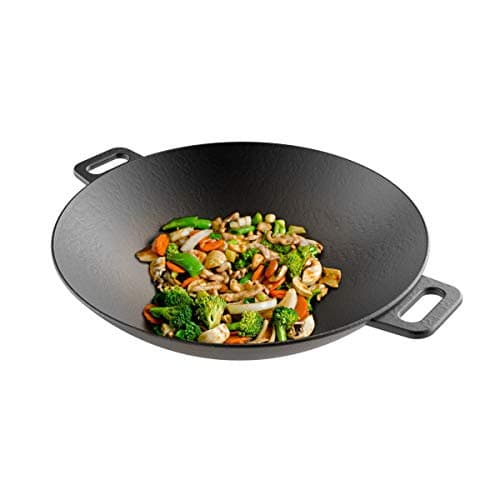
| Classic Cuisine | 14 in | Cast iron, pre-seasoned | Flat, two loop handles | Any hob; the cheapest full-size iron wok live |
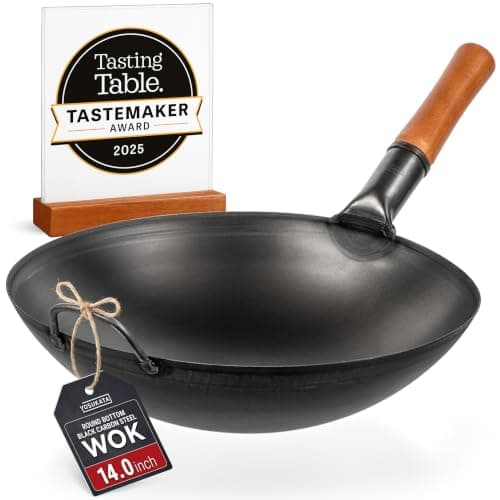
| Yosukata | 14 in | Carbon steel, pre-seasoned | Round | Gas with a wok ring only — not induction |
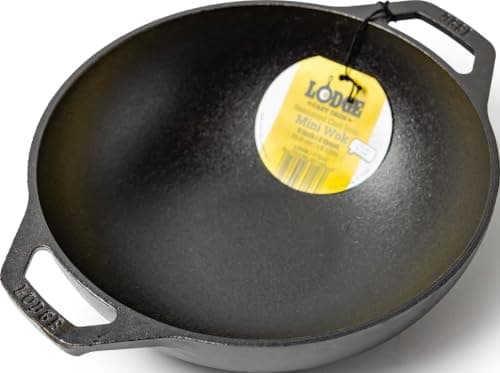
| Lodge mini | 9 in | Cast iron, dual loop handles, made in USA | Flat | One serving, or stove-to-table. Not a cooking wok |
Two things that table makes obvious. The only round-bottomed wok here is the carbon steel one, which is not a coincidence — a round bottom is for a gas ring, and induction needs flat contact with the coil. And the 9-inch Lodge is in the registry as a serving pan, not a stir-fry pan; it gets bought by mistake often enough to be worth saying plainly.
Is a cast iron wok good for health or for iron intake?
It is as safe as any other bare iron pan, which is to say: fine. The cooking surface is polymerized oil over iron — no coating, no PFAS, nothing to scratch off into the food. Small amounts of dietary iron do transfer, more so with acidic food, which is a documented effect rather than a health claim we are making; cast iron for iron deficiency covers what the evidence actually supports. The general safety question is is cast iron safe.
So: are cast iron woks good?
Good pans, often the wrong pan. Buy one if you want big-batch searing, deep frying and braising in a shape that holds a lot of food, or if your burner is too weak to keep a thin wok hot. Buy carbon steel if you want to stir-fry, because the technique the pan exists for requires a pan you can lift with one hand. And if you already own a cast iron skillet, be honest about whether you need either — a 12-inch skillet does most of what a domestic “stir-fry” actually is.
The rankings: best cast iron woks if you have decided on iron, best carbon steel woks if you have decided against it, and Yosukata vs Craft Wok for the head-to-head at the top of the carbon steel field.
How to choose, in four questions
- Will you toss, or stir?If you intend to learn the tossing motion, weight is disqualifying — buy carbon steel. If you will stir with a spatula like most home cooks, iron is on the table.
- What is your hob? Induction or glass-ceramic means flat-bottomed, no exceptions. Gas with a wok ring is the only setup where a round bottom makes sense.
- What are you really cooking? Frying, searing and braising favour iron. Fast vegetable-and-prawn cooking favours steel.
- Can you lift it full, one-handed, over a sink? Answer honestly. A wok you dread washing is a wok you stop using, and 14 inches of cast iron is heavier than people picture.
The picks, and why one of them is not cast iron
Three cast iron woks and one carbon steel, deliberately, because on this question the honest answer for a lot of readers is the other material. The Lodge is the lighter, better-finished iron option and is cast in Lodge's own Tennessee foundries; the Classic Cuisine is the cheapest full-size flat-bottomed iron wok we can find live; the Yosukata is the carbon steel benchmark for anyone who read the sections above and changed their mind; and the 9-inch Lodge mini is not a cooking wok at all but a genuinely good single-serving and stove-to-table pan, which is worth knowing before you buy it expecting dinner for four.
Living with a cast iron wok
The same care as any bare iron, with one wok-specific wrinkle: the sloped sides never get as hot as the base, so the seasoning up top builds more slowly and stays patchier. That is normal and not a defect. Season the whole bowl deliberately rather than relying on cooking to do it — how to season cast iron, and how to season carbon steel if you went the other way.
Dry it on the burner every time. Rust needs both water and oxygen, and a wok's curve holds a puddle you will not notice. Technique, if the pan is new to you: how to use a wok.