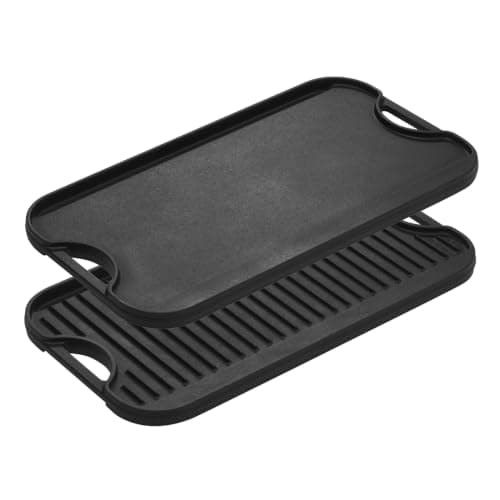
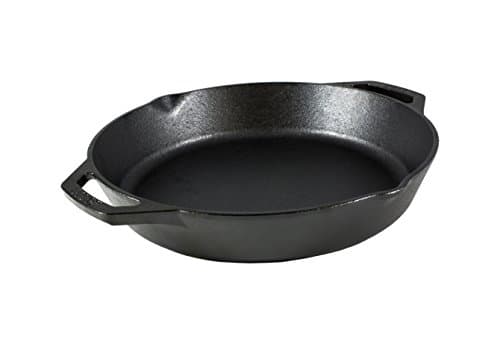
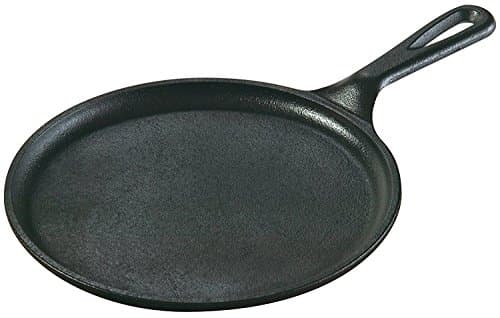
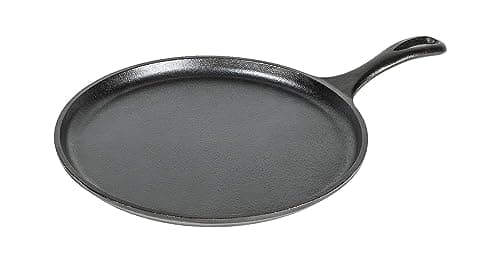
For most kitchens the best cast iron for pancakes is the Lodge 10.5-inch round griddle: a flat, unwalled plate, cheap, and heavy enough to hold its temperature through a full batch. Scale up to the 20-inch two-burner Pro-Grid if you cook for a crowd, down to the 8-inch round if you cook for one, and use the skillet you already own if you would rather not buy anything — it works, with one annoyance.
A pancake is a flat cake cooked on a hot griddle or frying pan with a small amount of fat, and the tool it wants is, unsurprisingly, a griddle — historically a flat iron plate, used for exactly the food you cook without walls. The same object is a comal across Mexico and Central America, where it does tortillas and flatbreads; if that is your main use, start from our best cast iron comalsinstead, because the shortlists overlap almost completely. (The other flat-iron relative, the sizzling oval server, is a table-service pan rather than a cooking surface — see best cast iron fajita pans.)
Why walls are the problem
Everyone's first instinct is the skillet in the cupboard, and it does cook a pancake. But a skillet is a bowl with sloped sides, and that costs you two things. Steam that would otherwise escape sideways gets held against the batter at the rim, so the edges of the cake set softer than the middle. And a spatula has to go in at an angle, which is how a half-cooked pancake gets folded over on itself. On a flat plate the spatula comes in level from any direction and the steam goes where it likes.
It is the same reason a flat griddle beats a skillet for smash burgers, laid out in best cast iron for smash burgers, and the same argument the grill pan vs griddle comparison makes about ridges. Walls and ridges are features for other jobs; for batter they are obstacles.
Why cast iron and not a thin nonstick
Because of mass. Pancake batter goes onto the plate cold, several ladles in a row, and a thin aluminum pan drops in temperature every time — which is why the second batch always browns differently from the first. A high-thermal-mass plate barely notices, so cake four looks like cake one. The cost is at the other end: cast iron is slow to change temperature in both directions, so you cannot correct a too-hot griddle by turning the dial down and pouring immediately. You set it, you leave it, and you accept that the first pancake is the test strip.
Cast iron's other advantage here is that it is bare metal, so a well-built seasoning releases pancakes with a small amount of butter and keeps improving, instead of a coating that slowly stops working. The browning you are after — the Maillard reaction plus a little sugar caramelisation — needs a surface that is genuinely hot and stays hot, which is the whole argument for iron on a breakfast table.
Medium-low, and leave it alone
The commonest pancake complaint on cast iron is a dark, almost burnt outside with a raw middle, and it is nearly always too much heat. Cast iron keeps absorbing energy long after the surface is hot enough, so a griddle left on medium-high for ten minutes is far hotter than it needs to be. Set medium-low, give it five minutes, and test with a few drops of water — they should skitter and evaporate in a couple of seconds, not explode instantly. Our preheating guide covers the method, and why cast iron heats unevenly explains why the center of a griddle over one burner runs hotter than its rim — useful to know when you are placing four cakes on a 10.5-inch round. For the wider technique, how to cook on a cast iron griddle covers heat zones and batch cooking.
The four picks, and who each is for
The 10.5-inch round griddle is the default: two or three pancakes at a time, fits a standard burner, light enough to handle one-handed, and cheap. The 20-inch Pro-Grid is the family machine — Lodge publishes it at 20 by 10.5 inches and 13.5 lb, spanning two burners, flat on one side and ridged on the other, with a grease channel — and it is genuinely awkward to wash and store, which is the price of that surface area. The Lodge 10.25-inch skillet is on the list because most readers already own one and it does work; it is ranked third only because of the walls. The 8-inch round is the one-or-two-person version and the right size for a single tall stack.
On a glass-ceramic cooktop,think twice about the 20-inch slab: it bridges two heating zones, overhangs the glass, and weighs 13.5 lb, and the rule on those surfaces is to lift rather than slide. A 10.5-inch round is the safer choice — the reasoning is in best cast iron for glass-top and electric stoves.
How to choose a pancake surface
Match the surface to the stack you actually make
A 10.5-inch round holds two or three normal pancakes; a 20-inch two-burner slab holds about four and keeps up with a table of people. An 8-inch round is one or two. Buying bigger than your burner is a trap on electric and glass cooktops, where heat has to travel out through the metal from a six-to-nine-inch zone.
Flat beats reversible if you only cook batter
A reversible grill/griddle is two tools in one slab, but you only ever use the flat side for pancakes, and the ridged side makes the piece heavier and harder to store. Buy reversible because you also want grill marks indoors, not because of breakfast.
Check the handles before you commit to a big slab
The thing that goes wrong with a two-burner griddle is not cooking, it is carrying it to the sink full of bacon fat. Short cast handles on a 13.5 lb plate are a two-mitt job, and the plate will not fit a standard sink flat. A silicone handle holder is a cheap and genuinely useful addition.
Season it, then cook fatty things on it
Pancakes are a low-fat food cooked at moderate heat, which is not how you build seasoning. Break a new griddle in with bacon, burgers or anything else that leaves fat behind, following the seasoning routine, and the batter will release much more readily by the third breakfast. Our cast iron bacon guide is a pleasant way to do it.
Butter or oil?
A thin film of clarified butter or a neutral oil, wiped on with a paper towel between batches. Whole butter browns fast at griddle temperature and leaves dark flecks on the next cake — fine if you like it, but wipe the plate between rounds.
Cleaning
Scrape while warm, rinse, dry fully over low heat, and wipe a trace of oil on. Lodge's own instruction for its griddles is hand wash, dry, oil. For burnt-on batter, use a scraper or chainmail rather than steel wool — see chainmail vs steel wool and how to clean a cast iron griddle.