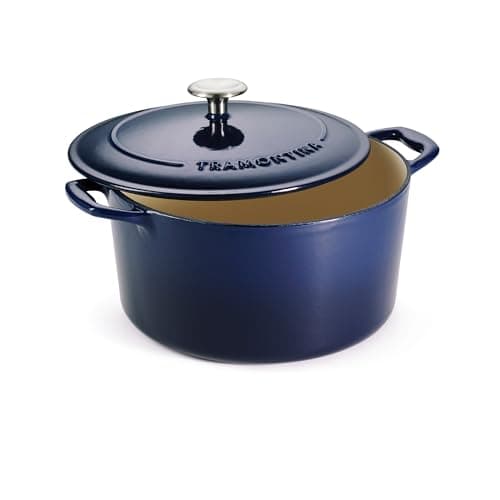
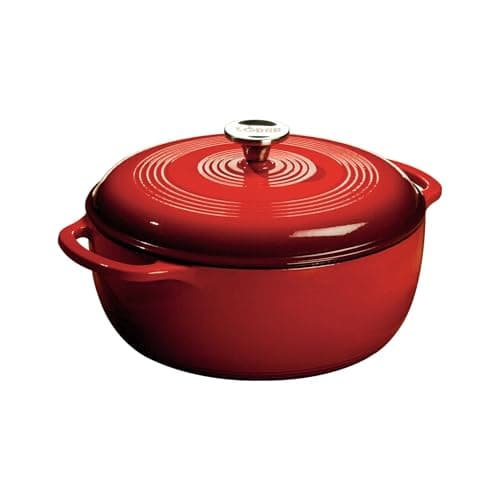
Buy the Lodge if you bake bread or want the safer default. It is the only one of the two with a clearly published oven-safe rating — 500°F, stated on Lodge's own care page — and that single fact decides the most demanding job either pot will be asked to do. Buy the Tramontina if you cook for four or five and want the extra half quart of capacity for roughly similar money. What you should not do is agonize: these two pots braise, simmer and roast so similarly that no honest cook could pick them apart blind. This is a decision about bread and batch size, not about cooking quality.
Lodge and Tramontina are playing the same game, and it is a game they both play well: a heavy enameled cast iron dutch oven that does most of what a French pot does for a small fraction of the money. Both are cast iron coated in vitreous enamel — powdered glass fused to the metal — so neither needs seasoning, neither will rust, and both shrug off a three-hour tomato and wine braise that would strip a bare pan. Neither is a luxury object. If you want the heirloom tier, that is a different conversation entirely, and we have it in Lodge vs Le Creuset.
Between these two, the internet tends to manufacture a rivalry that the pots do not really support. So here is the honest framing: they are close, the differences are narrow and specific, and there are exactly three of them that matter.
Difference 1: the published temperature rating
This is the biggest practical gap between them, and it is not about how hot each pot can actually get — it is about what the manufacturer will tell you.
Lodge states plainly that its enameled cast iron is usable on the stovetop and in the oven up to 500°F. That covers essentially any bread recipe, including the preheat-the-empty-pot method, and it means you can buy the pot for sourdough without doing any homework.
Tramontina does not make the equivalent figure easy to find — its own storefront lists its enameled dutch ovens without a prominent oven-safe rating, and listings for these pots commonly show a knob rated below the Lodge's. We are not going to invent a number for a spec the manufacturer does not publish clearly. What we will say is the practical thing: if you are buying for bread, read the exact listing for the exact pot you are about to buy, and if you cannot find a rating, buy the Lodge. The lid knob is usually the limiting part, not the pot body, and it is the part people forget to check.
If bread is the whole reason you want a dutch oven, our best dutch ovens for sourdough roundup goes deeper on what the pot needs to survive.
Difference 2: capacity
The Tramontina is the larger pot — 6.5 quarts against the Lodge's 6 — and that half quart is more useful than it sounds if you routinely batch-cook. It is the difference between a chili that fits comfortably and one that threatens the rim, and it gives a big joint of meat a little more room to sit under liquid.
It is also weight you have to lift. A six-quart enameled pot is already heavy before you add food, and weight is the single most common reason a dutch oven quietly stops being used. If you cook for one, two or three, the extra capacity is not a benefit, it is a tax — and the smaller Lodge is the better everyday pot. Our what size dutch oven do you need guide has the full sizing argument, and 5-quart vs 7-quart covers the same fork one size up.
Difference 3: the company behind the pot
Lodge has been casting iron in South Pittsburg, Tennessee since 1896 and was the first manufacturer to season its cookware in the foundry, a change it made in 2002 that the rest of the industry then copied. Worth being precise, though: that American bare-iron heritage is not what you are buying here. Lodge's enameled line is separate and newer, introduced in 2005 specifically to compete with the European makers. Buyers routinely assume the enameled pots come out of the same Tennessee foundry as the skillets. They do not.
Tramontina is a genuinely large Brazilian manufacturer — founded in 1911 by Valentin Tramontina, headquartered in Carlos Barbosa in Rio Grande do Sul, running eight manufacturing plants with more than ten thousand employees and selling into 120 countries. This is not a no-name importer slapping a badge on a generic pot, which is a fair worry at this price and the reason a lot of cheap enameled cookware deserves suspicion. Tramontina is a real cookware company with real scale.
Where Lodge still wins is the depth of its consumer support in the US: it is easier to get a clear answer out of Lodge about a chipped pot, and far easier to find its care documentation. Tramontina is enormous, but its cookware is one line among more than twenty thousand products spanning cutlery, appliances, garden tools and construction equipment.
Where they are genuinely the same
The cooking. Both are thick enameled cast iron with a heavy lid. The mass holds a low, steady temperature for hours; the lid traps steam. Brown your meat hard in batches to build real Maillard fond, deglaze, add liquid partway up the food, cover and go low and slow, and neither pot will give you a result you could distinguish from the other. Anyone claiming a meaningful searing or braising difference between these two is describing a preference, not an outcome.
The care routine.Enamel is glass on both. Both chip if you knock them against a sink or drop the lid on the rim. Both dislike sudden temperature swings — Lodge explicitly warns against introducing cold ingredients into a hot empty pan, and against heating enameled cookware empty on the stovetop. Wash with soap and water, use wooden or silicone tools if you want to keep the interior pristine, and that is the entire routine for either. See how to care for enameled cast iron.
The ceiling. Neither has the enamel hardness, the handle comfort or the resale value of a French pot. Both are working pots. That is the point of both of them, and it is why the value tier is where most people should shop.
The honest case against each
Against the Lodge:it is the smaller pot, so batch cookers will find it fills faster than they would like. Its enamel and hardware are a visible step below the French pots — thinner finish, smaller handles that are less comfortable in oven mitts — and over years of hard use it is more likely to stain or craze than a Le Creuset, and there is effectively no resale market.
Against the Tramontina: the temperature rating is not published where a buyer can easily find it, which is a real problem for the single most demanding job people buy these pots for. Its enamel is not as hard-wearing as the premium brands over years of use. And its extra capacity brings extra weight that a lot of households will experience as a downside rather than a feature.
The verdict
Buy the Lodgeif you bake bread, if you cook for one to four, or if you simply want the choice that requires no research. The published 500°F rating removes the only genuine risk in this price bracket, and the smaller size is the more liveable everyday pot.
Buy the Tramontinaif you regularly cook for four or five and freeze leftovers, and bread is not your main reason for owning a dutch oven. You get a real cookware company's pot with more room in it, and for stews, chilis, soups and braises it will not give an inch to the Lodge.
And if this comparison has convinced you that the value tier is where you belong — which for most people it is — our best budget dutch ovens roundup ranks the whole bracket, and the best dutch oven brands maps how these two sit against Le Creuset, Staub, Cuisinart and Amazon Basics.
How to decide between them
Answer the bread question first
This is the fastest way to end the decision. If you intend to bake bread — especially the preheat-the-empty-pot method — the pot needs a rating you can actually verify, and the lid knob is usually the limiting part. Lodge publishes 500°F. If you cannot find an equivalent published figure for the specific Tramontina listing in front of you, that is your answer. If you never bake bread, this criterion drops out entirely and capacity should decide it instead.
Size for the household you actually feed
Six quarts suits most households; 6.5 suits batch cookers. Do not buy capacity speculatively — a pot you find heavy is a pot you stop reaching for, and that is the real cost. If you are genuinely between the two, take the smaller one.
Do not pay a premium for either badge
These two sit close enough on price that a sale can invert them. Neither brand carries a premium worth chasing at this tier, so if one is meaningfully discounted when you look, that is a legitimate reason to pick it — provided the bread question above has already been settled. Live prices for both are on this page.
Check the interior color if you are still learning to sear
A pale interior makes it much easier to judge how far your fond has browned, which matters while you are still building the instinct. Both of these pots are commonly sold with light interiors, but colorways vary by listing — worth a glance before you order if you are new to braising. Our how to braise in a dutch oven guide walks the method either pot is built for.
Ignore the sets
Both brands will sell you the pot bundled with pieces you did not ask for. Buy the single dutch oven. It is the piece you will use several times a week if it suits you, and a bundle spreads your money across items that sit in a cupboard while you find that out.