Buy the dutch oven — and if bread is the main reason you are buying, buy the Lodge combo cooker specifically. It is the cheapest vessel in this comparison, its shallow base loads a shaped loaf almost as easily as a cloche does, and unlike a cloche it also sears, braises and roasts. Buy the cloche instead only ifyou bake bread constantly, you already own a pot for everything else, and lifting a hot twelve-and-a-half pounds of iron out of a 450°F oven is a problem you actually have. That last one is a real reason, not a soft one.
These two vessels work by the same mechanism, which is why the choice confuses people. Both are a heavy container with a tight lid. Both get preheated. Both trap the water leaving the dough and hold it against the loaf for the first half of the bake. The differences are not about physics so much as shape, weight, and how many other jobs the thing can do when you are not baking.
Why a covered vessel bakes better bread at all
A home oven is a dry, draughty box. A bakery deck oven injects steam. Trapping the dough's own moisture under a lid is the home workaround, and King Arthur Baking puts it plainly: “the steam that's created inside the pot miraculously transforms the dough.” Three things happen.
The crust stays soft and extensible for longer, so the loaf keeps rising instead of setting early — that is oven spring, and it is why a covered loaf is taller. Steam gelatinizes the starch on the surface, which is what produces the glossy sheen and lets a scored slash open into an ear. And the enzymes keep converting starch to simple sugars that then brown once the lid comes off, which is where the color and most of the flavor in the crust comes from.
None of that is specific to cast iron. A preheated vessel with thermal mass and a lid does it. The dutch oven has been used as a bread oven for centuries for exactly this reason, and a clay cloche is the older version of the same idea.
What each one actually is
The dutch oven
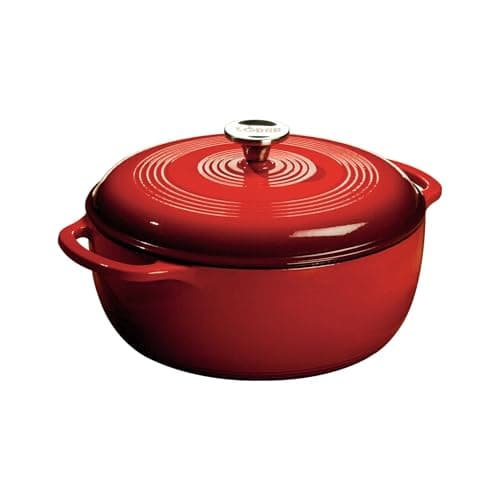
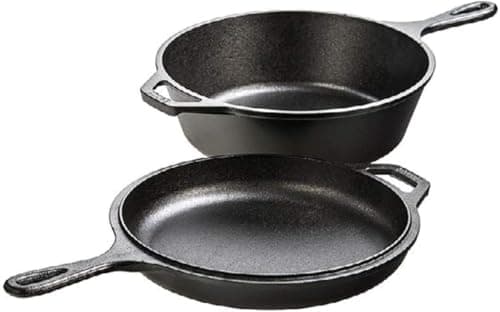
A deep cast-iron pot with a heavy lid, bare or enameled. Iron is dense, so it is heavy, and it holds a lot of heat. It will go on a burner, into an oven, onto a grill and — if it is bare — into a fire. Lodge publishes that its combo cooker is compatible with any stovetop (including induction), oven, grill, or campfire. That range is the whole case for the pot.
The bread cloche
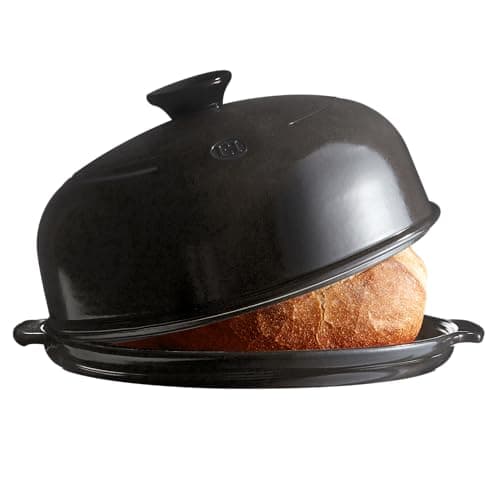
A shallow base with a tall domed lid, made of fired clay rather than metal. Emile Henry's is fired from refractory Burgundy clay, made in France, carries a 10-year guarantee, and is sized to hold a 3½–4 cup flour recipe — a single standard boule. It is a bread tool. It is not a pot and it does not pretend to be one.
The five things that actually differ
1. Loading the loaf — the cloche's real win
This is the difference bakers feel first. A tall dutch oven means lowering a wet, slack, proofed boule down inside hot vertical walls, by hand or by parchment sling, hoping it lands centered. A cloche base is shallow and open: you tip the loaf onto a flat surface, score it in the open, and then put the dome over the top. Scoring is easier, placement is easier, and your knuckles stay further from 450°F metal.
The important caveat, and the reason our pick is what it is: a combo cookergets you most of this. It is a shallow skillet with a deep pan as the lid — invert it and you are loading onto a flat base exactly like a cloche. That single design detail is why the cheapest vessel here beats the specialist for most people.
2. Weight
Published figure: Lodge's combo cooker is 12.85 lb for the pair, and a 5.5-quart enameled pot is heavier still. Emile Henry does not publish a weight for the cloche and we are not going to invent one. What we can say from the materials is that fired clay is far less dense than cast iron, so a clay vessel of the same size is in a different weight class. That difference in material is the whole practical case for the cloche.
If you have wrist or shoulder trouble, this is not a minor preference. Maneuvering a lid off a screaming-hot pot halfway through a bake, with oven mitts on, is the single most awkward moment in home bread baking.
3. Durability — iron's turn
Cast iron is close to indestructible. You can drop a Lodge on a tile floor and worry about the tile. Ceramic is not like that: it chips, and a hard knock can crack it. It also dislikes sudden violent temperature swings more than metal does, so running a hot cloche under a cold tap is how people destroy them.
Emile Henry backs its HR ceramic with a 10-year guarantee against production faults, which is a real commitment. Even so, a 20-year-old cloche in daily use is a rarer thing than a 70-year-old skillet, and the skillet probably came out of a flea market.
4. What it does on the other six days of the week
A cloche bakes bread. That is the list. A dutch oven braises short ribs, boils pasta, fries chicken, makes chili, holds a soup, roasts a whole chicken and — in the case of the combo cooker — splits into two skillets. If you are buying one vessel, the pot is not a close call.
We would also say the reverse plainly: if you already own a good dutch oven and you are considering a cloche as your second bread vessel, that is a perfectly rational purchase. The specialist is nicer at its one job.
5. Oven-temperature ceiling
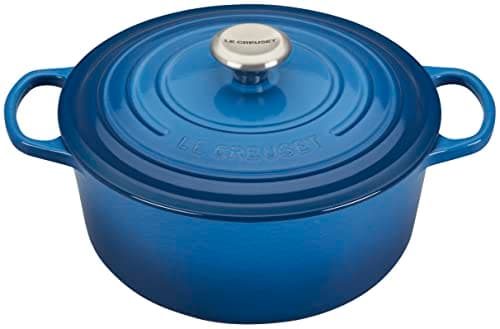
Bread baking runs hot. King Arthur's dutch-oven method preheats the vessel at 450°F, and plenty of sourdough recipes go higher. Bare cast iron does not care at all. Enameled pots are limited by the knob — Le Creuset's published knob rating is the high end of the enameled field, and cheaper pots are often rated lower, which is why we flag the figure on every enameled pick.
For the cloche, Emile Henry does not state a maximum oven temperature on the product page, so we are not going to quote one. Retailer listings for the wider HR ceramic line cite a high ceiling, but that is a retailer's number, not the maker's, and bread temperatures are exactly where you want the maker's number. Check the care card in the box before you preheat above a conventional bread temperature.
Head to head, at a glance
| | Cast-iron dutch oven | Bread cloche |
|---|
| Material | Cast iron, bare or enameled | Fired refractory clay (Emile Henry: Burgundy clay, France) |
| Loading a wet boule | Awkward in a tall pot; easy in a combo cooker | Easiest — shallow open base |
| Weight | Heavy (combo cooker: published 12.85 lb) | Lighter; maker publishes no figure |
| Loaf capacity | One loaf to a large double batch, by pot size | One loaf (published 3½–4 cups flour) |
| Stovetop use | Yes, including induction | No |
| Other jobs | Braising, frying, soup, roasting, searing | Bread |
| Toughness | Effectively unbreakable | Chips and cracks; 10-year guarantee |
| Price bracket | From very cheap (bare Lodge) to luxury (French enamel) | Mid-to-premium, and only bakes bread |
Which to buy, by baker
You bake a loaf a week and own no pot: combo cooker
Cheapest thing here, easiest iron to load, and it turns into two skillets when you are not baking. This is the recommendation for most people reading this page. Our sourdough roundup ranks it first for the same reasons.
You want one pot for everything, bread included: enameled dutch oven
A mid-size enameled pot bakes a very good loaf and then does the braising, which bare iron does less happily because long acidic cooking strips seasoning. Start at what size dutch oven to buy and bare vs enameled.
You bake constantly and already own a pot: cloche
Light, purpose-shaped, nothing to season, and a pleasure if bread is the hobby rather than a thing you occasionally do. It is the only recommendation on this page where we would tell you to buy the specialist.
Lifting hot iron is genuinely difficult for you: cloche
Take this seriously before anything else on the page. The best bread vessel is the one you can get in and out of a hot oven safely every time, and a dropped dutch oven is an injury and a destroyed floor.
You bake big or high-hydration loaves: dutch oven, and a large one
The cloche is sized to a single standard boule. A large dutch oven gives the headroom a tall, wet, aggressively-springing loaf needs without touching the lid.
The honest bottom line
The cloche is better at loading and lighter in the hand. The dutch oven bakes an indistinguishable loaf and then cooks dinner. Unless bread is most of what you cook, or weight is a real constraint, buy the pot — and buy the combo cooker if bread is the reason you are shopping, because it takes most of the cloche's advantage and costs less than any other vessel here.
Whichever you buy, the technique matters more than the hardware. Preheating the vessel with the oven, getting the loaf in fast so you do not dump the heat, and pulling the lid for the last third of the bake will do more for your crust than the choice between clay and iron — and King Arthur even documents a cold-start method that skips the scariest step entirely. Our dutch oven bread method walks through it.
How to choose a bread vessel without buying twice
Match the vessel to your loaf, not to a photograph
Weigh your usual dough. The cloche is published as a 3½–4 cup flour vessel; a 5-to-6 quart dutch oven handles that comfortably and has room for more. Buying a vessel your standard recipe does not fit is the most common and most annoying mistake here.
Shallow base beats deep pot for loading
If the loading step is what puts you off baking, the fix is shape, not material. A combo cooker or a shallow-based bread pot solves it in iron, for less money than a cloche.
Check the knob rating on anything enameled
Bread preheats hard. Enameled lids are limited by their knob, and the cheap pots are often rated lower than the French ones. If you intend to bake at high heat, read the rating before you buy — or buy bare iron, which has no knob to worry about.
Never thermal-shock ceramic
No cold water on a hot cloche, no hot cloche onto a cold wet surface. This is the single way most clay bakers die, and it is not covered by any guarantee.
Bare iron needs seasoning; clay and enamel do not
A bare combo cooker is the cheapest route to great bread and the one that asks for upkeep — dry it, oil it, keep it out of the dishwasher. See how to season a dutch oven. If you want zero ritual, that argues for enamel or clay.
Buy the parchment, not the gadget
A sheet of parchment used as a sling solves most of the dutch oven's loading problem for pennies. Try that before you spend on a second vessel to fix it.
Prices on both move
Bare Lodge iron is cheap and discounts often; the French ceramics and enamels discount rarely but deeply when they do. Every figure here is pulled live and date-stamped — trust the button, not an article from last year.