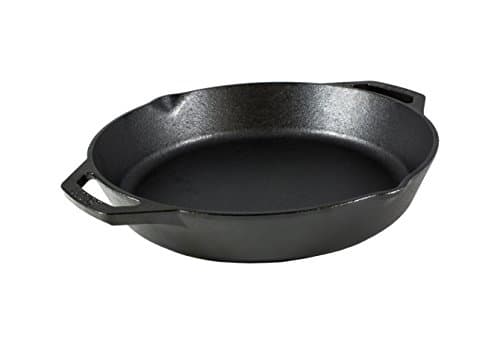
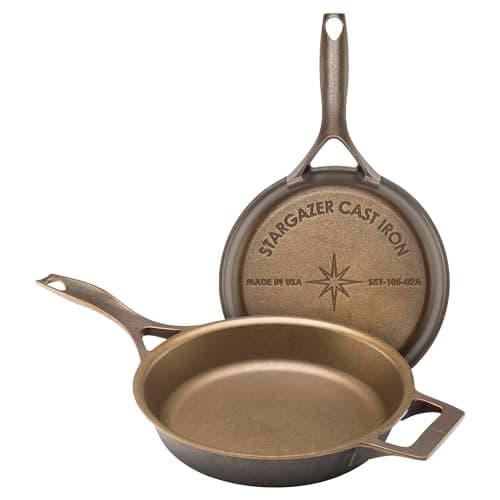
The best Smithey alternative is the Stargazer 10.5-inch, best for a cook who wants a polished American skillet they can order on Amazon. The budget pick is the Backcountry Iron Wasatch 10.25-inch, best for anyone who wants the milled surface and nothing else from the premium tier. And if the real reason you are reading this is the price, the honest alternative is a Lodgeand six months of cooking — seasoning does most of what polishing does, for about a tenth of the money.
Smithey is the brand people fall for and then cannot buy. It sells direct, there is no dependable first-party Amazon store, and the pan most shoppers have in mind is the No. 12 at a published $220. Searching for an alternative is a completely rational response to both facts, and it is worth being precise about what you are replacing before you pick a replacement.
What Smithey is known for
Three things, all of them real and all of them published by the company itself.
First, the surface. Smithey describes the No. 12 as a “satin-smooth, polished finish” and labels its whole cast iron line “Polished, Pre-seasoned, Perfected”. That is the opposite of the pebbly texture a sand mold leaves behind, and it is the thing an owner notices first: a polished pan releases food early in its life instead of after a year of building seasoning.
Second, where it is made and how it is finished. The company states plainly that “We design and craft our cookware in the USA”, that the team inspects every pan several times through manufacturing, and that it guarantees the quality of every Smithey for life. The No. 12 arrives pre-seasoned with “2-3 coats of pure grape seed oil”.
Third, the lineage. Smithey is part of the generation of American makers that started up around 2015 in Charleston, South Carolina, alongside Stargazer in Pennsylvania and Field in the same year, all of them chasing the smooth-walled Griswold pans that American foundries stopped making. That is a genuine revival, not a marketing story, and it is a perfectly good reason to want one.
What Smithey does not claim, and we will not claim for it, is that it sears harder than a cheap pan. Iron is iron. A crust is a function of mass and heat, and a published 8.7 lb at 12 inches is in the same league as any other 12-inch casting. You are buying the surface, the finish and the object.
The brief an alternative has to meet
So the test for everything below is narrow and checkable: a cooking surface that is smooth by design rather than by luck, a pan that ships seasoned and cooks on day one, American manufacture if that is part of why you wanted a Smithey, and a listing you can actually buy from. Four criteria, and different pans hit different combinations of them. Nothing here hits all four at a lower price with no trade at all — if that pan existed, Smithey would have a problem rather than a waitlist.
Matching it on the surface: Stargazer and Field
These two are the real answers, and they split by size and weight.
Stargazer publishes exactly the thing Smithey publishes in different words: a CNC-machined cooking surface, cast, machined, finished and seasoned in Allentown, Pennsylvania. Machining is a stronger claim than polishing, because it is a tolerance rather than a texture, and the 10.5-inch is the size most people cook in. Its honest drawback is that the weight saving barely exists — at a published 5.2 lb it is about half a pound under the 10.25-inch Lodge's 5.66 lb. Buy it for the interior, not for your wrist.
Field is the one that is genuinely light. It is cast thin in the pre-war style, described by the reference literature as “smoother, lighter cast-iron skillets”, and the No. 6 is a jewel of a pan. It is also 8.38 inches, which is a one-to-two serving skillet, so it is the wrong pan if you are replacing a No. 12. Treat it as the Smithey alternative for a small kitchen or a second pan, and read our Field vs Stargazer comparison before you choose between the two.
Matching it on price: the Backcountry Wasatch
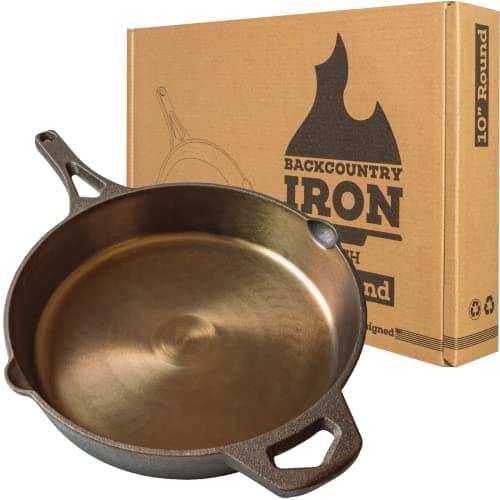
This is the pick that makes the page worth writing. Backcountry Iron's Wasatch is the cheapest genuinely milled cooking surface we can find on Amazon — not a smoother sand casting, an actually machined interior — and it publishes real dimensions rather than adjectives: 10.25 inches across, 11 inches spout to spout, a 4.75-inch handle, and 7 lb.
That 7 lb is the catch, and it is a big one. It is well over a same-diameter Lodge and nothing like a Field. Backcountry Iron also does not publish where the pans are cast, which matters if American manufacture was part of the appeal. So it clears two of the four criteria — the surface and the purchasability — and fails the other two. For a lot of people that is the right trade, and it is why this pan is the budget pick rather than the Lodge.
Matching it on object-ness: the Finex
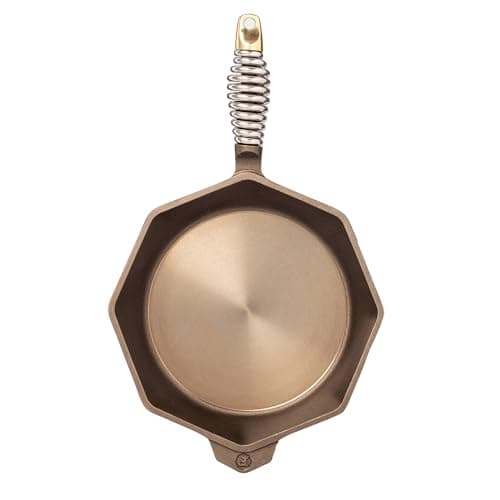
A share of Smithey shoppers are not after a cooking surface at all. They want the beautiful American pan, and the alternative for them is Finex: octagonal with eight pour spouts, a coiled stainless spring handle that runs cooler than solid cast iron, and a finer surface than a pebbly Lodge. It is also the pan Lodge acquired in August 2019, the first acquisition in its 123-year history, to get “entry into the luxury cast iron cookware segment”, with production moving to the Tennessee foundries.
Its honest cons are the mirror image of Field's: Finex casts thick, so it is among the heaviest pans in its size, and it is priced at a large multiple of a Lodge for design rather than for a better sear. If you want the showpiece, it is the showpiece. Our Finex vs Smithey head-to-head is the page that argues this one properly.
The two Lodges, and the question nobody wants asked
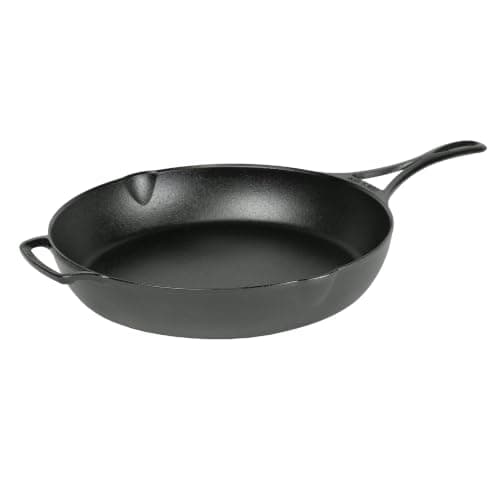
The Blacklock is the sensible middle. Lodge engineers the line lighter than its traditional iron and triple-seasons it at the foundry, so it starts closer to slick than a standard Lodge does. What it is not is machined, and Lodge never says it is — it is a thinner, better-seasoned sand casting. If what you wanted from a Smithey was “lighter and slicker than my Lodge”, this is the cheap version of that wish. If what you wanted was the glassy milled interior, it is not.
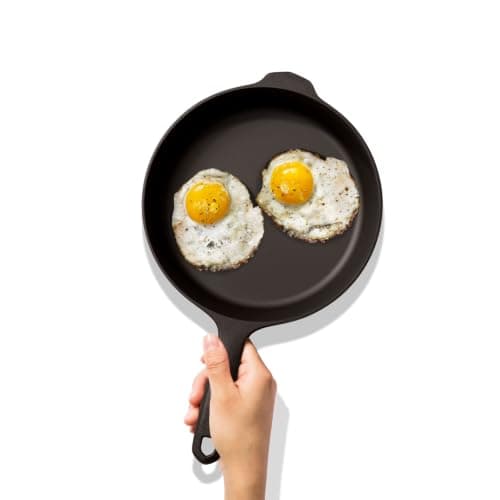
And then the classic 10.25-inch, which is on this page as the control rather than as a compromise. A seasoned surface is the working non-stick layer on any bare pan, machined or not, and a Lodge that has been cooked in for six months releases a fried egg. The polished pans get you there sooner and look better doing it. They do not get you somewhere a Lodge cannot go. If you have never owned cast iron, buy the Lodge first; come back here only if the pebbly surface turns out to be the thing that actually bothers you.
What none of these fixes
Every pan on this page is bare iron. All of them rust if left wet, all of them need drying and a wipe of oil, none of them likes a long acidic simmer, and all of them are heavy compared with the aluminum pan they are replacing. A polished surface shortens the break-in; it does not change the care routine. If the care routine is the real objection, the answer is a different material rather than a different brand, and our enameled vs bare cast iron page is the place to start — or, if the premium pan you actually had in mind was French and enameled rather than American and polished, the best Le Creuset skillet alternatives.
How to judge a “smooth” claim
The word does almost no work on its own, and this is the single most useful thing to know when you are shopping a Smithey substitute. There are three different claims hiding under it. As-cast means the texture the mold left, which on a modern pan is pebbly; some makers simply cast more finely than others. Polishedmeans the surface was worked after casting — Smithey's own word. Machined or milledmeans metal was cut away to a tolerance, which is Stargazer's and Backcountry's claim. Only the last of those is a specification. A listing that says “smooth” and nothing else is describing a hope.
Size, not brand, is the decision most people get wrong
If you are replacing a Smithey No. 12 you are replacing a 12-inch pan with a published 10.5-inch cooking surface, and a Field No. 6 at 8.38 inches is not that pan however good it is. Work out the flat area you need first, then shop brands inside it. Our skillet sizes guide does the arithmetic, and 10-inch vs 12-inch is the specific version of the question.
Weight is a separate axis from surface, and the brands do not line up
It is tempting to assume the premium pans are all light. They are not. Field is light and smooth; Stargazer is smooth and about as heavy as a Lodge; Finex is smooth-ish and heavier than a Lodge; Backcountry is milled and heavier still, at a published 7 lb. Pick which of the two properties you are buying before you pick a brand. Our lightweight skillets roundup ranks on published weight alone, which is the cleanest way to see it.
The limits of what we can tell you
We have not cooked on a Smithey and we do not have a test kitchen. Every figure above is attributed to the maker's own published specification, read on the date in the sources list, and where a maker publishes nothing — Field's and Finex's weights, Backcountry's country of manufacture — this page says “not published” rather than filling the gap. We do not link Smithey because there is no verified first-party listing to link, and our methodology page says all of this in those words. Prices come from the live Amazon API with an as-of date under every table.